


Japanese parliamentary debate over pension reform descended into chaos yesterday after the opposition demanded that Cabinet ministers reveal their payments -- or lack of them -- into the creaking state pension scheme.
Pension reform is one of the biggest headaches confronting Japan's rapidly ageing society and the main opposition Democratic Party hopes to make it a focus of Upper House elections in July.
Prime Minister Junichiro Koizumi's ruling coalition was aiming to push pension reform bills through a Lower House panel later yesterday to clear the way for enactment of the legislation, which would cut benefits while boosting payments.
The government, however, was embarrassed last week when three Cabinet ministers admitted failing to pay pension premiums, despite a public campaign to persuade ordinary citizens to do so.
"Do you think that mistrust in the pension system has been removed even a little bit?" Democratic lawmaker Motohisa Furukawa, 38, challenged Koizumi in a Lower House panel.
Furukawa -- waving what he said were documents on pension payments by members of the opposition's "Shadow Cabinet" -- challenged Koizumi to have his Cabinet members come clean.
Ruling and opposition parties had agreed to unveil the data by noon, media said, but Welfare Minister Chikara Sakaguchi told the panel the announcements would come after its work was over.
Debate then stalled amid shouting and desk-pounding until another Democrat demanded to know if Koizumi himself had paid up.
"I paid what I should have paid," Koizumi said.
A growing number of Japanese, especially young people, are refusing to pay premiums because they doubt the pension system will be able to provide benefits when they retire.
Koizumi's Liberal Democratic Party looked set for further embarrassment after media said Cabinet member Toshimitsu Motegi, 48, had also failed to pay premiums.
Democratic "Shadow Trade Minister" Shu Watanabe also confessed on his home page to having "missed" one month's worth of payments in 1990.
"It's classic Japanese reform -- many little steps in the right direction," said Jesper Koll, chief Japan analyst at Merrill Lynch in Tokyo.
Long life expectancy and falling birth rates mean Japan is expected to have roughly one person over 65 for every two of working age by 2025, a higher dependency ratio than any other industrialized nation.
The government legislation would raise contributions to a notional 18.35 percent of salary -- with employers and workers each paying half -- by 2017 from a current maximum 13.58 percent.
Benefits would be reduced to around 50 percent of salary by 2023 from about 60 percent, while the government's share of contributions to the basic pension scheme covering non-wage earners would rise to half from one-third by 2009.

Republican US lawmakers on Friday criticized US President Joe Biden’s administration after sanctioned Chinese telecoms equipment giant Huawei unveiled a laptop this week powered by an Intel artificial intelligence (AI) chip. The US placed Huawei on a trade restriction list in 2019 for contravening Iran sanctions, part of a broader effort to hobble Beijing’s technological advances. Placement on the list means the company’s suppliers have to seek a special, difficult-to-obtain license before shipping to it. One such license, issued by then-US president Donald Trump’s administration, has allowed Intel to ship central processors to Huawei for use in laptops since 2020. China hardliners
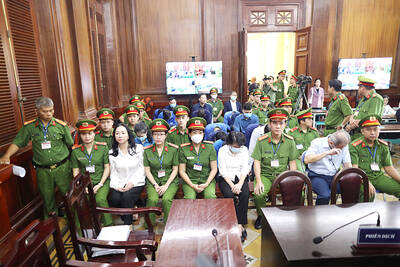
A top Vietnamese property tycoon was on Thursday sentenced to death in one of the biggest corruption cases in history, with an estimated US$27 billion in damages. A panel of three hand-picked jurors and two judges rejected all defense arguments by Truong My Lan, chair of major developer Van Thinh Phat, who was found guilty of swindling cash from Saigon Commercial Bank (SCB) over a decade. “The defendant’s actions ... eroded people’s trust in the leadership of the [Communist] Party and state,” read the verdict at the trial in Ho Chi Minh City. After the five-week trial, 85 others were also sentenced on

DISADVANTAGE: Erin O’Toole, who led the Conservatives during the election campaign in 2021, estimated that the interference cost his party as many as nine legislative seats Canada’s domestic spy agency on Monday concluded that China interfered in the past two elections, an official probe heard, the firmest evidence so far of suspected Chinese meddling in Canadian politics. Canadian Prime Minister Justin Trudeau’s Liberal Party won both the elections, held in 2019 and 2021. Under pressure from opposition lawmakers unhappy about media reports on China’s possible role, Trudeau set up a commission into foreign interference. The commission was shown a slide on Monday containing an extract of a briefing in February last year from the Canadian Security Intelligence Service (CSIS). “We know that the PRC [People’s Republic of China] clandestinely

‘DELUSIONAL’: Targeting the families of Hamas’ leaders would not push the group to change its position or to give up its demands for Palestinians, Ismail Haniyeh said Israeli aircraft on Wednesday killed three sons of Hamas’ top political leader in the Gaza Strip, striking high-stakes targets at a time when Israel is holding delicate ceasefire negotiations with the militant group. Hamas said four of the leader’s grandchildren were also killed. Ismail Haniyeh’s sons are among the highest-profile figures to be killed in the war so far. Israel said they were Hamas operatives, and Haniyeh accused Israel of acting in “the spirit of revenge and murder.” The deaths threatened to strain the internationally mediated ceasefire talks, which appeared to gain steam in recent days even as the sides remain far


 RSS
RSS