


Russia on Wednesday killed a Security Council resolution put forward by the US and Britain to encourage Greek and Turkish Cypriots to adopt a UN plan to unify their Mediterranean island.
Three days before tomorrow's twin referendums in Cyprus on the UN plan, Russian Deputy Ambassador Gennady Gatilov accused Washington and London of rushing a resolution through the 15-nation Security Council without time for deliberation.
The vote on the measure was 14 to 1, but Russia's "no" vote was enough to kill it because of its veto power as one of the UN body's five permanent members along with the US, France, Britain and China.
"In these conditions the Russian side has no other choice but to exercise a technical veto in order to ensure, in the future, conditions for normal, mutually respected work," Gatilov said. It was the first Russian veto since 1994.
US envoy James Cunningham said Washington was "disappointed that one member of the Security Council" had opposed the text, despite a plea from UN Secretary-General Kofi Annan and a call by US Secretary of State Colin Powell to Russian Foreign Minister Sergei Lavrov.
"As everybody else fell into place and it became clear it would be 14 to 1 and that the Russian veto reasons would be explained as procedural rather than substantive, we decided it was worth going for a vote that made clear the whole Council was really behind it," said a senior US State Department official who asked not to be named.
The UN has been campaigning for a united Cyprus to join the EU with nine other countries on May 1.
But opinion polls show the UN plan faces serious opposition on the Greek Cypriot side although the Turkish Cypriot north appears to favor it.
If either side votes "no," only the Greek Cypriot government in the south would enter the EU, leaving the north -- which is recognized only by Turkey -- on its own.
The resolution was intended to reassure the Greek Cypriot south that the Security Council would fulfill its security obligations under the unity deal, backers said.
Contingent on the plan's approval, it would have banned the supply of arms to Cyprus and revamped the UN peacekeeping mission already on the island to help carry out the plan.
The support of 14 council members sent a "strong message of support" for unifying Cyprus, British envoy Adam Thomson said. But several delegations complained even as they voted for the text that more time would have been helpful.
"There is a risk this signal could be misinterpreted. That is what we fear," French Ambassador Jean-Marc de la Sabliere said.
Russia, a longtime ally of Greece with a strong interest in security matters in the Mediterranean, had argued forcefully against any council action before tomorrow. Russia and Greece have a historical friendship that goes back hundreds of years, and they share the same orthodox religion.
Britain had led the battle for the resolution as the former colonial power in Cyprus, while the US was seen pushing hard for the island's reunification as part of a campaign to bring Turkey closer to Europe.

Republican US lawmakers on Friday criticized US President Joe Biden’s administration after sanctioned Chinese telecoms equipment giant Huawei unveiled a laptop this week powered by an Intel artificial intelligence (AI) chip. The US placed Huawei on a trade restriction list in 2019 for contravening Iran sanctions, part of a broader effort to hobble Beijing’s technological advances. Placement on the list means the company’s suppliers have to seek a special, difficult-to-obtain license before shipping to it. One such license, issued by then-US president Donald Trump’s administration, has allowed Intel to ship central processors to Huawei for use in laptops since 2020. China hardliners
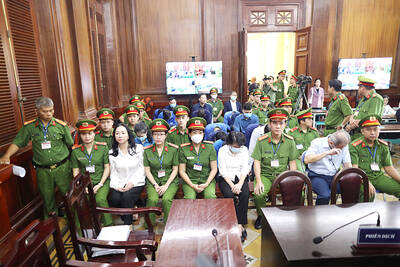
A top Vietnamese property tycoon was on Thursday sentenced to death in one of the biggest corruption cases in history, with an estimated US$27 billion in damages. A panel of three hand-picked jurors and two judges rejected all defense arguments by Truong My Lan, chair of major developer Van Thinh Phat, who was found guilty of swindling cash from Saigon Commercial Bank (SCB) over a decade. “The defendant’s actions ... eroded people’s trust in the leadership of the [Communist] Party and state,” read the verdict at the trial in Ho Chi Minh City. After the five-week trial, 85 others were also sentenced on

DISADVANTAGE: Erin O’Toole, who led the Conservatives during the election campaign in 2021, estimated that the interference cost his party as many as nine legislative seats Canada’s domestic spy agency on Monday concluded that China interfered in the past two elections, an official probe heard, the firmest evidence so far of suspected Chinese meddling in Canadian politics. Canadian Prime Minister Justin Trudeau’s Liberal Party won both the elections, held in 2019 and 2021. Under pressure from opposition lawmakers unhappy about media reports on China’s possible role, Trudeau set up a commission into foreign interference. The commission was shown a slide on Monday containing an extract of a briefing in February last year from the Canadian Security Intelligence Service (CSIS). “We know that the PRC [People’s Republic of China] clandestinely

‘DELUSIONAL’: Targeting the families of Hamas’ leaders would not push the group to change its position or to give up its demands for Palestinians, Ismail Haniyeh said Israeli aircraft on Wednesday killed three sons of Hamas’ top political leader in the Gaza Strip, striking high-stakes targets at a time when Israel is holding delicate ceasefire negotiations with the militant group. Hamas said four of the leader’s grandchildren were also killed. Ismail Haniyeh’s sons are among the highest-profile figures to be killed in the war so far. Israel said they were Hamas operatives, and Haniyeh accused Israel of acting in “the spirit of revenge and murder.” The deaths threatened to strain the internationally mediated ceasefire talks, which appeared to gain steam in recent days even as the sides remain far


 RSS
RSS