


He has been charged with two dozen crimes, voted into parliament three times and even from inside a jail cell Mohammed Shahabuddin reigns supreme over his lawless district where only the potholes outnumber his portraits.
Shahabuddin epitomizes the rough politics in the eastern Indian state of Bihar where candidates for elections that start tomorrow include suspected murderers, alleged rapists and fugitives who somehow manage to file nomination papers.
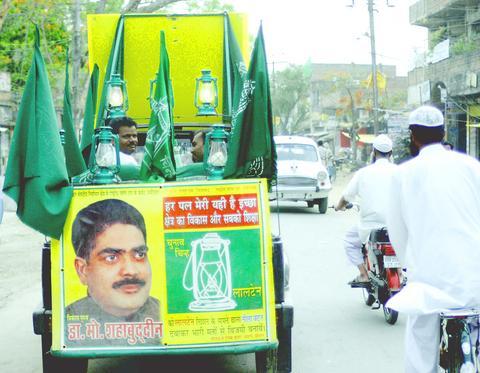
PHOTO: AP
Shahabuddin, who turns 37 on May 10, the last of five dates of the staggered national election, is in jail pending trial over the murder of Munna Chowdhary, a 17-year-old local political activist whose body was allegedly thrown into the furnace of a brick kiln.
But Shahabuddin remains the undisputed king of Siwan, a dusty town 200km northwest of Bihar's capital Patna, where his deep-set eyes stare out from pictures on the motorcycles and cycle-rickshaws which plough the beat-up streets.
"Such is his fear and clout that no other political party candidate, though they are contesting, have dared to put up their flags or posters," said Ajit Kumar Singh, a doctor.
His party office has a statue of Mahatma Gandhi, the icon of India's non-violent independence struggle.
But Gandhi would be unlikely to win an election in Bihar, a state of 83 million people where voting is colored by gun-slinging, tough-talking and open brawls.
"No one can win an election in Bihar without firing even a single bullet," said veteran Bihar journalist Kanhaiya Bhellary of The Week magazine.
Shahabuddin has denied involvement in all the criminal cases brought against him and has never been convicted, depriving the federal Election Commission of a possible way to bar him.
The only other political office in Siwan belongs to the Communist Party of India (Marxist-Leninist) (CPI-ML), a far-left agrarian party that is Shahabuddin's only credible rival and was the root of one of the most notorious cases against Shahabuddin.
In 1997, Chandrashekhar, a charismatic CPI-ML youth leader at New Delhi's prestigious Jawaharlal Nehru University, died in a hail of bullets when he was addressing a meeting on the busy market street in Siwan.
Four years later, when Shahabuddin and his posse led a drive against cheating during college exams, he clashed with a senior police officer who said he was in charge of the tests.
The police officer was reportedly slapped on the cheek, enraging him to such an extent that he launched an operation against Shahabuddin in his ancestral village of Pratapgarh.
"It was a 10-hour gun battle in which Shahabuddin's men fired from all kinds of automatic weapons," said a local witness.
"Shahabuddin managed to escape in the night after 11 of his men were killed," the witness said.
Shahabuddin's evasion of the law ended last year when a new state police chief, D.P. Ojha, reopened his file and slapped a slew of cases against him.
Ojha even sent a report to the federal home ministry claiming Shahabuddin had links with rival Pakistan's spy agency and gunrunners in violence-torn Kashmir.
After months of remaining underground, Shahabuddin surrendered with fanfare in August and vowed to "teach a lesson to madman Ojha."
Ojha was soon sacked by the state government.
Laloo Prasad Yadav, head of Shahabuddin's Rashtriya Janata Dal party and Bihar's de facto ruler, called Shahabuddin his "younger brother" and personally escorted him to file his election nomination.
Many of his constituents see Shahabuddin as a figure similar to Robin Hood.
"He opened so many colleges and schools. Even the girls are going to school.
"Siwan is so safe that women go out for late-night films. He is also opening a huge university. We are all very happy with him," Pradeep Kumar Jaiswal said at a teashop.
"We have put up flags on our own. There is no fear," said Mohammed Riyaz, a furniture shop owner.
But at the CPI-ML office, 24-year-old Abhiyuday, who is studying physics in the state capital Patna, swears his party would one day rid Siwan of "Shahabuddin's terror."
"Those who are putting his flag on their rooftops are doing so out of fear," he said.
"In their hearts, they want a change and we are going to give them this change. Comrade Chandrashekhar did not die in vain."
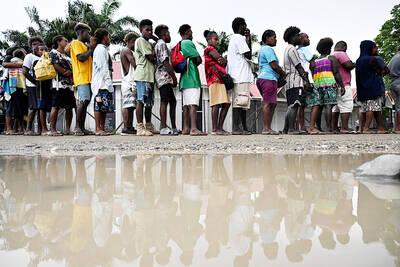
SEEKING CHANGE: A hospital worker said she did not vote in previous elections, but ‘now I can see that maybe my vote can change the system and the country’ Voting closed yesterday across the Solomon Islands in the south Pacific nation’s first general election since the government switched diplomatic allegiance from Taiwan to Beijing and struck a secret security pact that has raised fears of the Chinese navy gaining a foothold in the region. The Solomon Islands’ closer relationship with China and a troubled domestic economy weighed on voters’ minds as they cast their ballots. As many as 420,000 registered voters had their say across 50 national seats. For the first time, the national vote also coincided with elections for eight of the 10 local governments. Esther Maeluma cast her vote in the
Nearly half of China’s major cities are suffering “moderate to severe” levels of subsidence, putting millions of people at risk of flooding, especially as sea levels rise, according to a study of nationwide satellite data released yesterday. The authors of the paper, published by the journal Science, found that 45 percent of China’s urban land was sinking faster than 3mm per year, with 16 percent at more than 10mm per year, driven not only by declining water tables, but also the sheer weight of the built environment. With China’s urban population already in excess of 900 million people, “even a small portion

UNSETTLING IMAGES: The scene took place in front of TV crews covering the Trump trial, with a CNN anchor calling it an ‘emotional and unbelievably disturbing moment’ A man who doused himself in an accelerant and set himself on fire outside the courthouse where former US president Donald Trump is on trial has died, police said yesterday. The New York City Police Department (NYPD) said the man was declared dead by staff at an area hospital. The man was in Collect Pond Park at about 1:30pm on Friday when he took out pamphlets espousing conspiracy theories, tossed them around, then doused himself in an accelerant and set himself on fire, officials and witnesses said. A large number of police officers were nearby when it happened. Some officers and bystanders rushed

HYPOCRISY? The Chinese Ministry of Foreign Affairs yesterday asked whether Biden was talking about China or the US when he used the word ‘xenophobic’ US President Joe Biden on Wednesday called for a hike in steel tariffs on China, accusing Beijing of cheating as he spoke at a campaign event in Pennsylvania. Biden accused China of xenophobia, too, in a speech to union members in Pittsburgh. “They’re not competing, they’re cheating. They’re cheating and we’ve seen the damage here in America,” Biden said. Chinese steel companies “don’t need to worry about making a profit because the Chinese government is subsidizing them so heavily,” he said. Biden said he had called for the US Trade Representative to triple the tariff rates for Chinese steel and aluminum if Beijing was


 RSS
RSS