


US President George W. Bush said on Monday that US intelligence operations may need to be reformed because of weaknesses that allowed the Sept. 11, 2001, attacks to take place.
After the attacks, the FBI and the CIA were criticized for failing to "connect the dots" of the plot because of factors such as poor information sharing and inadequate analysis.
An Aug. 6, 2001, presidential intelligence document, made public by the White House on Saturday under pressure from the 9/11 commission, said the FBI had detected patterns of suspicious activity that pointed toward possible preparations for hijackings or other attacks.
It also said the FBI was conducting 70 full-field investigations into al-Qaeda's presence in the US. But US National Security Adviser Condoleezza Rice, in her public testimony to the commission last week, pointed to structural problems in US intelligence that prevented all agencies from sharing information.
Bush, at a news conference with visiting Egyptian President Hosni Mubarak, said he was hoping to hear recommendations about what needed to be changed from the commission investigating the hijacked airliner attacks.
"Now, the 9/11 commission hearings are going to analyze that which went on and hopefully bring recommendations forward to help this administration and future administrations do our solemn duty to protect the American people," he said. "And that's why I think the hearings are a good thing, particularly when they address any weaknesses in the system."
Bush, who originally opposed creation of the 10-member, bipartisan panel and only allowed Rice to testify under oath and in public after coming under pressure, pointed to her comment that "now may be a time to revamp and reform our intelligence services."
"And we look forward to hearing recommendations. We're thinking about that ourselves and we look forward to working with the commission," he said.
A Newsweek poll released on Saturday showed six out of 10 Americans felt the Bush administration underestimated the threat of terrorism prior to Sept. 11, 2001. The poll of 1,005 adults also showed a 51-percent disapproval rating for Bush's conduct of the war in Iraq, where violence has flared up in the last week.
California Republican Jane Harman, the senior Democrat on the House Intelligence Committee and the author of intelligence reform legislation, said Bush's statement "signals that he and other top officials may finally be snapping out of their deep state of denial over our intelligence failures."
Nearly half of China’s major cities are suffering “moderate to severe” levels of subsidence, putting millions of people at risk of flooding, especially as sea levels rise, according to a study of nationwide satellite data released yesterday. The authors of the paper, published by the journal Science, found that 45 percent of China’s urban land was sinking faster than 3mm per year, with 16 percent at more than 10mm per year, driven not only by declining water tables, but also the sheer weight of the built environment. With China’s urban population already in excess of 900 million people, “even a small portion

UNSETTLING IMAGES: The scene took place in front of TV crews covering the Trump trial, with a CNN anchor calling it an ‘emotional and unbelievably disturbing moment’ A man who doused himself in an accelerant and set himself on fire outside the courthouse where former US president Donald Trump is on trial has died, police said yesterday. The New York City Police Department (NYPD) said the man was declared dead by staff at an area hospital. The man was in Collect Pond Park at about 1:30pm on Friday when he took out pamphlets espousing conspiracy theories, tossed them around, then doused himself in an accelerant and set himself on fire, officials and witnesses said. A large number of police officers were nearby when it happened. Some officers and bystanders rushed
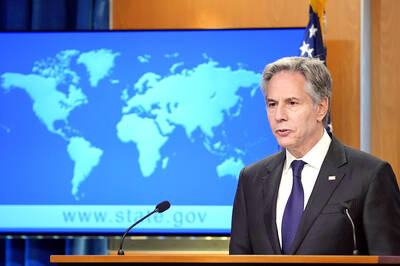
Beijing is continuing to commit genocide and crimes against humanity against Uyghurs and other Muslim minorities in its western Xinjiang province, U.S. Secretary of State Antony Blinken said in a report published on Monday, ahead of his planned visit to China this week. The State Department’s annual human rights report, which documents abuses recorded all over the world during the previous calendar year, repeated language from previous years on the treatment of Muslims in Xinjiang, but the publication raises the issue ahead of delicate talks, including on the war in Ukraine and global trade, between the top U.S. diplomat and Chinese
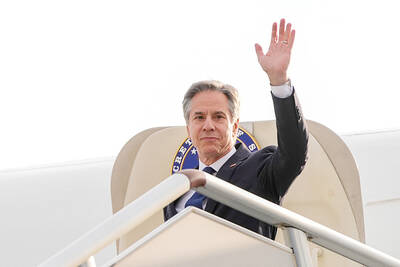
‘IN A DIFFERENT PLACE’: The envoy first visited Shanghai, where he attended a Chinese basketball playoff match, and is to meet top officials in Beijing tomorrow US Secretary of State Antony Blinken yesterday arrived in China on his second visit in a year as the US ramps up pressure on its rival over its support for Russia while also seeking to manage tensions with Beijing. The US diplomat tomorrow is to meet China’s top brass in Beijing, where he is also expected to plead for restraint as Taiwan inaugurates president-elect William Lai (賴清德), and to raise US concerns on Chinese trade practices. However, Blinken is also seeking to stabilize ties, with tensions between the world’s two largest economies easing since his previous visit in June last year. At the


 RSS
RSS