


US President George W. Bush was to use a prime-time news conference last night to reassure the US public about rising casualties and instability in Iraq and defend the administration's response to a pre-Sept. 11, 2001, memo that warned of threats from al-Qaeda.
Both issues are critical to Bush's re-election strategy, which hinges on the president's record on national security.
Bush was to open his press conference -- the 12th of his presidency and the third during evening prime-time -- with a statement on Iraq, White House communications director Dan Bartlett said on Monday.
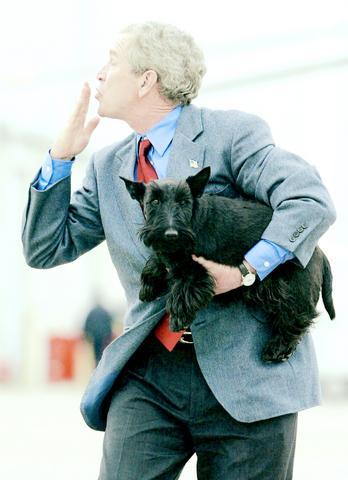
PHOTO: REUTERS
He said Bush was prepared to address questions about a memo, titled "Bin Laden Determined To Strike in US," that he received on Aug. 6, 2001, as part of the President's daily brief.
"After a tough week, there are important questions that are on the minds of the American people," Bartlett said.
With the Sept. 11 commission hearings and the recent battles in Iraq being broadcast into American homes, this was a good time for Bush to defend his policies, said Stephen Hess, a political analyst at the liberal-leaning Brookings Institution.
"This is an administration that gets in trouble because it doesn't speak up in a timely way and defend itself," Hess said.
The news conference was "really quite necessary," he said.
At his Texas ranch on Monday, Bush deflected questions about the presidential memo, telling reporters that if the FBI had known about an imminent terrorist attack against the US, the agency would have told him.
To questions about whether the security situation in Iraq was untenable, Bush replied, "The situation in Iraq has improved."
The president's upbeat assessment was based on a fragile cease-fire in Fallujah. The predominantly Sunni Muslim city west of Baghdad has been the site of fighting between insurgents and US troops after a mob mutilated the bodies of US security contractors killed in a March 30 ambush.
US troops have killed about 700 insurgents in Iraq since the beginning of the month. About 70 coalition troops -- almost all Americans -- have died in clashes.
"A civil society -- a peaceful society -- can't grow with people who are willing to kill in order to stop progress," Bush said. "And our job is to provide security for the Iraqi people so that a transition can take place."
US Vice President Dick Cheney said in Tokyo yesterday that the administration would soon announce its choice as US ambassador to the new Iraqi government. Paul Bremer has been the chief US civilian official in Baghdad, running the provisional authority there.
Karlyn Bowman, who does research on public opinion and politics at the American Enterprise Institute, a conservative think tank in Washington, said Bush knows there is widespread anxiety throughout the US about the situation in Iraq.
"He has to convey being in charge and having a clear plan of what's ahead," Bowman said. "And I'm sure he will express compassion for the families" of those killed in the fighting.
"I think on 9/11, the president has to reiterate that they would have done much more if they would have had specific information," she said.
She added that most Americans were not really anxiously waiting to read the memo, which was declassified and released on Saturday.
"I'm still not sure the public is in the mood to point the finger," Bowman said.

Republican US lawmakers on Friday criticized US President Joe Biden’s administration after sanctioned Chinese telecoms equipment giant Huawei unveiled a laptop this week powered by an Intel artificial intelligence (AI) chip. The US placed Huawei on a trade restriction list in 2019 for contravening Iran sanctions, part of a broader effort to hobble Beijing’s technological advances. Placement on the list means the company’s suppliers have to seek a special, difficult-to-obtain license before shipping to it. One such license, issued by then-US president Donald Trump’s administration, has allowed Intel to ship central processors to Huawei for use in laptops since 2020. China hardliners
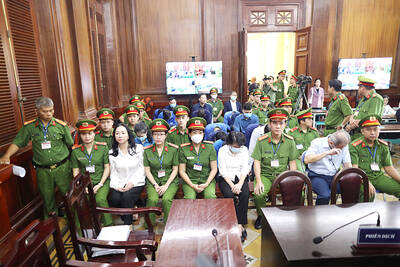
A top Vietnamese property tycoon was on Thursday sentenced to death in one of the biggest corruption cases in history, with an estimated US$27 billion in damages. A panel of three hand-picked jurors and two judges rejected all defense arguments by Truong My Lan, chair of major developer Van Thinh Phat, who was found guilty of swindling cash from Saigon Commercial Bank (SCB) over a decade. “The defendant’s actions ... eroded people’s trust in the leadership of the [Communist] Party and state,” read the verdict at the trial in Ho Chi Minh City. After the five-week trial, 85 others were also sentenced on

‘DELUSIONAL’: Targeting the families of Hamas’ leaders would not push the group to change its position or to give up its demands for Palestinians, Ismail Haniyeh said Israeli aircraft on Wednesday killed three sons of Hamas’ top political leader in the Gaza Strip, striking high-stakes targets at a time when Israel is holding delicate ceasefire negotiations with the militant group. Hamas said four of the leader’s grandchildren were also killed. Ismail Haniyeh’s sons are among the highest-profile figures to be killed in the war so far. Israel said they were Hamas operatives, and Haniyeh accused Israel of acting in “the spirit of revenge and murder.” The deaths threatened to strain the internationally mediated ceasefire talks, which appeared to gain steam in recent days even as the sides remain far
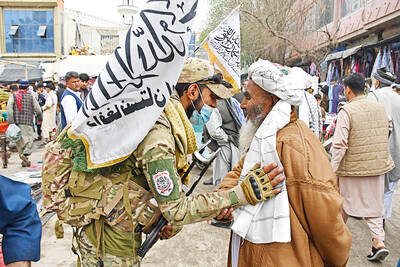
The Taliban’s reclusive supreme leader made a rare public appearance yesterday, an Afghan government spokesman said, leading thousands of worshipers in prayers marking Eid al-Fitr. Hibatullah Akhundzada has made only a handful of public appearances since inheriting the leadership of the Taliban in 2016 and leading the movement back to power with the withdrawal of US forces in 2021. Taliban government spokesman Zabihullah Mujahid said prayer in the largest mosque in Kandahar was “performed under the leadership of the supreme leader.” In a statement on X, he said the early-morning service “was attended by thousands of compatriots” in the southern province considered the


 RSS
RSS