


Pro-democracy figures yesterday charged that China had violated constitutional law by asserting control over Hong Kong's political reforms, and some predicted the move could stir unrest in the territory.
China issued a ruling on Tuesday that Hong Kong must get Beijing's blessing before trying to change the way it selects its leader and lawmakers -- giving the central government more control over such matters than is spelled out in the Basic Law, Hong Kong's mini-constitution.
The Standing Committee of China's National People's Congress put forth the ruling in an interpretation of the territory's constitution -- a move many here viewed as an attempt to quash growing calls for full democracy.
"It has been calculated to add new obstacles to Hong Kong's already bumpy road to full democracy," said Law Yuk-kai, director of the Hong Kong Human Rights Monitor.
The Basic Law holds out democracy as a goal for Hong Kong but sets no timetable, and Beijing insists it's only explaining the way forward.
The deputy secretary-general of the Standing Committee, Qiao Xiaoyang (
Law said China's top legislative committee had changed the constitution with "no due process" but rather through "a political body operating in a black box without any fair hearing."
The Hong Kong Bar Association agreed, saying Beijing was making law, not interpreting it.
"This is adding to the law," bar chairman Edward Chan told reporters Tuesday night. "Hong Kong cannot accept this."
Meanwhile, the US reiterated its support for democracy in Hong Kong -- a stance Beijing has condemned previously as improper meddling in Chinese affairs.
US Consulate General spokeswoman Susan Stevenson said yesterday that Washington is urging Hong Kong "to do everything possible to respond to the expressed aspirations of the Hong Kong people for electoral reform and universal suffrage."
Activists said they planned to march in protest Sunday to China's representative office in Hong Kong.
China guaranteed Hong Kong civil liberties and a great deal of autonomy -- unheard of in the mainland -- when the former British colony returned to its rule in 1997. But The Standard newspaper likened Beijing's latest action to "infecting the territory with a deadly plague."
"It is bad for Hong Kong, but it is bad for China, too, because it will not allow Beijing to benefit from the lessons of a smooth transition to democracy," The Standard wrote in an editorial.
Others, however, were more optimistic, noting that Beijing has not ruled out political reforms and that it has even left open the possibility for changes in the way Hong Kong's next leader is chosen when Chief Executive Tung Chee-hwa's (
Tung was chosen by an 800-member committee loyal to Beijing and has been enormously unpopular with locals who see him as the mainland's puppet who looks out for tycoons but not ordinary Hong Kong citizens.
Many people in Hong Kong want direct elections of their next leader as well as all lawmakers in 2008.

Republican US lawmakers on Friday criticized US President Joe Biden’s administration after sanctioned Chinese telecoms equipment giant Huawei unveiled a laptop this week powered by an Intel artificial intelligence (AI) chip. The US placed Huawei on a trade restriction list in 2019 for contravening Iran sanctions, part of a broader effort to hobble Beijing’s technological advances. Placement on the list means the company’s suppliers have to seek a special, difficult-to-obtain license before shipping to it. One such license, issued by then-US president Donald Trump’s administration, has allowed Intel to ship central processors to Huawei for use in laptops since 2020. China hardliners
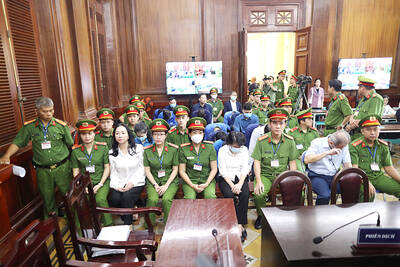
A top Vietnamese property tycoon was on Thursday sentenced to death in one of the biggest corruption cases in history, with an estimated US$27 billion in damages. A panel of three hand-picked jurors and two judges rejected all defense arguments by Truong My Lan, chair of major developer Van Thinh Phat, who was found guilty of swindling cash from Saigon Commercial Bank (SCB) over a decade. “The defendant’s actions ... eroded people’s trust in the leadership of the [Communist] Party and state,” read the verdict at the trial in Ho Chi Minh City. After the five-week trial, 85 others were also sentenced on

DISADVANTAGE: Erin O’Toole, who led the Conservatives during the election campaign in 2021, estimated that the interference cost his party as many as nine legislative seats Canada’s domestic spy agency on Monday concluded that China interfered in the past two elections, an official probe heard, the firmest evidence so far of suspected Chinese meddling in Canadian politics. Canadian Prime Minister Justin Trudeau’s Liberal Party won both the elections, held in 2019 and 2021. Under pressure from opposition lawmakers unhappy about media reports on China’s possible role, Trudeau set up a commission into foreign interference. The commission was shown a slide on Monday containing an extract of a briefing in February last year from the Canadian Security Intelligence Service (CSIS). “We know that the PRC [People’s Republic of China] clandestinely

‘DELUSIONAL’: Targeting the families of Hamas’ leaders would not push the group to change its position or to give up its demands for Palestinians, Ismail Haniyeh said Israeli aircraft on Wednesday killed three sons of Hamas’ top political leader in the Gaza Strip, striking high-stakes targets at a time when Israel is holding delicate ceasefire negotiations with the militant group. Hamas said four of the leader’s grandchildren were also killed. Ismail Haniyeh’s sons are among the highest-profile figures to be killed in the war so far. Israel said they were Hamas operatives, and Haniyeh accused Israel of acting in “the spirit of revenge and murder.” The deaths threatened to strain the internationally mediated ceasefire talks, which appeared to gain steam in recent days even as the sides remain far


 RSS
RSS