


His handsome face was seen around the world. The photograph, used on the front of the Economist magazine, showed Ahmad Batebi, his hands holding the bloodstained T-shirt of a fellow student beaten by paramilitaries. His look of indignation captured the mood of young Iranians demonstrating for democracy in the summer of 1999.
Just holding that shirt earned Batebi a 15-year prison sentence for endangering national security, served in the notorious Evin prison in north Tehran.
The student is still paying the price for his dissent. His father said last week he had given up trying to persuade the hardline Iranian judiciary to review the case.
"I believe my son is just a pawn for the political authorities," said Mohammad Bagher Batebi, a softly spoken man who travels three and a half hours every other Sunday to see his son for only 15 minutes.
"I have sent letters to the judiciary but they don't even acknowledge receiving them ... Our only hope is the outside world," he said.
After meeting a visiting UN human rights envoy last Novem-ber during brief leave from prison, Batebi was abducted and subjected to threats, sleep deprivation and other psychological torture before being thrown back into prison.
"When I saw Ahmad after that, I could hardly recognize him," his father said.
A prison doctor recently recommended the student receive medical treatment outside the jail for injuries -- caused by beatings -- to an eardrum, his left eye and his lower back. The judicial authorities have yet to answer the request.
In the first three months of his imprisonment, Batebi wrote an open letter to the authorities describing how interrogators held his head in a drain full of excrement and beat him on the testicles. His trial lasted for just three minutes, with the Economist cover cited as evidence that he had jeopardized the reputation of the Islamic republic. His case illustrates how Iran's clerical establishment continues to rule through repression and fear. Dozens of other political prisoners languish in jails across the country. Human rights monitors say no one knows precisely how many because some families choose to suffer in silence.
Reformist members of parliament helped to arrange correspondence courses for Batebi and temporary leave for him to take his university exams. Other student prisoners do not enjoy such privileges, however.
"Please mention the other students in prison. They have it much worse," Mohammad Batebi said.
One of his son's cellmates, Arzhang Davoudi, 49, was detained after meeting Batebi during his November leave.
Davoudi, speaking on a prison telephone last week, said he was beaten severely during his first days in detention, but had refused to apologize for his political activities or writings.
"I can't hear in one ear now because of the beatings and I have trouble seeing out of my left eye," Davoudi said. "I don't regret anything and I didn't confess to anything. I don't co-operate at all ... We want the world to know all the brutality that is going on in Iran, especially against intellectuals."
Shortly after the interview Davoudi was transferred from the political prisoners' cell block to one housing ordinary criminals, Batebi's family said.
After more than 2,000 reformist candidates were barred from the Iranian election last month, campaigners for democracy fear Western governments may ignore Iran's authoritarian methods.
"The regime believes it can cut deals with Europe and America, then do as it pleases domestically," said one Iranian journalist.
Despite claims of reform, the elder Batebi remains worried.
"My son's experience shows that human beings in Iran have no value," he said.

Republican US lawmakers on Friday criticized US President Joe Biden’s administration after sanctioned Chinese telecoms equipment giant Huawei unveiled a laptop this week powered by an Intel artificial intelligence (AI) chip. The US placed Huawei on a trade restriction list in 2019 for contravening Iran sanctions, part of a broader effort to hobble Beijing’s technological advances. Placement on the list means the company’s suppliers have to seek a special, difficult-to-obtain license before shipping to it. One such license, issued by then-US president Donald Trump’s administration, has allowed Intel to ship central processors to Huawei for use in laptops since 2020. China hardliners

Conjoined twins Lori and George Schappell, who pursued separate careers, interests and relationships during lives that defied medical expectations, died this month in Pennsylvania, funeral home officials said. They were 62. The twins, listed by Guinness World Records as the oldest living conjoined twins, died on April 7 at the Hospital of the University of Pennsylvania, obituaries posted by Leibensperger Funeral Homes of Hamburg said. The cause of death was not detailed. “When we were born, the doctors didn’t think we’d make 30, but we proved them wrong,” Lori said in an interview when they turned 50, the Philadelphia Inquirer reported. The
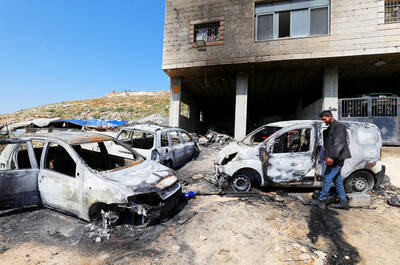
RAMPAGE: A Palestinian man was left dead after dozens of Israeli settlers searching for a missing 14-year-old boy stormed a village in the Israeli-occupied West Bank US President Joe Biden on Friday said he expected Iran to attack Israel “sooner, rather than later” and warned Tehran not to proceed. Asked by reporters about his message to Iran, Biden simply said: “Don’t,” underscoring Washington’s commitment to defend Israel. “We are devoted to the defense of Israel. We will support Israel. We will help defend Israel and Iran will not succeed,” he said. Biden said he would not divulge secure information, but said his expectation was that an attack could come “sooner, rather than later.” Israel braced on Friday for an attack by Iran or its proxies as warnings grew of
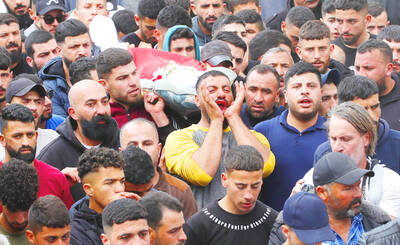
IN PURSUIT: Israel’s defense minister said the revenge attacks by Israeli settlers would make it difficult for security forces to find those responsible for the 14-year-old’s death Israeli Prime Minister Benjamin Netanyahu on Saturday condemned the “heinous murder” of an Israeli teenager in the occupied West Bank as attacks on Palestinian villages intensified following news of his death. After Benjamin Achimeir, 14, was reported missing near Ramallah on Friday, hundreds of Jewish settlers backed by Israeli forces raided nearby Palestinian villages, torching vehicles and homes, leaving at least one villager dead and dozens wounded. The attacks escalated in several villages on Saturday after Achimeir’s body was found near the Malachi Hashalom outpost. Agence France-Presse correspondents saw smoke rising from burned houses and fields. Mayor Amin Abu Alyah, of the


 RSS
RSS