


Thousands of visitors from 27 US allies, including Britain, Japan and Australia, will be fingerprinted and photographed on arrival in the US to tighten border security, US officials said on Friday.
The policy, to begin at airports and seaports by Sept. 30 and at the 50 busiest US land crossings by the end of the year, extends a program that started on Jan. 5 in which everyone who comes to the US on a visa -- except diplomats -- is fingerprinted and photographed on arrival.
With the new policy, this will be extended to citizens of the 27 "visa waiver" nations whose citizens generally do not need visas for short visits.
US officials say taking two digital index-finger scans and a photograph takes seconds and helps prevent attacks like those on Sept. 11, 2001, but the policy has upset many visitors and its expansion drew protests from the tourism industry.
The 27 nations affected are Andorra, Australia, Austria, Belgium, Britain, Brunei, Denmark, Finland, France, Germany, Iceland, Ireland, Italy, Japan, Liechtenstein, Luxembourg, Monaco, the Netherlands, New Zealand, Norway, Portugal, San Marino, Singapore, Slovenia, Spain, Sweden and Switzerland.
US officials said the new policy reflected the likelihood that those nations would miss an Oct. 26 deadline to begin issuing passports with biometric data such as fingerprints.
The Bush administration said it asked the US Congress for a two-year extension to the deadline and said that its decision to fingerprint and photograph even visitors who do not need visas was designed to close a loophole.
"It will add security by allowing us to check against our terrorist criminal watchlist those foreign visitors who are traveling from Visa Waiver Program countries," said Homeland Security Department Undersecretary Asa Hutchinson.
Citizens from these countries, which include some of the closest US allies whose governments backed the invasion of Iraq, are generally permitted to visit the US without a visa for up to 90 days for pleasure or business.
The old policy applied to people from these nations who required US visas, for example to study or work legally.
It has angered many visitors and triggered retaliatory measures from nations including Brazil, which now fingerprints US visitors, and China, which has said it will require some US citizens seeking Chinese visas to appear for interviews.
US and British travel groups criticized the policy.
"[We are] greatly disappointed and very concerned about potential negative reactions in key inbound tourism markets in western Europe, Japan and other important ... countries," said US Travel Industry Association president William Norman.
"These new moves clearly will not help to encourage UK citizens to travel to the USA, and we would urge very strongly that the American authorities reconsider their actions," said a spokesman for the Association of British Travel Agents.
US officials said most Canadian citizens, most of whom do not need visas, will not be fingerprinted or photographed.
They also said Mexicans carrying border crossing cards -- which include biometric identifiers and are only issued after the person has had a background check -- are also exempt if they enter for 72 hours and stay within the "border zone."
Hutchinson said the US would not oppose moves by other countries to impose more security measures on US citizens.
"We recognize that it's a two-way street," he said.
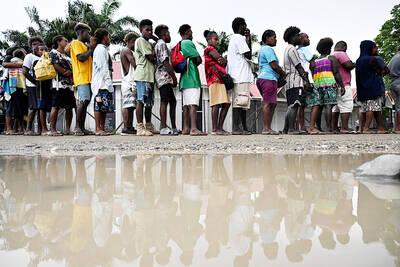
SEEKING CHANGE: A hospital worker said she did not vote in previous elections, but ‘now I can see that maybe my vote can change the system and the country’ Voting closed yesterday across the Solomon Islands in the south Pacific nation’s first general election since the government switched diplomatic allegiance from Taiwan to Beijing and struck a secret security pact that has raised fears of the Chinese navy gaining a foothold in the region. The Solomon Islands’ closer relationship with China and a troubled domestic economy weighed on voters’ minds as they cast their ballots. As many as 420,000 registered voters had their say across 50 national seats. For the first time, the national vote also coincided with elections for eight of the 10 local governments. Esther Maeluma cast her vote in the
Nearly half of China’s major cities are suffering “moderate to severe” levels of subsidence, putting millions of people at risk of flooding, especially as sea levels rise, according to a study of nationwide satellite data released yesterday. The authors of the paper, published by the journal Science, found that 45 percent of China’s urban land was sinking faster than 3mm per year, with 16 percent at more than 10mm per year, driven not only by declining water tables, but also the sheer weight of the built environment. With China’s urban population already in excess of 900 million people, “even a small portion

UNSETTLING IMAGES: The scene took place in front of TV crews covering the Trump trial, with a CNN anchor calling it an ‘emotional and unbelievably disturbing moment’ A man who doused himself in an accelerant and set himself on fire outside the courthouse where former US president Donald Trump is on trial has died, police said yesterday. The New York City Police Department (NYPD) said the man was declared dead by staff at an area hospital. The man was in Collect Pond Park at about 1:30pm on Friday when he took out pamphlets espousing conspiracy theories, tossed them around, then doused himself in an accelerant and set himself on fire, officials and witnesses said. A large number of police officers were nearby when it happened. Some officers and bystanders rushed

HYPOCRISY? The Chinese Ministry of Foreign Affairs yesterday asked whether Biden was talking about China or the US when he used the word ‘xenophobic’ US President Joe Biden on Wednesday called for a hike in steel tariffs on China, accusing Beijing of cheating as he spoke at a campaign event in Pennsylvania. Biden accused China of xenophobia, too, in a speech to union members in Pittsburgh. “They’re not competing, they’re cheating. They’re cheating and we’ve seen the damage here in America,” Biden said. Chinese steel companies “don’t need to worry about making a profit because the Chinese government is subsidizing them so heavily,” he said. Biden said he had called for the US Trade Representative to triple the tariff rates for Chinese steel and aluminum if Beijing was


 RSS
RSS