


The justice minister has threatened to arrest election officials, thousands of polling stations are without ballots and parts of war-torn Aceh are too dangerous to hold elections.
But none of that will stop Indonesia from holding parliamentary elections tomorrow for the second time since the fall of ex-dictator Suharto in 1998 -- though election officials acknowledge voting will be delayed for up to five days in the remote regions of Papua and West Irian Jaya.

PHOTO: REUTERS
"Obviously [the delays] are disappointing but that is not a fundamental flaw in the process," said Glyn Ford, chief observer for the European Election Observation Mission which includes 230 monitors.
"We have to put this in context," he said. "This is probably the biggest and most complex election in the world and takes place in a country that spans three time zones and includes some polling stations that are four or five days walk from the nearest road."
The reports of delays and government bungling have at times overshadowed campaigning in the run-up to tomorrow's vote, underscoring the chaotic nature of democracy in the world's most populous Muslim nation.
Sporadic violence marred the country's first democratic ballot in 1999 and the counting process took over two months.
The campaigning has been peaceful this time around despite warnings from intelligence and police officials that Islamic radicals are plotting fresh terror attacks to disrupt the vote.
The General Election Commission has been criticized for hiring companies that failed to make ballot boxes or ballots and for repeatedly missing deadlines. A third of the country lacked election supplies and voter cards just days ahead of polls, according to the non-governmental People's Voter Education Network.
The failures prompted Justice Minister Yusril Mahendra to threaten election commissioners with jail this week and former president Abdurrahman Wahid to demand the resignation of the commission chairman. Wahid complained that 2 million of his party's supporters have not been able to register to vote.
Logistics have also been an issue, with the election commission turning to Air Force helicopters, Navy frigates and horses to reach polling stations on isolated islands and in mountainous villages.
Authorities have also beefed up security in Aceh, where government troops are fighting separatists rebels, and Central Sulawesi where Muslims have been blamed for a series of deadly attacks on Christians over the past six months.
"People here are worried about snipers," said Yahdi Basmah of the Central Sulawesi Electoral Commission. "They are scared to vote and volunteers are afraid to distribute election materials in remote villages for fear of being killed."
Despite the setbacks, election officials said on Friday that all but 2,500 of the 585,218 polling stations will be open. Still, areas in the eastern province of Papua face delays and 48 villages in Aceh are barred from voting because they are in areas controlled by the separatist Free Aceh Movement.
Then, there is the ballot itself. With 24 parties and hundreds of names, it is the size of a broadsheet newspaper and almost too big to fit into a polling booth.
Complicating matters, voters for the first time will be choosing candidates along with parties. In addition, citizens will elect numerous governing bodies.
Rules could also trip up some voters, who are required to either select a candidate and party or just the party. A vote for a candidate alone -- or for a candidate and a different party -- makes the ballot invalid.
"This is the most complicated election system I've ever seen," said the Asia Foundation's Tim Meisburger, who has monitored elections in Cambodia, East Timor, Sri Lanka, South Africa, Bosnia and Bangladesh.
"There is quite a bit of concern that voters will not understand the process well enough and that there will be a large number of invalid ballots."

Republican US lawmakers on Friday criticized US President Joe Biden’s administration after sanctioned Chinese telecoms equipment giant Huawei unveiled a laptop this week powered by an Intel artificial intelligence (AI) chip. The US placed Huawei on a trade restriction list in 2019 for contravening Iran sanctions, part of a broader effort to hobble Beijing’s technological advances. Placement on the list means the company’s suppliers have to seek a special, difficult-to-obtain license before shipping to it. One such license, issued by then-US president Donald Trump’s administration, has allowed Intel to ship central processors to Huawei for use in laptops since 2020. China hardliners

Conjoined twins Lori and George Schappell, who pursued separate careers, interests and relationships during lives that defied medical expectations, died this month in Pennsylvania, funeral home officials said. They were 62. The twins, listed by Guinness World Records as the oldest living conjoined twins, died on April 7 at the Hospital of the University of Pennsylvania, obituaries posted by Leibensperger Funeral Homes of Hamburg said. The cause of death was not detailed. “When we were born, the doctors didn’t think we’d make 30, but we proved them wrong,” Lori said in an interview when they turned 50, the Philadelphia Inquirer reported. The
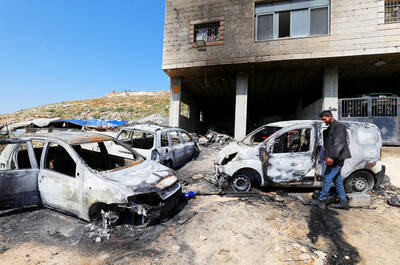
RAMPAGE: A Palestinian man was left dead after dozens of Israeli settlers searching for a missing 14-year-old boy stormed a village in the Israeli-occupied West Bank US President Joe Biden on Friday said he expected Iran to attack Israel “sooner, rather than later” and warned Tehran not to proceed. Asked by reporters about his message to Iran, Biden simply said: “Don’t,” underscoring Washington’s commitment to defend Israel. “We are devoted to the defense of Israel. We will support Israel. We will help defend Israel and Iran will not succeed,” he said. Biden said he would not divulge secure information, but said his expectation was that an attack could come “sooner, rather than later.” Israel braced on Friday for an attack by Iran or its proxies as warnings grew of

A prominent Christian leader has allegedly been stabbed at the altar during a Mass yesterday in southwest Sydney. Bishop Mar Mari Emmanuel was saying Mass at Christ The Good Shepherd Church in Wakeley just after 7pm when a man approached him at the altar and allegedly stabbed toward his head multiple times. A live stream of the Mass shows the congregation swarm forward toward Emmanuel before it was cut off. The church leader gained prominence during the COVID-19 pandemic, amassing a large online following, Officers attached to Fairfield City police area command attended a location on Welcome Street, Wakeley following reports a number


 RSS
RSS