


The reward is high, but so is the risk as some of the 27 teams pursuing a US$10 million prize for the first privately funded manned spaceflight near a goal that once seemed outlandish.
Organizers of the X Prize believe that teams could attempt the space trip as early as this summer.
When the competition was announced just eight years ago, many were skeptical that any privately financed team could meet the requirements to collect the prize: Build a spacecraft capable of taking three passengers 101km above the planet, then make a second successful suborbital trip within two weeks.
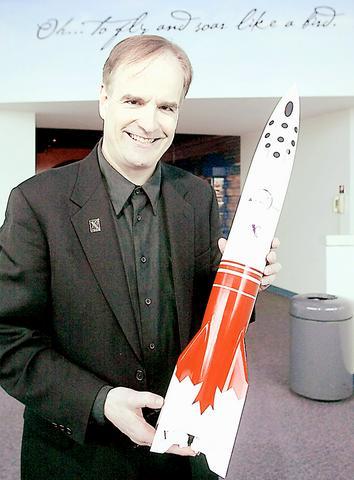
PHOTO: AP
"It's going to happen in 2004. Someone will win it," said Gregg Maryniak, director of the St. Louis-based X Prize Foundation, a group created to spark development of reusable spacecraft that can take average citizens into space.
Many of the teams vying for the X Prize already have conducted test launches. One US team propelled a spacecraft to 20,400m. While a couple of US teams are among the top contenders, crews from six other nations are also in pursuit of the prize.
It's a diverse group tapping into the same spirit of exploration that led adventurers to sail ships across unknown oceans. Teams range from one financed by a billionaire to a group of scraped-together volunteers. Several boast leading minds who toss around aerospace terms with dizzying precision. Others lament unexpected fires and explosions as part of the learning process.
Safety is stressed, but team members know they're embarking on a journey with built-in risks, maybe even death.
"It's a possibility. It's a cost that exploration has to pay. Otherwise, you stay home and watch TV and eat French fries," said Pablo de Leon, the 39-year-old team leader of an Argentinian group that is building a vertical rocket named Gauchito ("The Little Cowboy").
"If we are not the ones, someone else will do it. But it will be done," de Leon said.
Canadian Brian Feeney, 44, is team leader of the Toronto-based da Vinci Project. In its simplest terms, the group wants to lift a spacecraft called Wild Fire using an immense helium balloon. The design switches over to rockets to fly and uses a steerable parachute to land.
Feeney plans to be on board for the first manned attempt. He said he thinks of the risk as similar to that of climbing Mount Everest, the world's tallest peak. "Life is way too short to not explore those boundaries," he said.
"How many times does a kid have a chance to go into space? I'm living my dream," he said. "I feel like I'm limited; my bicycle won't go as far as I want it to. My grandest dream goes all the way to the stars."
Nine of the 27 teams have built "serious hardware" and four or five appear to be at the leading edge of the competition, according to Maryniak.

Republican US lawmakers on Friday criticized US President Joe Biden’s administration after sanctioned Chinese telecoms equipment giant Huawei unveiled a laptop this week powered by an Intel artificial intelligence (AI) chip. The US placed Huawei on a trade restriction list in 2019 for contravening Iran sanctions, part of a broader effort to hobble Beijing’s technological advances. Placement on the list means the company’s suppliers have to seek a special, difficult-to-obtain license before shipping to it. One such license, issued by then-US president Donald Trump’s administration, has allowed Intel to ship central processors to Huawei for use in laptops since 2020. China hardliners
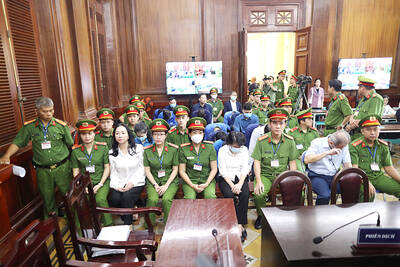
A top Vietnamese property tycoon was on Thursday sentenced to death in one of the biggest corruption cases in history, with an estimated US$27 billion in damages. A panel of three hand-picked jurors and two judges rejected all defense arguments by Truong My Lan, chair of major developer Van Thinh Phat, who was found guilty of swindling cash from Saigon Commercial Bank (SCB) over a decade. “The defendant’s actions ... eroded people’s trust in the leadership of the [Communist] Party and state,” read the verdict at the trial in Ho Chi Minh City. After the five-week trial, 85 others were also sentenced on

Conjoined twins Lori and George Schappell, who pursued separate careers, interests and relationships during lives that defied medical expectations, died this month in Pennsylvania, funeral home officials said. They were 62. The twins, listed by Guinness World Records as the oldest living conjoined twins, died on April 7 at the Hospital of the University of Pennsylvania, obituaries posted by Leibensperger Funeral Homes of Hamburg said. The cause of death was not detailed. “When we were born, the doctors didn’t think we’d make 30, but we proved them wrong,” Lori said in an interview when they turned 50, the Philadelphia Inquirer reported. The

RAMPAGE: A Palestinian man was left dead after dozens of Israeli settlers searching for a missing 14-year-old boy stormed a village in the Israeli-occupied West Bank US President Joe Biden on Friday said he expected Iran to attack Israel “sooner, rather than later” and warned Tehran not to proceed. Asked by reporters about his message to Iran, Biden simply said: “Don’t,” underscoring Washington’s commitment to defend Israel. “We are devoted to the defense of Israel. We will support Israel. We will help defend Israel and Iran will not succeed,” he said. Biden said he would not divulge secure information, but said his expectation was that an attack could come “sooner, rather than later.” Israel braced on Friday for an attack by Iran or its proxies as warnings grew of


 RSS
RSS