


The Basque separatist group ETA may call a unilateral ceasefire in its campaign of violence, a founder and other Basque sources said, in an effort to win political concessions from the newly elected Socialists due to take power next month.
Julen Madariaga, a founding member of ETA, said he thought a truce could be called soon.

PHOTO: AP
"I have the impression that in a very short time -- in coming days, or coming weeks -- that ETA will declare a ceasefire," he said in a telephone interview Monday night from his home in southern France.
Within the month, Jose Luis Rodriguez Zapatero and his Socialists are to take over from the conservative Prime Minister Jose Maria Aznar, who cracked down on ETA.
"ETA always has known how to take advantage of these occasions. ... It's very weak and needs a strategic truce," said Kepa Aulestia, a Basque writer who focuses on ETA issues in his columns in El Correo and La Vanguardia newspapers.
ETA issued a statement on Sunday proposing dialogue with the Socialists, but when Zapatero responded the following day, it was with these point-blank words: "The only communique I await from ETA, as do the vast majority of Spaniards, is one in which it abandons violence."
Aznar's Popular Party government had succeeded in weakening ETA, but has not been able to end the separatist group's violence, which has killed more than 800 people since the late 1960s.
Spanish and French police arrested more than 150 suspected ETA members last year, including senior commando leaders, and the number of killings blamed on ETA dropped to three, compared with 23 in 2000, after the last ceasefire ended.
ETA, whose name is the Basque-language acronym for Basque Homeland and Freedom, demands independence for the three Basque country provinces and part of neighboring Navarra in northern Spain, and three other areas in southwest France on the other side of the Pyrenees mountain border.
A minority of Basque nationalists support that demand -- if not ETA's bombing campaign. Others want more autonomy, but not necessarily outright independence. About half of the region's 2 million people want to remain part of Spain.
The government had claimed that ETA used that previous truce to regroup and 2000 was its deadliest year in almost a decade.
Police recently foiled two bombing attempts blamed on ETA, including one on trains headed to downtown Madrid on Christmas Eve. A half-tonne bomb was found in late February in a truck apparently headed for Madrid.
The Aznar government originally blamed ETA for the March 11 railway bombings in Madrid, which killed 190 people and injured more than 1,800. But investigators now are focussing on an Islamic group with alleged ties to al-Qaeda.
Politicians and analysts in northern Spain said they expected a new ETA ceasefire.
"I believe there will be a truce soon," said Gorka Espiau of Elkarri social movement, which advocates negotiations, including with ETA, to resolve the problem.
The three-province Basque country is one of 17 autonomous regions created by the 1978 Constitution that followed the 1975 death of longtime dictator General Francisco Franco.
It already collects and spends its own taxes and manages many of its public services. If it gets more rights, or independence, there are likely to be more demands from other regions, notably Catalonia in the northeast, which have their own language, culture and autonomy aspirations.

Republican US lawmakers on Friday criticized US President Joe Biden’s administration after sanctioned Chinese telecoms equipment giant Huawei unveiled a laptop this week powered by an Intel artificial intelligence (AI) chip. The US placed Huawei on a trade restriction list in 2019 for contravening Iran sanctions, part of a broader effort to hobble Beijing’s technological advances. Placement on the list means the company’s suppliers have to seek a special, difficult-to-obtain license before shipping to it. One such license, issued by then-US president Donald Trump’s administration, has allowed Intel to ship central processors to Huawei for use in laptops since 2020. China hardliners

Conjoined twins Lori and George Schappell, who pursued separate careers, interests and relationships during lives that defied medical expectations, died this month in Pennsylvania, funeral home officials said. They were 62. The twins, listed by Guinness World Records as the oldest living conjoined twins, died on April 7 at the Hospital of the University of Pennsylvania, obituaries posted by Leibensperger Funeral Homes of Hamburg said. The cause of death was not detailed. “When we were born, the doctors didn’t think we’d make 30, but we proved them wrong,” Lori said in an interview when they turned 50, the Philadelphia Inquirer reported. The
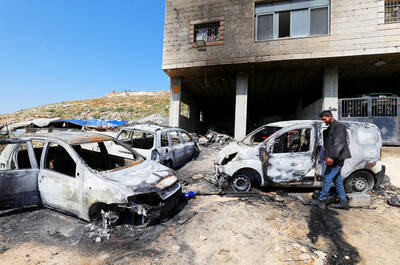
RAMPAGE: A Palestinian man was left dead after dozens of Israeli settlers searching for a missing 14-year-old boy stormed a village in the Israeli-occupied West Bank US President Joe Biden on Friday said he expected Iran to attack Israel “sooner, rather than later” and warned Tehran not to proceed. Asked by reporters about his message to Iran, Biden simply said: “Don’t,” underscoring Washington’s commitment to defend Israel. “We are devoted to the defense of Israel. We will support Israel. We will help defend Israel and Iran will not succeed,” he said. Biden said he would not divulge secure information, but said his expectation was that an attack could come “sooner, rather than later.” Israel braced on Friday for an attack by Iran or its proxies as warnings grew of

A prominent Christian leader has allegedly been stabbed at the altar during a Mass yesterday in southwest Sydney. Bishop Mar Mari Emmanuel was saying Mass at Christ The Good Shepherd Church in Wakeley just after 7pm when a man approached him at the altar and allegedly stabbed toward his head multiple times. A live stream of the Mass shows the congregation swarm forward toward Emmanuel before it was cut off. The church leader gained prominence during the COVID-19 pandemic, amassing a large online following, Officers attached to Fairfield City police area command attended a location on Welcome Street, Wakeley following reports a number


 RSS
RSS