


As thousands of people swarmed around a hilltop shrine in Herat on Tuesday for the burial of Afghanistan's aviation minister, his warlord father demanded the government find those who killed him two days before or let his own people seek revenge.
The minister for civil aviation and tourism, Mir Wais Sadeq, 31, was gunned down by soldiers serving a rival of his father, Ismail Khan. Khan, the richest and most powerful of Afghanistan's warlords, is the governor of the western province of Herat.
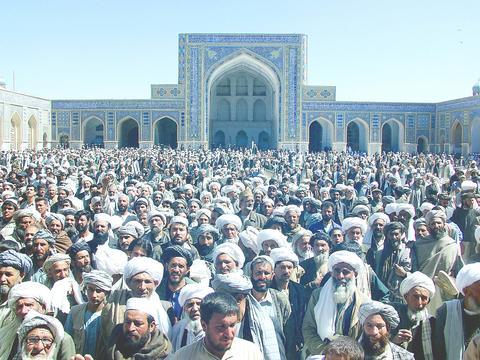
PHOTO: AP
The killing appears to have stemmed from the personal ambition of one man. Zaher Naibzadah, commander of Herat's 17th Division, a former comrade in arms of Khan, fled the city on horseback after heavy fighting at his family compound Sunday night. By Tuesday he was reported to be in his home province of Badghis, some 75km away.
Sadeq had gone on Sunday afternoon to the house of Naibzadah, who was appointed as commander by President Hamid Karzai. He apparently intended to remonstrate with Naibzadah about an altercation earlier between Khan and some of Naibzadah's soldiers. But Sadeq and three others were shot and killed outside the house, sparking a fierce firefight that lasted for several hours, before Khan's troops overran the compound.
Naibzadah initially said the death toll was up to 100, but it appears to be much lower. On Tuesday, a foreign diplomat, citing local hospital figures, said that 11 people had been killed and 13 wounded. Interviews at the scene of the fighting also indicated that a total of 10 or 11 people had died.
The killing of the young minister has enormous political ramifications. Supporters of Khan warned of a plot to undermine or unseat Khan, while the central government moved quickly to exert its influence in the region, sending in ministers and troops.
The government is deploying 1,500 soldiers of the Afghan National Army to Herat -- 1,000 of them have already arrived on US military planes. But the soldiers are moving tentatively and will meet local people and explain their presence before patrolling the streets, a US military officer with them said.
Karzai sent his defense and interior ministers and their deputies to Herat on Monday, and they all attended Tuesday's funerals of Sadeq and two other local officials gunned down with him, the head of police security in Herat, Ghulam Siddiq, and the head of counternarcotics, Ghulam Nabi. All three men were buried together at the shrine of Khoja Abdullah Ansar, a Sufi mystic and poet who died hundreds of years ago, overlooking the city.
The ministers expressed sympathy over the losses and outrage at the killings. But tensions between Khan and the central authorities are high, one foreign diplomat said, particularly with the interior minister, Ahmed Ali Jalali. Khan and his son had only just returned from meetings in Kabul with Karzai and Jalali, in which the president had tried to persuade Kahn to give up Herat and become governor of another province.
Supporters of Khan and members of Jamiat-e-Islami, the mujahidin faction to which he belongs, called the killings a terrorist attack and suggested that they were part of a wider plot to remove Khan.
Naibzadah, in interviews with news agencies since his flight from Herat, said Khan's forces attacked first. He said Khan had turned against him because of ideological differences, and because the governor refused to respect the central government's authority.
Khan walked beside his son's casket as it was pulled on a gun-carriage through the streets and laid it on the hilltop as a crowd seethed around him. For a moment, he sat in silent prayer amid hundreds of chanting mourners.
Khan called for restraint and patience from his people. But he also sent a warning to the central government.
"We will pay very careful attention" to Karzai, he said, "to see what he is doing."
Nearly half of China’s major cities are suffering “moderate to severe” levels of subsidence, putting millions of people at risk of flooding, especially as sea levels rise, according to a study of nationwide satellite data released yesterday. The authors of the paper, published by the journal Science, found that 45 percent of China’s urban land was sinking faster than 3mm per year, with 16 percent at more than 10mm per year, driven not only by declining water tables, but also the sheer weight of the built environment. With China’s urban population already in excess of 900 million people, “even a small portion

UNSETTLING IMAGES: The scene took place in front of TV crews covering the Trump trial, with a CNN anchor calling it an ‘emotional and unbelievably disturbing moment’ A man who doused himself in an accelerant and set himself on fire outside the courthouse where former US president Donald Trump is on trial has died, police said yesterday. The New York City Police Department (NYPD) said the man was declared dead by staff at an area hospital. The man was in Collect Pond Park at about 1:30pm on Friday when he took out pamphlets espousing conspiracy theories, tossed them around, then doused himself in an accelerant and set himself on fire, officials and witnesses said. A large number of police officers were nearby when it happened. Some officers and bystanders rushed

HYPOCRISY? The Chinese Ministry of Foreign Affairs yesterday asked whether Biden was talking about China or the US when he used the word ‘xenophobic’ US President Joe Biden on Wednesday called for a hike in steel tariffs on China, accusing Beijing of cheating as he spoke at a campaign event in Pennsylvania. Biden accused China of xenophobia, too, in a speech to union members in Pittsburgh. “They’re not competing, they’re cheating. They’re cheating and we’ve seen the damage here in America,” Biden said. Chinese steel companies “don’t need to worry about making a profit because the Chinese government is subsidizing them so heavily,” he said. Biden said he had called for the US Trade Representative to triple the tariff rates for Chinese steel and aluminum if Beijing was
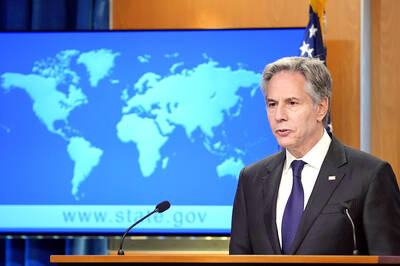
Beijing is continuing to commit genocide and crimes against humanity against Uyghurs and other Muslim minorities in its western Xinjiang province, U.S. Secretary of State Antony Blinken said in a report published on Monday, ahead of his planned visit to China this week. The State Department’s annual human rights report, which documents abuses recorded all over the world during the previous calendar year, repeated language from previous years on the treatment of Muslims in Xinjiang, but the publication raises the issue ahead of delicate talks, including on the war in Ukraine and global trade, between the top U.S. diplomat and Chinese


 RSS
RSS