


Amsterdam's mayor officiated at the Netherlands' first gay wedding three years ago -- and since then, the issue has all but disappeared from the country's political agenda.
While the US is engaged in fierce debate over gay marriage, Canadians are discussing a federal law to legalize it and many European countries legally recognize civil unions.
But in the Netherlands, nobody really talks about the issue anymore.
"It's really become less of something that you need to explain," says Anne-Marie Thus, who in 2001 married Helene Faasen. "We're totally ordinary. We take our children to preschool every day. People know they don't have to be afraid of us."
Around the world, countries are coming to terms with how to treat same-sex couples -- and the trend in many is toward liberalizing laws.
In Denmark, civil unions with the same rights as marriage have been around since 1989 and other Nordic countries followed suit in the 1990s.
The Dutch were the first to eliminate any distinction between gay and straight, striking all references to gender in the marriage laws. Belgium soon did the same.
Canada jumped to the forefront of gay rights in North America in June when it announced plans to legalize same-sex marriages. Many same-sex couples streamed north to marry in Ottawa and British Columbia after courts in those provinces authorized weddings.
In most of Africa, homosexuality is illegal and gay marriage unthinkable. But in South Africa, gay rights were enshrined in the post-apartheid constitution and some groups are lobbying for the right to marry.
In Japan, homosexuality is no longer considered a mental illness as it once was, but many gays still feel pressure to go through with a sham heterosexual marriage.
In Malaysia, homosexuality remains illegal and sodomy is punishable by up to 20 years in prison, but the laws are rarely enforced and gays are mostly left alone if they keep to themselves. Gay marriage is not under consideration in this predominantly Muslim country.
Gay rights activists in the Phillipines say a few unofficial same-sex marriage ceremonies have taken place, but are not recognized by law. Michael Urbano, a spokesman for the rights group Pro-Gay, said Filipino gays face more pressing problems than seeking a law recognizing same-sex marriages.
"It's a right that gays should enjoy, but we should first face the primary problem of gays -- it's discrimination and homophobia," said Urbano, who added that many gays in the Philippines are forced into sham heterosexual marriages due to pressure from their families.
Strongly Roman Catholic countries such as Spain and Italy refuse to recognize gay couples, following the Vatican's abhorrence of homosexuality. But there are important exceptions.
In Portugal, and in Spain's Navarra and Basque regions, gay couples who live together long enough receive the same benefits as heterosexuals covered by common law unions. In Argentina's capital, Buenos Aires, gay couples can register for a civil union.
France and Germany recognize civil union laws, and Britain is in the process of adopting them.
The Dutch have watched the hoopla in the US with some bemusement. Amsterdam Mayor Job Cohen, who married six couples at the stroke of midnight on April 1, 2001, when the Dutch law took effect, sent a note of support to Gavin Newsom, the San Francisco mayor who set off a rush to California when he officiated same-sex ceremonies.
In contrast to Amsterdam's boisterous gay clubs and the spring rite of the Gay Pride parade through its famed canals, Faasen and Thus, the Dutch lesbian couple, live a quiet middle-class life in a neat apartment on the city's outskirts. They hardly seem like revolutionaries, or even trendsetters.
Faasen is a notary and Thus works part-time in a home for the elderly. The couple have a 3 1/2-year-old son, Nathan, and 2-year-old daughter, Myrthle. Faasen adopted the two, who are Thus' biological children. Their reasons for marrying were prosaic.
"With marriage, you have a whole range of legal issues settled right in one go," Faasen says, scooping up Myrthle. "Child care, life insurance, health insurance, pension, inheritance. Otherwise you're left taking care of those things bit by bit, where it's possible."
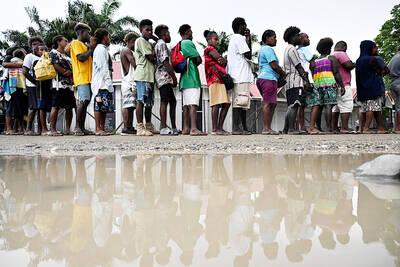
SEEKING CHANGE: A hospital worker said she did not vote in previous elections, but ‘now I can see that maybe my vote can change the system and the country’ Voting closed yesterday across the Solomon Islands in the south Pacific nation’s first general election since the government switched diplomatic allegiance from Taiwan to Beijing and struck a secret security pact that has raised fears of the Chinese navy gaining a foothold in the region. The Solomon Islands’ closer relationship with China and a troubled domestic economy weighed on voters’ minds as they cast their ballots. As many as 420,000 registered voters had their say across 50 national seats. For the first time, the national vote also coincided with elections for eight of the 10 local governments. Esther Maeluma cast her vote in the
Nearly half of China’s major cities are suffering “moderate to severe” levels of subsidence, putting millions of people at risk of flooding, especially as sea levels rise, according to a study of nationwide satellite data released yesterday. The authors of the paper, published by the journal Science, found that 45 percent of China’s urban land was sinking faster than 3mm per year, with 16 percent at more than 10mm per year, driven not only by declining water tables, but also the sheer weight of the built environment. With China’s urban population already in excess of 900 million people, “even a small portion

UNSETTLING IMAGES: The scene took place in front of TV crews covering the Trump trial, with a CNN anchor calling it an ‘emotional and unbelievably disturbing moment’ A man who doused himself in an accelerant and set himself on fire outside the courthouse where former US president Donald Trump is on trial has died, police said yesterday. The New York City Police Department (NYPD) said the man was declared dead by staff at an area hospital. The man was in Collect Pond Park at about 1:30pm on Friday when he took out pamphlets espousing conspiracy theories, tossed them around, then doused himself in an accelerant and set himself on fire, officials and witnesses said. A large number of police officers were nearby when it happened. Some officers and bystanders rushed

HYPOCRISY? The Chinese Ministry of Foreign Affairs yesterday asked whether Biden was talking about China or the US when he used the word ‘xenophobic’ US President Joe Biden on Wednesday called for a hike in steel tariffs on China, accusing Beijing of cheating as he spoke at a campaign event in Pennsylvania. Biden accused China of xenophobia, too, in a speech to union members in Pittsburgh. “They’re not competing, they’re cheating. They’re cheating and we’ve seen the damage here in America,” Biden said. Chinese steel companies “don’t need to worry about making a profit because the Chinese government is subsidizing them so heavily,” he said. Biden said he had called for the US Trade Representative to triple the tariff rates for Chinese steel and aluminum if Beijing was


 RSS
RSS