


Depending on who's telling the story, the editor of Thailand's Bangkok Post was shifted out of his job last week because of intense government pressure, or a touchy shareholder, or a long-term business strategy.
Whatever the truth, Veera Prateepchaikul's removal from the newspaper's newsroom has turned the spotlight on the state of the Thai press. Supporters of Prime Minister Thaksin Shinawatra and the Post's management have denied allegations of interference, but critics say journalistic freedom is in grave peril.
"I would describe the Thai media at the moment as being in an intensive care unit," said Kavi Chongkittavorn, an editor of The Nation, the Post's main rival.
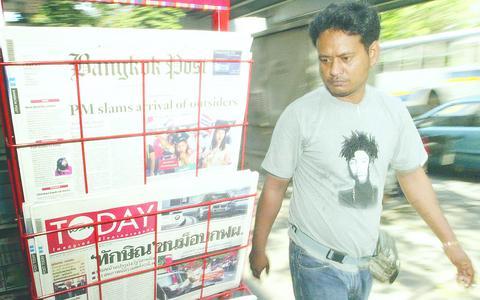
PHOTO: AP
Veera's reassignment to an administrative job at the Post underscores what many say is a systematic attempt to tame media criticism of the government headed by Thaksin, a telecommunications tycoon and one of Thailand's richest men.
The Bangkok Post has a circulation of only 65,000 copies. Yet as Thailand's oldest English-language newspaper it has long held a prestigious position in this country of 64 million people.
And, it 's not alone in its turmoil.
"This is the worst situation for the media since I began working in the field more than 20 years ago," Rungruang Preechakul said after recently resigning as editor of the Thai-language Siam Rath Weekly.
He alleged that unlike the old military regimes that ruled for decades after World War II, Thaksin's government uses money as a weapon against the press, not brute force.
Thaksin hasn't commented on the Post's controversy. In the past he's dismissed similar allegations of media bullying but has accused some journalists of "abusing professional ethics and reporting groundless stories" against him.
Thaksin entered politics in 1994 during a period of sweeping constitutional reform undertaken in a wave of enthusiasm after an unpopular military government was overthrown by street protests in 1992.
He was swept to power as prime minister in 2001 in a landslide election victory. Yet it's unclear how committed he is to Thailand's hard-won democratic ideals.
"Democracy is an excellent political system ... but you should not regard democracy as the end," Thaksin said last year. "The end should be improving the livelihood of your people and the progress of your country."
Responding to the current furor, Suranand Vejjajiva, the spokesman of Thaksin's Thai Rak Thai Party, said: "We are not going to interfere with press freedom in Thailand, which has one of the freest presses in Southeast Asia and perhaps even Asia."
"You can open a Thai-language paper and read criticisms in columns all around," he said. "There's no suppression at all. Of course, if there are criticisms, the government has a right to answer those criticisms."
Kavi said the press became vulnerable when Thailand's 1997 financial crisis shifted the balance of power from editorial departments to business managers struggling to keep newspapers alive.
Thaksin, with huge business interests, could and did provide the lifeblood of advertising where he pleased.
AIS, a mobile-phone company that is one of his family's businesses, pulled its ads from Prachachart Thurakij newspaper in 2000 after its publication of Thaksin's asset declaration records caused him legal headaches.
Thaksin's winning campaign gave him the political clout to match his wealth.
What actually happened at the Post remains murky. Veera himself has declined to discuss details of his job change.
"I don't want to talk much about that because I accepted the change after I was moved from the post," he said. "Someone offered me a job and I felt relief at that."
Post editor in chief Pichai Chuensukswadi acknowledged that the media were facing political pressure. But he said Veera had been promoted to help expand the newspaper's publishing company, not because of government interference.

Republican US lawmakers on Friday criticized US President Joe Biden’s administration after sanctioned Chinese telecoms equipment giant Huawei unveiled a laptop this week powered by an Intel artificial intelligence (AI) chip. The US placed Huawei on a trade restriction list in 2019 for contravening Iran sanctions, part of a broader effort to hobble Beijing’s technological advances. Placement on the list means the company’s suppliers have to seek a special, difficult-to-obtain license before shipping to it. One such license, issued by then-US president Donald Trump’s administration, has allowed Intel to ship central processors to Huawei for use in laptops since 2020. China hardliners
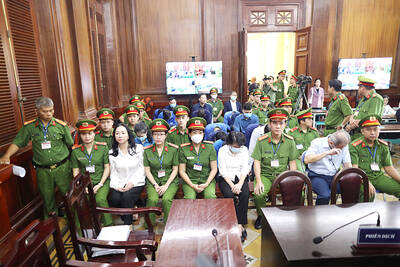
A top Vietnamese property tycoon was on Thursday sentenced to death in one of the biggest corruption cases in history, with an estimated US$27 billion in damages. A panel of three hand-picked jurors and two judges rejected all defense arguments by Truong My Lan, chair of major developer Van Thinh Phat, who was found guilty of swindling cash from Saigon Commercial Bank (SCB) over a decade. “The defendant’s actions ... eroded people’s trust in the leadership of the [Communist] Party and state,” read the verdict at the trial in Ho Chi Minh City. After the five-week trial, 85 others were also sentenced on

Conjoined twins Lori and George Schappell, who pursued separate careers, interests and relationships during lives that defied medical expectations, died this month in Pennsylvania, funeral home officials said. They were 62. The twins, listed by Guinness World Records as the oldest living conjoined twins, died on April 7 at the Hospital of the University of Pennsylvania, obituaries posted by Leibensperger Funeral Homes of Hamburg said. The cause of death was not detailed. “When we were born, the doctors didn’t think we’d make 30, but we proved them wrong,” Lori said in an interview when they turned 50, the Philadelphia Inquirer reported. The

RAMPAGE: A Palestinian man was left dead after dozens of Israeli settlers searching for a missing 14-year-old boy stormed a village in the Israeli-occupied West Bank US President Joe Biden on Friday said he expected Iran to attack Israel “sooner, rather than later” and warned Tehran not to proceed. Asked by reporters about his message to Iran, Biden simply said: “Don’t,” underscoring Washington’s commitment to defend Israel. “We are devoted to the defense of Israel. We will support Israel. We will help defend Israel and Iran will not succeed,” he said. Biden said he would not divulge secure information, but said his expectation was that an attack could come “sooner, rather than later.” Israel braced on Friday for an attack by Iran or its proxies as warnings grew of


 RSS
RSS