


Slavic Macedonians and ethnic Albanians alike mourned the death of their peacemaking President Boris Trajkovski, who died Thursday in a plane crash on a Bosnian mountainside.
The 47-year-old moderate, who epitomized the Balkan country's struggle for reconciliation following clashes in 2001 between security forces and ethnic Albanian militants, was praised Friday by both by the Slavic majority and the ethnic Albanian minority as a great statesman.
"It's a terrible moment like this when we all realize the value of life, the value of peace," said Vasil Bozinovski, 51, a Slavic entrepreneur.
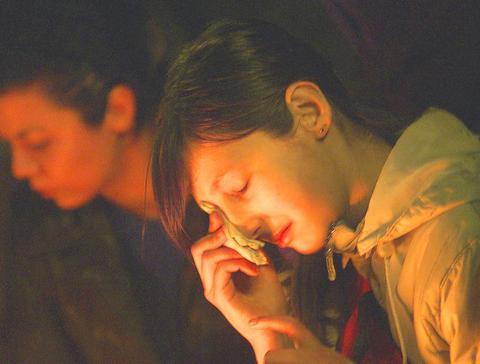
PHOTO: REUTERS
"His death has brought us all closer together," said Afrodita Halili, 23, an ethnic Albanian student. "I hope we find the strength to remain together."
Flags flew at half-staff and Macedonia began three days of mourning Friday as Parliament Speaker Ljupco Jordanovski took over as acting president.
World leaders expressed hope that the country would not lapse into the instability that plagued it in the late 1990s when the ethnic Albanian minority launched an insurgency demanding broader rights.
EU foreign policy chief Javier Solana flew to the capital, Skopje, to meet with government leaders and urge all Macedonians to "show courage, unity and maturity ... at this time of great loss."
Pope John Paul II sent a message saying he was praying that Trajkovski's "resolute commitment to peace will inspire the nation to continue steadfastly upon the path of dialogue, mutual respect and reconciliation."
US President George W. Bush issued a statement calling Trajkovski "a distinguished leader and a great friend of the United States."
"President Trajkovski showed extraordinary courage in leading his country from the brink of civil conflict to peace by signing the Ohrid Framework Agreement," Bush said.
"The United States strongly supports President Trajkovski's vision of a multi-ethnic, democratic Macedonia, at peace with itself and its neighbors, and on the path to full membership in the transatlantic community," Bush said.
Search teams on Friday recovered Trajkovski's body, along with those of six other officials and two pilots, from the wreckage of his twin-engine turboprop plane, which crashed in heavy fog, about 80km south of Sarajevo.
Trajkovski was en route to an international investment conference in Bosnia.
Macedonian prosecutor Roksanda Krstevska told Bosnian state radio that the flight data and cockpit voice recorders were found, which could provide clues to investigators about what caused the crash.
Macedonian officials gave assurances that Trajkovski's death would not undermine security. Their ethnic Albanian partners in the country's power-sharing government pledged to respect a Western-brokered peace deal that has kept Macedonia mostly peaceful since 2001.
"Our party will work together with coalition partners to achieve the goals that Boris Trajkovski set," said Teuta Arifi of the Democratic Union for Integration, a party formed by disbanded ethnic Albanian rebels.
Prime Minister Branko Crvenkovski said his government was "determined to keep Macedonia on its course, to maintain the peace process without any faltering."
"Even under these circumstances, all our institutions function normally," he said.
Elected in 1999, Trajkovski was Macedonia's second head of state since the former Yugoslav republic gained independence in 1991.
When Macedonia's ethnic Albanians launched their insurgency demanding broader rights for their community -- roughly a quarter of the country's 2 million people -- Trajkovski calmly steered the nation toward the peace deal, which met the rebels' demands in exchange for an end to hostilities.
He played a key role in implementing the 2001 peace pact, which has held despite continued scattered violence in Macedonia's northwest, a stronghold of the mostly Muslim ethnic Albanian minority.
Former rebel leader Ali Ahmeti praised Trajkovski's courage and called his death a great loss. "We all have to aim that this country is led by someone who is going to respect all of the people of Macedonia," he said.
"This is a tragedy for all of us. [He] was a sincere man, always willing to help everybody," said Reis ul-Ulema Hadziefendi Emini, head of Macedonia's Muslim community.
While Jordanovski took over as acting president, no date for elections was immediately set. Macedonian law requires a vote to elect a new head of state within 40 days.
Funeral arrangements were not immediately made known. Officials said the bodies would have to be identified first in Bosnia before being returned, a process that could take days.
Trajkovski is survived by his wife and two children.
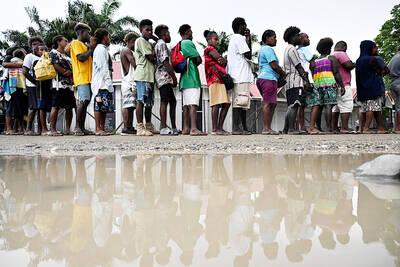
SEEKING CHANGE: A hospital worker said she did not vote in previous elections, but ‘now I can see that maybe my vote can change the system and the country’ Voting closed yesterday across the Solomon Islands in the south Pacific nation’s first general election since the government switched diplomatic allegiance from Taiwan to Beijing and struck a secret security pact that has raised fears of the Chinese navy gaining a foothold in the region. The Solomon Islands’ closer relationship with China and a troubled domestic economy weighed on voters’ minds as they cast their ballots. As many as 420,000 registered voters had their say across 50 national seats. For the first time, the national vote also coincided with elections for eight of the 10 local governments. Esther Maeluma cast her vote in the
Nearly half of China’s major cities are suffering “moderate to severe” levels of subsidence, putting millions of people at risk of flooding, especially as sea levels rise, according to a study of nationwide satellite data released yesterday. The authors of the paper, published by the journal Science, found that 45 percent of China’s urban land was sinking faster than 3mm per year, with 16 percent at more than 10mm per year, driven not only by declining water tables, but also the sheer weight of the built environment. With China’s urban population already in excess of 900 million people, “even a small portion

UNSETTLING IMAGES: The scene took place in front of TV crews covering the Trump trial, with a CNN anchor calling it an ‘emotional and unbelievably disturbing moment’ A man who doused himself in an accelerant and set himself on fire outside the courthouse where former US president Donald Trump is on trial has died, police said yesterday. The New York City Police Department (NYPD) said the man was declared dead by staff at an area hospital. The man was in Collect Pond Park at about 1:30pm on Friday when he took out pamphlets espousing conspiracy theories, tossed them around, then doused himself in an accelerant and set himself on fire, officials and witnesses said. A large number of police officers were nearby when it happened. Some officers and bystanders rushed

HYPOCRISY? The Chinese Ministry of Foreign Affairs yesterday asked whether Biden was talking about China or the US when he used the word ‘xenophobic’ US President Joe Biden on Wednesday called for a hike in steel tariffs on China, accusing Beijing of cheating as he spoke at a campaign event in Pennsylvania. Biden accused China of xenophobia, too, in a speech to union members in Pittsburgh. “They’re not competing, they’re cheating. They’re cheating and we’ve seen the damage here in America,” Biden said. Chinese steel companies “don’t need to worry about making a profit because the Chinese government is subsidizing them so heavily,” he said. Biden said he had called for the US Trade Representative to triple the tariff rates for Chinese steel and aluminum if Beijing was


 RSS
RSS