


Memo to Chinese officials: Take a bus.
China plans to eliminate official vehicles and drivers costing tens of billions of dollars a year as part of its crackdown on corruption and government waste.
China has long provided officials in the government, Communist Party and security forces with free transportation, a practice dating from the days when China had few private cars and most people got around by bicycle or bus.
Yet abuse of the privilege has aroused public ire amid rising wealth and widespread anger over lavish privileges and official corruption.
The official Xinhua News Agency, in a report yesterday, said a survey last year showed 95 percent of residents in Beijing, Shanghai and Guangzhou supported an "immediate reform of government car use."
The favored measure is to sell most government cars and pay officials monthly transportation subsidies, Xinhua said.
In major cities, vehicles bearing special license plates and windshield tags are a frequent sight, and many are imported luxury sedans or SUVs.
Such vehicles routinely skirt traffic laws or travel with sirens blaring.
By the end of the 1990s, more than 3.5 million government cars were officially registered, Xinhua said.
The cost of maintaining the vast fleet and its drivers is about 300 billion yuan (US$36.5 billion) annually, the report said.
No date for the start of the central government reform push was given, but many local governments have already begun cracking down on official cars.
Last year, Shanghai ordered the return of military and police license plates lent for private use and banned non-emergency vehicles from using sirens.
It also ordered an overall reduction in numbers of official cars, calling that an effort to reduce congestion and maintain the public image of the party and government.
Other cities have already begun auctioning government cars and paying officials transportation subsidies. In many places, government cars must now be domestic models and shared among officials.
The reforms aren't without controversy. Xinhua quoted academics expressing concern over the future of thousands of government drivers who would be thrown out of work, as well as the cost of transportation subsidies.
Nearly half of China’s major cities are suffering “moderate to severe” levels of subsidence, putting millions of people at risk of flooding, especially as sea levels rise, according to a study of nationwide satellite data released yesterday. The authors of the paper, published by the journal Science, found that 45 percent of China’s urban land was sinking faster than 3mm per year, with 16 percent at more than 10mm per year, driven not only by declining water tables, but also the sheer weight of the built environment. With China’s urban population already in excess of 900 million people, “even a small portion
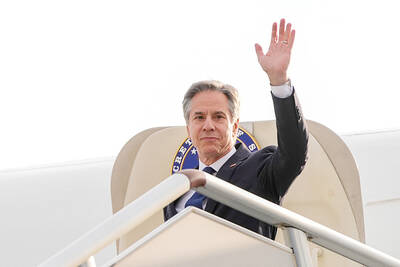
‘IN A DIFFERENT PLACE’: The envoy first visited Shanghai, where he attended a Chinese basketball playoff match, and is to meet top officials in Beijing tomorrow US Secretary of State Antony Blinken yesterday arrived in China on his second visit in a year as the US ramps up pressure on its rival over its support for Russia while also seeking to manage tensions with Beijing. The US diplomat tomorrow is to meet China’s top brass in Beijing, where he is also expected to plead for restraint as Taiwan inaugurates president-elect William Lai (賴清德), and to raise US concerns on Chinese trade practices. However, Blinken is also seeking to stabilize ties, with tensions between the world’s two largest economies easing since his previous visit in June last year. At the

UNSETTLING IMAGES: The scene took place in front of TV crews covering the Trump trial, with a CNN anchor calling it an ‘emotional and unbelievably disturbing moment’ A man who doused himself in an accelerant and set himself on fire outside the courthouse where former US president Donald Trump is on trial has died, police said yesterday. The New York City Police Department (NYPD) said the man was declared dead by staff at an area hospital. The man was in Collect Pond Park at about 1:30pm on Friday when he took out pamphlets espousing conspiracy theories, tossed them around, then doused himself in an accelerant and set himself on fire, officials and witnesses said. A large number of police officers were nearby when it happened. Some officers and bystanders rushed

Beijing is continuing to commit genocide and crimes against humanity against Uyghurs and other Muslim minorities in its western Xinjiang province, U.S. Secretary of State Antony Blinken said in a report published on Monday, ahead of his planned visit to China this week. The State Department’s annual human rights report, which documents abuses recorded all over the world during the previous calendar year, repeated language from previous years on the treatment of Muslims in Xinjiang, but the publication raises the issue ahead of delicate talks, including on the war in Ukraine and global trade, between the top U.S. diplomat and Chinese


 RSS
RSS