


As if facing the whine of the dentist's drill weren't ordeal enough, some Britons now have to stand in line for hours to get their teeth poked, prodded and pulled.
In a nation once infamous for the poor state of its teeth, hundreds of people recently lined up in one northeastern town hoping to sign up with the practice of a dentist newly recruited from the Netherlands.
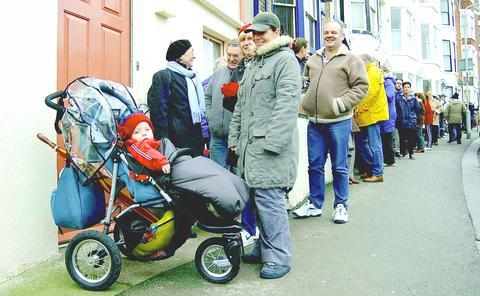
PHOTO: AP
Newspapers printed photos of a line that stretched around the block and said the scene in Scarborough, North Yorkshire, was reminiscent of World War II-era rationing.
Dentists are departing Britain's publicly funded National Health Service (NHS) in large numbers, leaving a growing number of Britons without access to affordable care.
The consequences for the nation's teeth cannot be good, the experts say.
"What's going on in Scarborough is a classic example of the NHS dentist system breaking down completely," said British Dental Association chairman Dr. John Renshaw, whose practice gets 3,000 inquiries a year from people wanting to register as new National Health Service patients.
A 2002 study by the independent Audit Commission found 40 percent of dentists were not accepting new patients through the state-funded system.
Dentists are available to those who can afford private treatment, but Britain's tradition of publicly funded healthcare means most people expect subsidized treatment. Only about 1 million of Britain's 60 million people have dental insurance.
Unlike medical care, NHS dental treatment is not free, but the cost is about a quarter of what private dentists charge and is capped at ?360 (US$670) per ailment.
The long line outside Dr. Arie Van Drie's Scarborough office was similar to a scene in Carmarthen, Wales, last summer, when more than 600 people lined up outside a dental practice advertising it would take 300 new public patients. News reports said some of those turned away made threatening and abusive calls to the office.
"It's a problem that's been building and building and building," said David Collins, of the British Dental Health Foundation. "There's an awful lot of people now who are only going for treatment ... when they feel that there's a problem, when it's an emergency."
Only 44 percent of adults and 60 percent of children are registered with an NHS dentist, government figures show. Most of the rest either pay for private care or simply do not go to the dentist.
Those who do not get annual checkups likely face big bills -- and aching jaws -- when problems finally demand treatment, Collins said.
Britons have long been the butt of jokes about bad teeth. Recently, the Austin Powers films and The Simpsons played humorously on the stereotype.
The British Dental Association says universities produce too few dentists each year -- about 800 -- and calls for that to be increased to 1,000.
Collins said the real problem was not a shortage of dentists, but an underfunded public service that drives many practitioners away.
Many dentists, he said, become frustrated because the NHS reimbursement system forces them to see too many patients too quickly and pays less than they can make in private practice. As a result, many NHS dentists now split their time with private patients.
"The problem is, without a lot more money being made available the problems of access are going to get worse rather than better," he said. "The future is tremendously uncertain."
Health Minister Rosie Winterton acknowledged a shortfall of NHS dentists but said US$170 million in new funding and a recruiting program for dentists abroad should ease the problem.
In the longer term, Winterton said a government plan to decentralize the dental service, handing more control to local authorities starting next year, would cut bureaucracy and boost service.
Winterton said Prime Minister Tony Blair's government was trying to reverse damage to the dental service under the Conservative Party administrations preceding it, which she said drove dentists out of the NHS by cutting their fees and closing two dental schools.
The NHS dental budget increased from about US$1.88 billion in 1998-1999 to US$2.25 billion in 2001-2002.
Blair has made improving Britain's ailing health service a top priority. While medical care has improved by many measures since he took office, complaints about long waiting lists and inadequate care still abound.
Blair promised in 1999 that all Britons would be able to see NHS dentists within two years, and political opponents point to the long waits in Scarborough as evidence he failed.
"Finding an NHS dentist is like finding a needle in a haystack," said Paul Burstow of the opposition Liberal Democrat party.
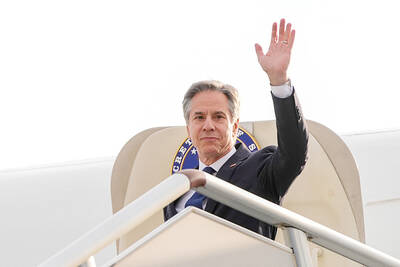
‘IN A DIFFERENT PLACE’: The envoy first visited Shanghai, where he attended a Chinese basketball playoff match, and is to meet top officials in Beijing tomorrow US Secretary of State Antony Blinken yesterday arrived in China on his second visit in a year as the US ramps up pressure on its rival over its support for Russia while also seeking to manage tensions with Beijing. The US diplomat tomorrow is to meet China’s top brass in Beijing, where he is also expected to plead for restraint as Taiwan inaugurates president-elect William Lai (賴清德), and to raise US concerns on Chinese trade practices. However, Blinken is also seeking to stabilize ties, with tensions between the world’s two largest economies easing since his previous visit in June last year. At the
Nearly half of China’s major cities are suffering “moderate to severe” levels of subsidence, putting millions of people at risk of flooding, especially as sea levels rise, according to a study of nationwide satellite data released yesterday. The authors of the paper, published by the journal Science, found that 45 percent of China’s urban land was sinking faster than 3mm per year, with 16 percent at more than 10mm per year, driven not only by declining water tables, but also the sheer weight of the built environment. With China’s urban population already in excess of 900 million people, “even a small portion

UNSETTLING IMAGES: The scene took place in front of TV crews covering the Trump trial, with a CNN anchor calling it an ‘emotional and unbelievably disturbing moment’ A man who doused himself in an accelerant and set himself on fire outside the courthouse where former US president Donald Trump is on trial has died, police said yesterday. The New York City Police Department (NYPD) said the man was declared dead by staff at an area hospital. The man was in Collect Pond Park at about 1:30pm on Friday when he took out pamphlets espousing conspiracy theories, tossed them around, then doused himself in an accelerant and set himself on fire, officials and witnesses said. A large number of police officers were nearby when it happened. Some officers and bystanders rushed
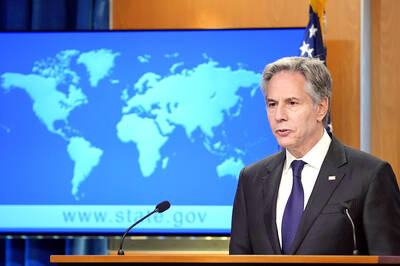
Beijing is continuing to commit genocide and crimes against humanity against Uyghurs and other Muslim minorities in its western Xinjiang province, U.S. Secretary of State Antony Blinken said in a report published on Monday, ahead of his planned visit to China this week. The State Department’s annual human rights report, which documents abuses recorded all over the world during the previous calendar year, repeated language from previous years on the treatment of Muslims in Xinjiang, but the publication raises the issue ahead of delicate talks, including on the war in Ukraine and global trade, between the top U.S. diplomat and Chinese


 RSS
RSS