


Jordan led a continuing attack on Israel's separation barrier at the world court on Tuesday, warning that the structure threatens the future stability of the kingdom.
With a parade of speakers denouncing Israel's actions in the West Bank, it appears the case could have implications for Israel's other occupational policies -- including settlements.
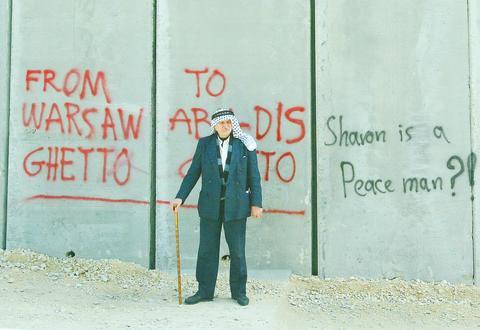
PHOTO: AP
Israel, which says the barrier is meant for self defense, declined to participate in the three-day hearing this week. It said sending the dispute to the court undermines peace negotiations, and also questioned the fairness of the court. The US and European nations have also avoided the hearings.
A total of 15 countries and organizations are participating, all of them sympathetic to the Palestinian case. Many of their arguments have taken aim not only at the barrier, but at Israel's 37-year occupation of the West Bank and Gaza Strip.
In an interview published Tuesday in the Israeli daily Yediot Ahronot, Prime Minister Ariel Sharon denounced the Hague process as "a campaign of hypocrisy."
"What is happening at The Hague is an attempt to deny Israel the right to defend itself," Sharon told the daily. "We will not give in. Israel will build the security fence and complete it."
Attention was focused Tuesday on Jordan, which controlled the West Bank before Israel captured it during the 1967 Mideast war. The hearings have raised tensions between the two neighbors, which signed a peace agreement in 1994.
Unlike other countries supporting the Palestinians this week, Jordan views the Israeli barrier as a direct threat, fearing the barrier will make life so hard for Palestinians that they will flee into the neighboring kingdom, straining its resources and upsetting a delicate demographic balance.
"With the exception of the Palestinians themselves, we feel we Jordanians are the ones who could be most affected by Israel's decision to place the wall where it has and where it intends to do so in the near future," Prince Zeid Al Hussein, head of the Jordanian delegation, told the court.
The hearing opened Monday, a day after a Palestinian suicide bomber in Jerusalem killed eight people. Israel has pointed to the attack as proof of the need for the barrier.
Al Hussein called the suicide bombings "horrific." But he also said they must be seen in the context of Israel's four-decade occupation of the West Bank and Gaza, which he called ``dominating ... and degrading'' to the Palestinian population.
Sir Arthur Watts, counsel for the Jordanians, attacked Israel's stance that the barrier is a temporary security measure.
Showing the justices a map of a proposed route of the barrier, he said the structure is meant to connect Israel proper with its settlements in the West Bank.
"The plan stretches for the most part well within the occupied territory," he said. "This wall is not primarily about the defense of Israel's territory."
"If the wall defends anything, it is ... the position of Israeli settlements in the occupied territories," he said, adding that there is "no right to self defense to that which is in itself unlawful."
Israel has built about one-quarter of the structure, a series of walls, fences, razor wire and trenches that could stretch 740km when complete. However, it has not made a decision on the final route of the barrier and has begun making small changes which it says are to ease the effect on Palestinian civilians.
Although the case is technically confined to issues surrounding the barrier, Watts' comments were the latest to question Israel's occupation policies. On Monday, Palestinian delegate Nasser Al-Kidwa told the tribunal the barrier is "about entrenching the occupation and the de facto annexation" of parts of the West Bank.
Speaking on the sidelines of the trial, Arab League secretary-general Amr Moussa accused Israel of trying to "annex territories." The 22-member league was scheduled to testify to the tribunal yesterday.
Daniel Taub, a legal adviser for the Israeli Foreign Ministry, accused the Palestinians of trying to do an end-run around the internationally backed "road map" peace plan.
"If they are really concerned about these broader issues, then we have an alternative mechanism to deal with them," Taub said.
The UN General Assembly asked the world court in December to give an advisory opinion on the matter. The court's rulings are not binding, but can be influential.
Whether the court will issue a clear-cut decision, however, remains in question.
Nearly half of China’s major cities are suffering “moderate to severe” levels of subsidence, putting millions of people at risk of flooding, especially as sea levels rise, according to a study of nationwide satellite data released yesterday. The authors of the paper, published by the journal Science, found that 45 percent of China’s urban land was sinking faster than 3mm per year, with 16 percent at more than 10mm per year, driven not only by declining water tables, but also the sheer weight of the built environment. With China’s urban population already in excess of 900 million people, “even a small portion

UNSETTLING IMAGES: The scene took place in front of TV crews covering the Trump trial, with a CNN anchor calling it an ‘emotional and unbelievably disturbing moment’ A man who doused himself in an accelerant and set himself on fire outside the courthouse where former US president Donald Trump is on trial has died, police said yesterday. The New York City Police Department (NYPD) said the man was declared dead by staff at an area hospital. The man was in Collect Pond Park at about 1:30pm on Friday when he took out pamphlets espousing conspiracy theories, tossed them around, then doused himself in an accelerant and set himself on fire, officials and witnesses said. A large number of police officers were nearby when it happened. Some officers and bystanders rushed

Beijing is continuing to commit genocide and crimes against humanity against Uyghurs and other Muslim minorities in its western Xinjiang province, U.S. Secretary of State Antony Blinken said in a report published on Monday, ahead of his planned visit to China this week. The State Department’s annual human rights report, which documents abuses recorded all over the world during the previous calendar year, repeated language from previous years on the treatment of Muslims in Xinjiang, but the publication raises the issue ahead of delicate talks, including on the war in Ukraine and global trade, between the top U.S. diplomat and Chinese

HYPOCRISY? The Chinese Ministry of Foreign Affairs yesterday asked whether Biden was talking about China or the US when he used the word ‘xenophobic’ US President Joe Biden on Wednesday called for a hike in steel tariffs on China, accusing Beijing of cheating as he spoke at a campaign event in Pennsylvania. Biden accused China of xenophobia, too, in a speech to union members in Pittsburgh. “They’re not competing, they’re cheating. They’re cheating and we’ve seen the damage here in America,” Biden said. Chinese steel companies “don’t need to worry about making a profit because the Chinese government is subsidizing them so heavily,” he said. Biden said he had called for the US Trade Representative to triple the tariff rates for Chinese steel and aluminum if Beijing was


 RSS
RSS