


The dispute between Pyongyang and Washington over the extent of North Korea's nuclear capabilities is threatening to disrupt chances of progress at six-nation talks next week.
The disagreement centers on North Korea's denial of a US claim that it has a uranium-based weapons program, though South Korea's Yonhap news agency reported yesterday that the North had conveyed its willingness to discuss the issue with Washington.
"We understand that North Korea recently told the government of a third country that it is willing to discuss the HEU issue with the United States," Yonhap quoted a high-ranking government source as saying.
The official said North Korea did not admit having a highly enriched uranium, or HEU, program.
Officials at the South Korea's Foreign Ministry and presidential office were unable to confirm the Yonhap report.
Undersecretary of State John Bolton, meeting with Japanese officials in Tokyo, warned Wednesday that North Korea's denial that it has a uranium program could hurt efforts to resolve the crisis.
"I think North Korea's unwillingness to discuss the uranium enrichment program could subvert President [George W.] Bush's determination for a peaceful, diplomatic resolution of the North Korean issue," Bolton said in an interview with Japanese public broadcaster NHK.
The questions about North Korea's nuclear` capabilities are expected to overshadow the six-party talks in Beijing that begin next Wednesday with China, Japan, Russia and South Korea also taking part.
North Korea has a plutonium-based nuclear program. But there's uncertainty about whether North Korea has made nuclear weapons and whether they can mount them on a missile and fire them.
The plutonium program is believed to be more of an immediate threat than the alleged uranium one, which does not require large-scale, easily detectable facilities and could require at least several years of operation before it can produce a bomb.
US officials believe North Korea has at least one or two nuclear bombs from plutonium, though some experts believe Pyongyang does not have the technology and resources to mount a nuclear warhead on a missile.
The recent confession of Abdul Qadeer Khan, Pakistan's proliferator of nuclear secrets, suggests North Korea's uranium program "is of longer duration and more advanced than we had assessed," US Assistant Secretary of State James Kelly said last week in Washington.
North Korea denies receiving nuclear secrets from Pakistan.
"There is no agreed estimate of anything," said Leon Sigal, a North Korea expert. "As with Iraq, there is significant disagreement in the intelligence community about pieces of this."
North Korea will likely try to capitalize on the uncertainty, brandishing the threat of what it vaguely describes as its "nuclear deterrent" in an effort to extract concessions.
US negotiators will likely hold firm, demanding that North Korea dismantle all nuclear projects in a verifiable, irreversible way.
A resolution is possible if the two adversaries move toward a step-by-step process under which North Korea -- perhaps the most secretive country in the world -- allows unprecedented access to its most guarded sites, and the US and its allies provide sweeping security assurances and economic aid.
Pyongyang might pursue two tracks: offer to freeze activities at its plutonium-based site at Yongbyon in exchange for concessions, and persist in denying or downplaying claims it has a uranium-based program. It could also attack the credibility of US intelligence following the failure to find weapons of mass destruction in Iraq.
North Korea might feel emboldened by reports that China, a traditional ally of Pyongyang, has not accepted the US contention that the North has a uranium program. However, China wants the Korean Peninsula to be free of nuclear weapons and could pressure the North to curtail its belligerence.
Some security analysts believe the mystery will put pressure on the US to be more explicit about what it knows.
"Unless the US introduces a high-level defector with certain knowledge of the North Korean [uranium program] locations, or can send the IAEA or other inspectors to the right place, US intelligence credibility will not be reinforced," said Larry Wortzel, a former US military attache in Beijing and now an analyst at the Heritage Foundation in Washington.
North Korea expelled inspectors of the International Atomic Energy Agency, or IAEA, from frozen nuclear facilities at Yongbyon after US officials alleged that the North admitted it had a uranium-based program in late 2002.
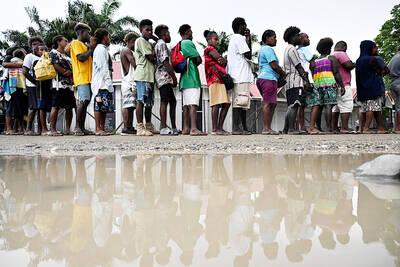
SEEKING CHANGE: A hospital worker said she did not vote in previous elections, but ‘now I can see that maybe my vote can change the system and the country’ Voting closed yesterday across the Solomon Islands in the south Pacific nation’s first general election since the government switched diplomatic allegiance from Taiwan to Beijing and struck a secret security pact that has raised fears of the Chinese navy gaining a foothold in the region. The Solomon Islands’ closer relationship with China and a troubled domestic economy weighed on voters’ minds as they cast their ballots. As many as 420,000 registered voters had their say across 50 national seats. For the first time, the national vote also coincided with elections for eight of the 10 local governments. Esther Maeluma cast her vote in the
Nearly half of China’s major cities are suffering “moderate to severe” levels of subsidence, putting millions of people at risk of flooding, especially as sea levels rise, according to a study of nationwide satellite data released yesterday. The authors of the paper, published by the journal Science, found that 45 percent of China’s urban land was sinking faster than 3mm per year, with 16 percent at more than 10mm per year, driven not only by declining water tables, but also the sheer weight of the built environment. With China’s urban population already in excess of 900 million people, “even a small portion

UNSETTLING IMAGES: The scene took place in front of TV crews covering the Trump trial, with a CNN anchor calling it an ‘emotional and unbelievably disturbing moment’ A man who doused himself in an accelerant and set himself on fire outside the courthouse where former US president Donald Trump is on trial has died, police said yesterday. The New York City Police Department (NYPD) said the man was declared dead by staff at an area hospital. The man was in Collect Pond Park at about 1:30pm on Friday when he took out pamphlets espousing conspiracy theories, tossed them around, then doused himself in an accelerant and set himself on fire, officials and witnesses said. A large number of police officers were nearby when it happened. Some officers and bystanders rushed

HYPOCRISY? The Chinese Ministry of Foreign Affairs yesterday asked whether Biden was talking about China or the US when he used the word ‘xenophobic’ US President Joe Biden on Wednesday called for a hike in steel tariffs on China, accusing Beijing of cheating as he spoke at a campaign event in Pennsylvania. Biden accused China of xenophobia, too, in a speech to union members in Pittsburgh. “They’re not competing, they’re cheating. They’re cheating and we’ve seen the damage here in America,” Biden said. Chinese steel companies “don’t need to worry about making a profit because the Chinese government is subsidizing them so heavily,” he said. Biden said he had called for the US Trade Representative to triple the tariff rates for Chinese steel and aluminum if Beijing was


 RSS
RSS