


Money illicitly siphoned from the UN oil-for-food program by former Iraqi president Saddam Hussein was used to finance anti-sanctions campaigns run by British politicians, according to documents that have surfaced in Baghdad.
Undercover cash from oil deals went to three businessmen, who in turn supported pressure groups involving the ex-Labour member of parliament (MP) George Galloway, Labour MP Tam Dalyell and the former Irish premier Albert Reynolds, according to allegations in documents compiled by the oil ministry, now under the control of the US occupation regime.
Separately, a dossier from the oil ministry in Baghdad has been handed by the British Foreign Office to Customs and Excise, which has been asked to investigate. They were also referred to the Cabinet Office because of their political sensitivity.
"The government has been given copies of certain documents [from Iraq]," a Foreign Office spokeswoman said yesterday. "They are being passed to the appropriate authorities for consideration."
Two of the three businessmen involved in UK campaigns, Burhan al-Chalabi and Riad al-Tajir, were based in Surrey; the other, Fawwaz Zureikat, a Jordanian entrepreneur, had offices in London.
Chalabi and Zureikat gave money to the Mariam Appeal, run by Galloway, the MP confirmed. Tahir said he ran another anti-sanctions campaign called Friendship Across Borders, which had Dalyell as its official patron and which organized visits to Baghdad by supportive politicians.
The three businessmen are alleged to have received money from Saddam via oil allocations. They sold the oil rights at a profit of more than US$1 million in an exploitation by Saddam of loopholes in the UN's then oil-for-food program.
Tahir agrees he profited from the oil deals. Chalabi refuses to comment. Zureikat confirmed to AFP in Jordan last week that he had made the oil deals.
The contents of the new documents shed light on Galloway's libel battle with the Daily Telegraph.
Last year newspaper reports based on purported Iraqi intelligence files led to Galloway being accused of receiving ?375,000 (US$708,000) annually in secret personal payments from Saddam.
Investigations in Iraq, New York, Paris, Moscow and London indicate the new British-related documents are authentic, although their meaning is not always clear.
These files do not implicate Galloway in personal corruption. Nor do they suggest that Dalyell and Reynolds, who always paid their own way, had any knowledge of what was going on.
Galloway said he was unaware that his financial sponsors had been getting oil cash from the UN program.
But he accepts that he knew his supporters had links with the regime, and regarded that as an inevitable price to pay.

Republican US lawmakers on Friday criticized US President Joe Biden’s administration after sanctioned Chinese telecoms equipment giant Huawei unveiled a laptop this week powered by an Intel artificial intelligence (AI) chip. The US placed Huawei on a trade restriction list in 2019 for contravening Iran sanctions, part of a broader effort to hobble Beijing’s technological advances. Placement on the list means the company’s suppliers have to seek a special, difficult-to-obtain license before shipping to it. One such license, issued by then-US president Donald Trump’s administration, has allowed Intel to ship central processors to Huawei for use in laptops since 2020. China hardliners

Conjoined twins Lori and George Schappell, who pursued separate careers, interests and relationships during lives that defied medical expectations, died this month in Pennsylvania, funeral home officials said. They were 62. The twins, listed by Guinness World Records as the oldest living conjoined twins, died on April 7 at the Hospital of the University of Pennsylvania, obituaries posted by Leibensperger Funeral Homes of Hamburg said. The cause of death was not detailed. “When we were born, the doctors didn’t think we’d make 30, but we proved them wrong,” Lori said in an interview when they turned 50, the Philadelphia Inquirer reported. The
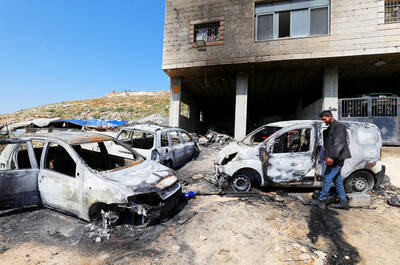
RAMPAGE: A Palestinian man was left dead after dozens of Israeli settlers searching for a missing 14-year-old boy stormed a village in the Israeli-occupied West Bank US President Joe Biden on Friday said he expected Iran to attack Israel “sooner, rather than later” and warned Tehran not to proceed. Asked by reporters about his message to Iran, Biden simply said: “Don’t,” underscoring Washington’s commitment to defend Israel. “We are devoted to the defense of Israel. We will support Israel. We will help defend Israel and Iran will not succeed,” he said. Biden said he would not divulge secure information, but said his expectation was that an attack could come “sooner, rather than later.” Israel braced on Friday for an attack by Iran or its proxies as warnings grew of

A prominent Christian leader has allegedly been stabbed at the altar during a Mass yesterday in southwest Sydney. Bishop Mar Mari Emmanuel was saying Mass at Christ The Good Shepherd Church in Wakeley just after 7pm when a man approached him at the altar and allegedly stabbed toward his head multiple times. A live stream of the Mass shows the congregation swarm forward toward Emmanuel before it was cut off. The church leader gained prominence during the COVID-19 pandemic, amassing a large online following, Officers attached to Fairfield City police area command attended a location on Welcome Street, Wakeley following reports a number


 RSS
RSS