


A group of developing countries rejected the science driving the UN's effort to fight obesity worldwide, saying the dietary recommendations are based on flawed research and "not worthy of serious consideration."
The scientific report underpinning the global obesity strategy recommends that countries strive to limit their people's intake of sugar and fat while encouraging increased consumption of fruits and vegetables. The report, which has been heavily criticized by the sugar industry, was being reviewed on Monday by a key committee of the UN Food and Agriculture Organization.
Worried that changes in eating patterns could harm agriculture, the Colombian delegation, speaking on behalf of the G77 group of developing nations and China, told the agency on Monday that the report was shoddy and that the answer was better nutrition education, not arbitrary limits of specific types of food. That argument mirrors what sugar and other food industry representatives contend.
The UN food organization, together with another UN agency, the World Health Organization (WHO), is building an unprecedented strategy aimed at reducing the worldwide burden of obesity-linked diseases such as diabetes, heart disease and cancer. The scientific report behind the strategy is considered to be the most significant statement in more than a decade on what the world should be doing about its diet.
The strategy, which is supposed to be finalized in May at the annual meeting of the governing body of the WHO, was launched in response to a mass of evidence that illnesses caused by bad diet and lack of exercise are no longer just the preserve of the Western world.
The proposals to governments include pushing manufacturers to make deeper cuts in fat, sugar and salt content and changes to advertising and tax policy to promote healthier eating.
The International Obesity Task Force, an independent expert group whose chair headed the scientific panel, stood by the findings and said criticisms were a ploy to delay adoption of the plan.
The US, which has been accused of kowtowing to the food industry, welcomed the strategy at a key UN meeting last month but asked that governments be given a further month to examine it and comment on it before it is adopted.
At the time, US Health and Human Services Secretary Tommy Thompson said the extra month was needed to ensure there was "more scientifically-based evidence in the guidelines."
The US delegation did not speak on the scientific report at the meeting in Rome, other than to say that "the United States supports limiting intake of ... sugar in the United States. However, numeric goals should be associated with individual intake and supported by a scientific basis."
objections
The objections by the G77 and China mark the first time that developing countries have publicly attacked the recommendations.
"For the sake of better nutrition and health safety, the members of the G77 are open to proposals for changes in the prevailing diets, provided that such proposals are science-based ... causing no harm to the prevailing food production system, food processing and food trading practices," the Colombian delegation said.
"Regretfully, it is the view of the G77 that the ... report fails the test of scientific rigor, objectivity and fairness," the group said. "Any uniform or `one size fits all' diet is an illusory concept and not worthy of serious consideration."
"It labels various food items as good and bad. It concludes, without any scientific evidence, that bad food is the main cause of chronic diseases. This arbitrary conclusion, apart from its shaky scientific foundation, is indeed prejudicial," the countries said.
They urged the Food and Agriculture Organization to seek the opinion of member nations on the report and not to take any further action until responses are in.
The group also said it was not convinced by an analysis by the UN agency of how the obesity plan would affect agriculture and food processing.
A particularly contentious recommendation advises that people keep their sugar intake to less than 10 percent of calories. This has sparked concerns that such advice might harm sugar producers and the food industry.
The Food and Agriculture Organization concluded that may not necessarily be so, overall.
If all of the 93 countries where sugar intake accounts for more than 10 percent of daily calories were to meet the target, the reduction in world consumption of sugar would be about 15 percent, it calculated.
"On the other hand, if all 85 countries where consumption is below the 10 percent mark were to increase consumption, the implied increase would more than compensate for the reduction in the `above 10 percent' countries," it said.
The Food and Agriculture Organization also noted that the dietary recommendations could be a bonanza for fruit and vegetable production, particularly in developing countries that can switch from sugar crops. The global plan advises that countries aim to get their people eating at least 400g a day.
Outside the meeting, Don Mitchell, an economist at the World Bank, said the increase in fruit and vegetable production could swamp any loss in sugar production.
With a note of reassurance for the agriculture industry, the Food and Agriculture Organization said that any major immediate response to the recommendations is unlikely on a global scale.
"The evidence to date indicates that -- apart from the experience of food safety scares -- dietary recommendations made in the past to reduce intake of sugar and fat, for example, have had only a limited impact on consumption," it said.

‘IN A DIFFERENT PLACE’: The envoy first visited Shanghai, where he attended a Chinese basketball playoff match, and is to meet top officials in Beijing tomorrow US Secretary of State Antony Blinken yesterday arrived in China on his second visit in a year as the US ramps up pressure on its rival over its support for Russia while also seeking to manage tensions with Beijing. The US diplomat tomorrow is to meet China’s top brass in Beijing, where he is also expected to plead for restraint as Taiwan inaugurates president-elect William Lai (賴清德), and to raise US concerns on Chinese trade practices. However, Blinken is also seeking to stabilize ties, with tensions between the world’s two largest economies easing since his previous visit in June last year. At the
Nearly half of China’s major cities are suffering “moderate to severe” levels of subsidence, putting millions of people at risk of flooding, especially as sea levels rise, according to a study of nationwide satellite data released yesterday. The authors of the paper, published by the journal Science, found that 45 percent of China’s urban land was sinking faster than 3mm per year, with 16 percent at more than 10mm per year, driven not only by declining water tables, but also the sheer weight of the built environment. With China’s urban population already in excess of 900 million people, “even a small portion

UNSETTLING IMAGES: The scene took place in front of TV crews covering the Trump trial, with a CNN anchor calling it an ‘emotional and unbelievably disturbing moment’ A man who doused himself in an accelerant and set himself on fire outside the courthouse where former US president Donald Trump is on trial has died, police said yesterday. The New York City Police Department (NYPD) said the man was declared dead by staff at an area hospital. The man was in Collect Pond Park at about 1:30pm on Friday when he took out pamphlets espousing conspiracy theories, tossed them around, then doused himself in an accelerant and set himself on fire, officials and witnesses said. A large number of police officers were nearby when it happened. Some officers and bystanders rushed
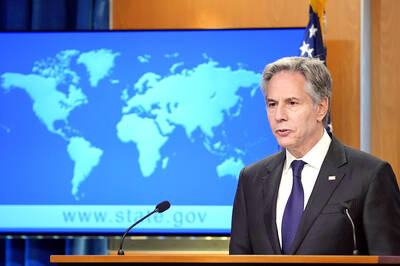
Beijing is continuing to commit genocide and crimes against humanity against Uyghurs and other Muslim minorities in its western Xinjiang province, U.S. Secretary of State Antony Blinken said in a report published on Monday, ahead of his planned visit to China this week. The State Department’s annual human rights report, which documents abuses recorded all over the world during the previous calendar year, repeated language from previous years on the treatment of Muslims in Xinjiang, but the publication raises the issue ahead of delicate talks, including on the war in Ukraine and global trade, between the top U.S. diplomat and Chinese


 RSS
RSS