


US President George W. Bush gave CIA director George Tenet a vote of confidence on Saturday and said his job was not in jeopardy, despite flaws in US prewar intelligence on Iraq.
"I strongly believe the CIA is ably led by George Tenet," Bush was quoted as saying in a transcript from an interview with NBC's Meet the Press.
Asked by moderator Tim Russert if Tenet's job was at risk, Bush replied, "No, not at all, not at all."
The hour-long interview, which was taped on Saturday, was to air yesterday morning. Excerpts of it were released ahead of time.
Democrats vying to challenge Bush for the presidency in the November election have seized on the administration's failure to find weapons of mass destruction in Iraq. Such weapons were a main reason Bush cited for the Iraq war, in which more than 500 US troops have died.
To try to quell some of the criticism, Bush on Friday named a commission to investigate failures in the Iraq intelligence.
Some Republicans have been eager to blame Tenet for the intelligence failures as way of trying to shield the White House. But Bush's comments indicated the White House does not favor that strategy, which could carry risks for him in an election year.
Tenet has staunchly defended Bush against critics who said the White House pressured intelligence analysts to skew their findings to bolster the case for war.
Republicans said Bush's decision to grant an interview with Russert, known as a tough questioner, was part of an effort to fight back against weeks of Democratic attack.
Asked if he thought the war and the lives lost in it were worth it even though no weapons were found, Bush said he felt the war was justified.
"Saddam Hussein was dangerous ... He had the ability to make weapons at the very minimum," Bush said.
The president defended his decision to ask the new commission on US intelligence to report back in March next year -- five months after the presidential election.
Democrats want the information sooner.
But Bush, who gave the commission a broad mandate that will include the study of intelligence about North Korea, Iran and other countries in addition to Iraq, said the panel should not be "hurried."
Bush said the commission's work could look into such cases as the Pakistani scientist Abdul Qadeer Khan who admitted leading a network to sell nuclear-weapons technology to other countries.
"This is a strategic look, a big-picture look," Bush said.
Many Democrats have criticized the decision to sketch out such a broad mandate for the commission, which they said should focus squarely on Iraq and include in its scope a look into whether the Bush administration hyped the intelligence.
Asked if he would testify before the commission, Bush said: "I will be glad to visit with them. I will be glad to share with them knowledge."
Nearly half of China’s major cities are suffering “moderate to severe” levels of subsidence, putting millions of people at risk of flooding, especially as sea levels rise, according to a study of nationwide satellite data released yesterday. The authors of the paper, published by the journal Science, found that 45 percent of China’s urban land was sinking faster than 3mm per year, with 16 percent at more than 10mm per year, driven not only by declining water tables, but also the sheer weight of the built environment. With China’s urban population already in excess of 900 million people, “even a small portion

UNSETTLING IMAGES: The scene took place in front of TV crews covering the Trump trial, with a CNN anchor calling it an ‘emotional and unbelievably disturbing moment’ A man who doused himself in an accelerant and set himself on fire outside the courthouse where former US president Donald Trump is on trial has died, police said yesterday. The New York City Police Department (NYPD) said the man was declared dead by staff at an area hospital. The man was in Collect Pond Park at about 1:30pm on Friday when he took out pamphlets espousing conspiracy theories, tossed them around, then doused himself in an accelerant and set himself on fire, officials and witnesses said. A large number of police officers were nearby when it happened. Some officers and bystanders rushed
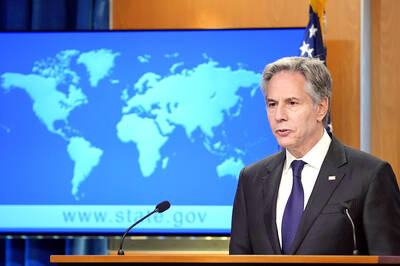
Beijing is continuing to commit genocide and crimes against humanity against Uyghurs and other Muslim minorities in its western Xinjiang province, U.S. Secretary of State Antony Blinken said in a report published on Monday, ahead of his planned visit to China this week. The State Department’s annual human rights report, which documents abuses recorded all over the world during the previous calendar year, repeated language from previous years on the treatment of Muslims in Xinjiang, but the publication raises the issue ahead of delicate talks, including on the war in Ukraine and global trade, between the top U.S. diplomat and Chinese

HYPOCRISY? The Chinese Ministry of Foreign Affairs yesterday asked whether Biden was talking about China or the US when he used the word ‘xenophobic’ US President Joe Biden on Wednesday called for a hike in steel tariffs on China, accusing Beijing of cheating as he spoke at a campaign event in Pennsylvania. Biden accused China of xenophobia, too, in a speech to union members in Pittsburgh. “They’re not competing, they’re cheating. They’re cheating and we’ve seen the damage here in America,” Biden said. Chinese steel companies “don’t need to worry about making a profit because the Chinese government is subsidizing them so heavily,” he said. Biden said he had called for the US Trade Representative to triple the tariff rates for Chinese steel and aluminum if Beijing was


 RSS
RSS