


Rescue workers sifted through debris and rubble as strong aftershocks jolted Indonesia's West Papua province yesterday following two massive quakes that killed up to 34 people and injured hundreds.
Frightened residents were awaken in their makeshift tents at 6:27am local time by a 5.3-magnitude aftershock, said the Meteorological and Geophysics Agency. Eight other aftershocks with magnitudes ranging from 2 to 3 were also recorded yesterday, it said.
The death toll from two powerful earthquakes that struck the region Friday and Saturday "was in the thirties," senior welfare minister, Jusuf Kalla, told the privately owned El-Shinta radio in Jakarta.
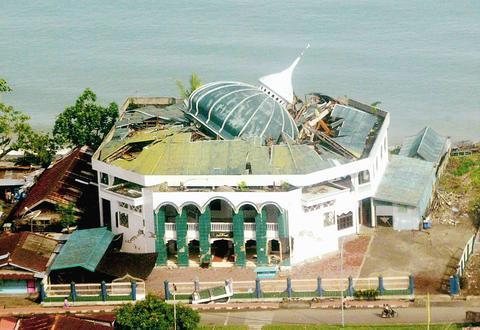
PHOTO: AP
Most people died under collapsed buildings in Nabire, which has a population of 26,000, Kalla said. A local hospital spokeswoman put the death toll at 34.
The quakes cracked the walls of schools, public buildings and damaged a bridge and an airport tarmac. A church tower crashed to the ground and a mosque's silver dome caved in.
"Most buildings built with cement are ruined and need to be fixed, but sending food is more urgent," Kalla said.
The government will send 50 tonnes of rice to the victims soon, said Kalla, who visited Nabire Saturday.
On yesterday workers combed through the wreckage in Nabire to find more victims. They say it could be days before reports of damage and death in remote villages could be confirmed.
"It's hard. We need a helicopter to look in some of the hard-to-reach villages near forests surrounding Nabire," said Frans Ayomis, the head of the local search and rescue team.
A team of doctors from the provincial capital Jayapura treated patients outside the badly damaged Nabire hospital. Hospital workers and local officials said hundreds of people have been injured.
Workers, afraid the hospital would collapse, set up dozens of beds under tents. Used syringes, blood-soaked cotton balls and plastic bottles littered the ground.
Jakarta officials Saturday said they did not expect the death toll to rise further. Houses in the more remote part of the mountainous region were mostly built from wood, bamboo and thatch, and it was unlikely that any more victims were trapped under debris.
The US Geological Survey gave a preliminary magnitude of 7.1 for Saturday's quake, which occurred near Nabire, while Geoscience Australia said it was magnitude 7.2.
However, Indonesia's Meteorology and Geophysics agency, however, recorded the temblor at 6.2. Seismologists said they believed the discrepancy in magnitudes was due to differences in the calibration of equipment and methods used.
A total of 33 aftershocks have rattled the region since Friday.
With the Nabire airport badly damaged and its runway cracked, relief groups were forced to depend on light planes to deliver much-needed supplies.
Nabire is on the northern coast of Papua, 3,200km northeast of Jakarta. The province, formerly known as Irian Jaya, occupies the western half of New Guinea island.
Papua sits astride the meeting point of two of the plates which make up the earth's crust, and the province is one of the most seismological active areas in the world.
Indonesia, a sprawling archipelago of 17,000 islands, is also prone to earthquakes because of its location on the so-called Pacific "Ring of Fire" -- volcanic arcs and oceanic trenches partly encircling the Pacific Basin.

‘IN A DIFFERENT PLACE’: The envoy first visited Shanghai, where he attended a Chinese basketball playoff match, and is to meet top officials in Beijing tomorrow US Secretary of State Antony Blinken yesterday arrived in China on his second visit in a year as the US ramps up pressure on its rival over its support for Russia while also seeking to manage tensions with Beijing. The US diplomat tomorrow is to meet China’s top brass in Beijing, where he is also expected to plead for restraint as Taiwan inaugurates president-elect William Lai (賴清德), and to raise US concerns on Chinese trade practices. However, Blinken is also seeking to stabilize ties, with tensions between the world’s two largest economies easing since his previous visit in June last year. At the
Nearly half of China’s major cities are suffering “moderate to severe” levels of subsidence, putting millions of people at risk of flooding, especially as sea levels rise, according to a study of nationwide satellite data released yesterday. The authors of the paper, published by the journal Science, found that 45 percent of China’s urban land was sinking faster than 3mm per year, with 16 percent at more than 10mm per year, driven not only by declining water tables, but also the sheer weight of the built environment. With China’s urban population already in excess of 900 million people, “even a small portion

UNSETTLING IMAGES: The scene took place in front of TV crews covering the Trump trial, with a CNN anchor calling it an ‘emotional and unbelievably disturbing moment’ A man who doused himself in an accelerant and set himself on fire outside the courthouse where former US president Donald Trump is on trial has died, police said yesterday. The New York City Police Department (NYPD) said the man was declared dead by staff at an area hospital. The man was in Collect Pond Park at about 1:30pm on Friday when he took out pamphlets espousing conspiracy theories, tossed them around, then doused himself in an accelerant and set himself on fire, officials and witnesses said. A large number of police officers were nearby when it happened. Some officers and bystanders rushed

Beijing is continuing to commit genocide and crimes against humanity against Uyghurs and other Muslim minorities in its western Xinjiang province, U.S. Secretary of State Antony Blinken said in a report published on Monday, ahead of his planned visit to China this week. The State Department’s annual human rights report, which documents abuses recorded all over the world during the previous calendar year, repeated language from previous years on the treatment of Muslims in Xinjiang, but the publication raises the issue ahead of delicate talks, including on the war in Ukraine and global trade, between the top U.S. diplomat and Chinese


 RSS
RSS