


With convincing wins in five of seven Democratic nominating contests on Tuesday, Senator John Kerry demonstrated broad nationwide support for his presidential drive even if he failed to shut down his southern rival John Edwards.
Political analysts said Kerry was firmly on track for the nomination despite Edwards' solid win in the key southern state of South Carolina and former NATO commander Wesley Clark's narrow triumph in Oklahoma, in the southwest.
"Kerry is still in the driving seat nationally," said Bruce Ransom, a professor of political science at Clemson University in South Carolina. Larry Sabato, director of the Center for Politics at the University of Virginia, said only an "enormous gaffe" could derail him.
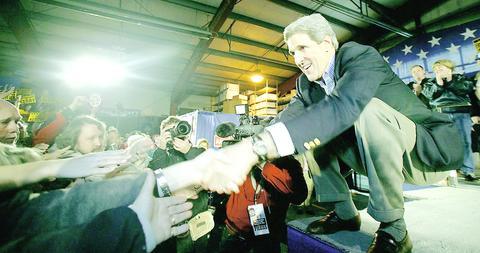
PHOTO: EPA
Most impressive, the analysts said, was the geographical reach of Kerry's wins, from the eastern state of Delaware, through North Dakota in the north, Missouri in the midwest and Arizona and New Mexico in the southwest.
"Let's keep it in perspective: Kerry ... has won now in every region of the country," Sabato said.
"John Edwards has won just in the south. That's not a national base," he said.
Pundits said Edwards, from North Carolina, had to show more than regional drawing power to have a serious shot at the nomination to face Republican President George W. Bush in November.
"If he wants to be competitive with Kerry, he has to show he can win outside his own backyard, and not just stick with the Southern boy image," Ransom said. The same argument went for Clark who won in a state just next door to his native Arkansas.
Edwards and Clark were fighting to keep their candidacies alive at least until "Super Tuesday" on March 2, when 10 states holding more than half the 2,162 delegates needed for the nomination will be up for grabs.
But the analysts warned that rank-and-file party members were eager to rally around a single candidate and begin the real fight for the White House.
"Democrats ... want to shut this down and get focused on Bush, and they're not going to be terribly patient with candidates who carry on the fight," Sabato said.
While Kerry was riding high after tacking on Tuesday's victories to previous wins in Iowa and New Hampshire, former Vermont governor Howard Dean's dismal performance provided further proof that his once high-flying campaign was out of gas.
His last hope is winning one of two contests to be held this weekend in the midwest state of Michigan and Washington in the northwest.
"Dean is going to have to get out if he wins nothing this weekend. He can't go on," Sabato said.
Despite frequent assertions that he would not seek the No. 2 slot on the Democratic ticket, experts said that Edwards' showing on Tuesday underscored the strength he could bring as Kerry's vice presidential running mate.
"I think Kerry is not unhappy that Edwards won," Sabato said.
Kerry "may be auditioning [Edwards] for veep [vice president] and he wants him to win some southern states so that he can say, `You see? I'm paying attention to the south ... that's why I've picked a southerner.'"
But Charles Jones, of the Brookings Institution, said that despite being a fierce campaigner and a compelling speaker, Edwards is still too unproven to appear on the national ticket.
"Edwards is not known nationally. He's had [just] five years experience in the Senate," Jones said.
"As someone has said, `he's cute, but so are a lot of other people,'" he added.

Republican US lawmakers on Friday criticized US President Joe Biden’s administration after sanctioned Chinese telecoms equipment giant Huawei unveiled a laptop this week powered by an Intel artificial intelligence (AI) chip. The US placed Huawei on a trade restriction list in 2019 for contravening Iran sanctions, part of a broader effort to hobble Beijing’s technological advances. Placement on the list means the company’s suppliers have to seek a special, difficult-to-obtain license before shipping to it. One such license, issued by then-US president Donald Trump’s administration, has allowed Intel to ship central processors to Huawei for use in laptops since 2020. China hardliners

Conjoined twins Lori and George Schappell, who pursued separate careers, interests and relationships during lives that defied medical expectations, died this month in Pennsylvania, funeral home officials said. They were 62. The twins, listed by Guinness World Records as the oldest living conjoined twins, died on April 7 at the Hospital of the University of Pennsylvania, obituaries posted by Leibensperger Funeral Homes of Hamburg said. The cause of death was not detailed. “When we were born, the doctors didn’t think we’d make 30, but we proved them wrong,” Lori said in an interview when they turned 50, the Philadelphia Inquirer reported. The
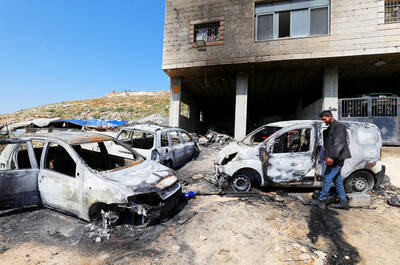
RAMPAGE: A Palestinian man was left dead after dozens of Israeli settlers searching for a missing 14-year-old boy stormed a village in the Israeli-occupied West Bank US President Joe Biden on Friday said he expected Iran to attack Israel “sooner, rather than later” and warned Tehran not to proceed. Asked by reporters about his message to Iran, Biden simply said: “Don’t,” underscoring Washington’s commitment to defend Israel. “We are devoted to the defense of Israel. We will support Israel. We will help defend Israel and Iran will not succeed,” he said. Biden said he would not divulge secure information, but said his expectation was that an attack could come “sooner, rather than later.” Israel braced on Friday for an attack by Iran or its proxies as warnings grew of

A prominent Christian leader has allegedly been stabbed at the altar during a Mass yesterday in southwest Sydney. Bishop Mar Mari Emmanuel was saying Mass at Christ The Good Shepherd Church in Wakeley just after 7pm when a man approached him at the altar and allegedly stabbed toward his head multiple times. A live stream of the Mass shows the congregation swarm forward toward Emmanuel before it was cut off. The church leader gained prominence during the COVID-19 pandemic, amassing a large online following, Officers attached to Fairfield City police area command attended a location on Welcome Street, Wakeley following reports a number


 RSS
RSS