


Intelligence officials have long been wary of outsiders' second-guessing. But they have reluctantly begun to acknowledge that a major overhaul could be in order after what may be two of the greatest intelligence setbacks in decades: the failure to anticipate the Sept. 11 attacks and the misjudgment of Iraq's weapons stockpiles. They hope the independent commission that US President George W. Bush will appoint can offer them more help and less finger pointing.
Within the CIA in particular, the words "intelligence review" still conjure bitter memories from the 1970s and the congressional inquiry by the committee headed by Senator Frank Church, whose effort to unearth abuses and impose reforms is remembered by many as an inquisition.
The kinds of solutions recommended for spy agencies by congressional panels and blue-ribbon commissions have been derided, then and since, by many intelligence professionals as naive or unworkable.
"Unless we're prepared for another intelligence failure, we need to get about the business of improving our intelligence service," said Representative Porter Goss, who, as chairman of the House Intelligence Committee and as a former spy, is perhaps the CIA's most important ally on Capitol Hill.
Goss is among those who have argued that any new intelligence inquiry should look forward, rather than dwell on any past mistakes.
That approach, of course, is the most politically palatable one, and it is the one that raises fewest hackles among intelligence professionals.
Others, including Senator John Rockefeller IV, the top Democrat on the Senate Intelligence Committee, have made clear that they will seek to ensure that any inquiry takes the Bush administration to task for building what they call a flawed case that the US needed to act quickly to wage war against Iraq.
But Goss and others will argue that an inquiry ought to lead Americans to understand that intelligence gathering and analysis is, at best, an imperfect science.
"The intelligence community will never bat 1,000; it can't get there," Goss said in an interview on Friday. "We've been watching too many James Bond movies, to think it always comes out all right in the end. It doesn't."
To critics of the nation's spy agencies, George Tenet, the director of central intelligence, will present the biggest target in any inquiry. On his watch, one of the longest in the history of the agency, the CIA and its sister agencies have failed to forecast nuclear weapons tests by Pakistan and India, and have apparently misread the dangers posed by terrorism and Iraq.
Still, many senior intelligence officials argue that Tenet and his successors really need more power, not less, to oversee the work of some 15 rival agencies, and more independence to make judgments without being guided by the White House.
One option sure to be addressed by the new commission is one already under review by the independent panel looking into the Sept. 11 attacks. The idea is to establish a single director of national intelligence, appointed to a fixed term of office like the current FBI chief, and give that director real authority over bodies like the Defense Intelligence Agency and the National Security Agency, which now remain under Pentagon control.
Those who advocate such an overhaul contend that too much of the intelligence network, with a post-Sept. 11 budget approaching US$40 billion a year but a structure that grew out of the Cold War, remains beholden to the Defense Department and its preoccupation with tactical military concerns.
A more independent national intelligence chief, they argue, would control the budgets and day-to-day operations of the Pentagon's intelligence agencies, and could do a better job of redeploying them to address more pressing concerns like terrorism and the proliferation of nuclear weapons instead of the military and its preoccupation with enemy armies.
Tenet serves at the pleasure of the president, and has devoted much of his energy to cultivating that relationship. His ties to Bush may be closer than those between any previous intelligence chief and president, current and former intelligence officials say, but some also say that a director who could not be removed from office by the president might be in a better position to challenge the White House when necessary and make hard intelligence calls.
Still, the record of past inquiries suggests that such changes are more readily proposed than carried out. After the Sept. 11 attacks, a joint congressional inquiry by the Senate and House Intelligence Committees issued a long list of recommendations for changes within intelligence operations, including the creation of a director of national intelligence.
Few if any of those recommendations were adopted. This time, though, at least to judge from comments made by members of Congress and others in the past week, it may be that the glaring nature of intelligence failures on Iraq produce more appetite for change.
That is part of the reason that intelligence agencies remain uncomfortable about the potential for recriminations that is part of any review. Among those most on the line, to the extent that the inquiry will focus on Iraq, are officials within the CIA's most secretive branch, the directorate of operations, whose collection of human intelligence on Iraq, beginning in the mid-1990s, has been widely judged to be inadequate.
In a sign of the continuing defensiveness within intelligence agencies, senior intelligence officials even this past weekend were refusing to acknowledge that the CIA and others were wrong when it came to Iraq and its stockpiles of illicit weapons, days after David Kay, the former chief weapons inspector, drew that conclusion in public.
But the attention that the inquiry will get may bring other help, like bigger budgets for agencies whose spending has soared since the Sept. 11 attacks but that plead for still more money for spies, satellites and other means of collecting intelligence.

Republican US lawmakers on Friday criticized US President Joe Biden’s administration after sanctioned Chinese telecoms equipment giant Huawei unveiled a laptop this week powered by an Intel artificial intelligence (AI) chip. The US placed Huawei on a trade restriction list in 2019 for contravening Iran sanctions, part of a broader effort to hobble Beijing’s technological advances. Placement on the list means the company’s suppliers have to seek a special, difficult-to-obtain license before shipping to it. One such license, issued by then-US president Donald Trump’s administration, has allowed Intel to ship central processors to Huawei for use in laptops since 2020. China hardliners

Conjoined twins Lori and George Schappell, who pursued separate careers, interests and relationships during lives that defied medical expectations, died this month in Pennsylvania, funeral home officials said. They were 62. The twins, listed by Guinness World Records as the oldest living conjoined twins, died on April 7 at the Hospital of the University of Pennsylvania, obituaries posted by Leibensperger Funeral Homes of Hamburg said. The cause of death was not detailed. “When we were born, the doctors didn’t think we’d make 30, but we proved them wrong,” Lori said in an interview when they turned 50, the Philadelphia Inquirer reported. The
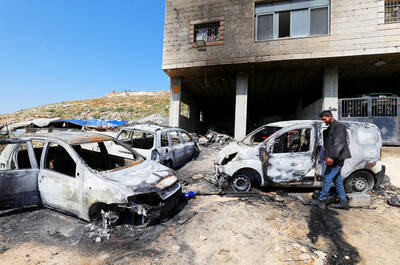
RAMPAGE: A Palestinian man was left dead after dozens of Israeli settlers searching for a missing 14-year-old boy stormed a village in the Israeli-occupied West Bank US President Joe Biden on Friday said he expected Iran to attack Israel “sooner, rather than later” and warned Tehran not to proceed. Asked by reporters about his message to Iran, Biden simply said: “Don’t,” underscoring Washington’s commitment to defend Israel. “We are devoted to the defense of Israel. We will support Israel. We will help defend Israel and Iran will not succeed,” he said. Biden said he would not divulge secure information, but said his expectation was that an attack could come “sooner, rather than later.” Israel braced on Friday for an attack by Iran or its proxies as warnings grew of
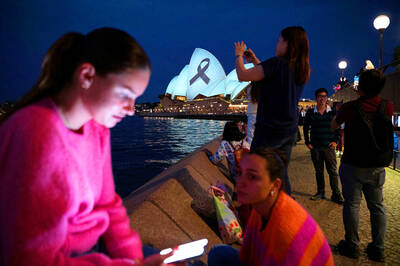
A prominent Christian leader has allegedly been stabbed at the altar during a Mass yesterday in southwest Sydney. Bishop Mar Mari Emmanuel was saying Mass at Christ The Good Shepherd Church in Wakeley just after 7pm when a man approached him at the altar and allegedly stabbed toward his head multiple times. A live stream of the Mass shows the congregation swarm forward toward Emmanuel before it was cut off. The church leader gained prominence during the COVID-19 pandemic, amassing a large online following, Officers attached to Fairfield City police area command attended a location on Welcome Street, Wakeley following reports a number


 RSS
RSS