


Exasperated parents who tell their children "look at me while I'm talking to you" should actually be telling them the opposite, say psychologists who have studied the way the young process complex information.
A new study shows that children who avert their gaze while adults are speaking to them may in fact be concentrating on taking in the facts rather than being distracted by someone's face.
"Gaze aversion," as it is known, seems to help the mind absorb difficult detail in ways that are not yet fully understood.
Researchers have carried out two school studies in which children were taught to look away when spoken to, in order to see whether they can take in more facts than others who hold the teachers' gaze. The results from one study, to be published shortly, will show that the youngest primary children do better if they turn away. This could also apply to adults.
For centuries, people who don't meet the eyes of those speaking to them have been seen as shifty or underhand. Psychologists now believe that signals picked up from looking at someone's face may interfere with simultaneously performing demanding mental tasks.
It is possible that looking away helps the brain to avoid processing unnecessary, distracting information that will slow up the task in hand.
Gwyneth Doherty-Sneddon, a psychologist at the University of Stirling in Scotland, has carried out studies into gaze aversion in young children to see if they were using it to control their "mental load."
In comparing a group of 30 five-year-olds with a group of eight-year-olds she found that the older children looked away more from the questioner's face when they were thinking about a difficult query. They didn't look away when it was being asked, just when they were trying to frame their response.
"There's a tendency in many cultures to encourage children to `look at me while I'm speaking to you,'" Doherty-Sneddon said.
"Adults often interpret looking away as a sign of disengagement or lack of interest, but our research points to the idea that it is a technique for helping them to concentrate. Rather than being discouraged, it should actually be encouraged," she said.
It could be that children who spend a lot of time looking away are actually demonstrating their readiness to learn rather than demonstrating, as is commonly assumed, that they are bored and have "switched off."

Republican US lawmakers on Friday criticized US President Joe Biden’s administration after sanctioned Chinese telecoms equipment giant Huawei unveiled a laptop this week powered by an Intel artificial intelligence (AI) chip. The US placed Huawei on a trade restriction list in 2019 for contravening Iran sanctions, part of a broader effort to hobble Beijing’s technological advances. Placement on the list means the company’s suppliers have to seek a special, difficult-to-obtain license before shipping to it. One such license, issued by then-US president Donald Trump’s administration, has allowed Intel to ship central processors to Huawei for use in laptops since 2020. China hardliners
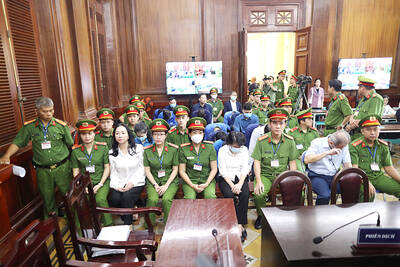
A top Vietnamese property tycoon was on Thursday sentenced to death in one of the biggest corruption cases in history, with an estimated US$27 billion in damages. A panel of three hand-picked jurors and two judges rejected all defense arguments by Truong My Lan, chair of major developer Van Thinh Phat, who was found guilty of swindling cash from Saigon Commercial Bank (SCB) over a decade. “The defendant’s actions ... eroded people’s trust in the leadership of the [Communist] Party and state,” read the verdict at the trial in Ho Chi Minh City. After the five-week trial, 85 others were also sentenced on

‘DELUSIONAL’: Targeting the families of Hamas’ leaders would not push the group to change its position or to give up its demands for Palestinians, Ismail Haniyeh said Israeli aircraft on Wednesday killed three sons of Hamas’ top political leader in the Gaza Strip, striking high-stakes targets at a time when Israel is holding delicate ceasefire negotiations with the militant group. Hamas said four of the leader’s grandchildren were also killed. Ismail Haniyeh’s sons are among the highest-profile figures to be killed in the war so far. Israel said they were Hamas operatives, and Haniyeh accused Israel of acting in “the spirit of revenge and murder.” The deaths threatened to strain the internationally mediated ceasefire talks, which appeared to gain steam in recent days even as the sides remain far
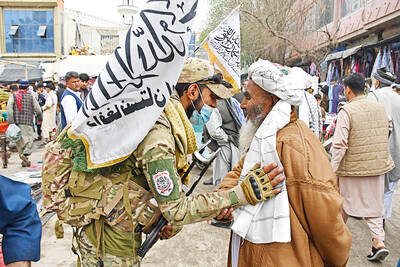
The Taliban’s reclusive supreme leader made a rare public appearance yesterday, an Afghan government spokesman said, leading thousands of worshipers in prayers marking Eid al-Fitr. Hibatullah Akhundzada has made only a handful of public appearances since inheriting the leadership of the Taliban in 2016 and leading the movement back to power with the withdrawal of US forces in 2021. Taliban government spokesman Zabihullah Mujahid said prayer in the largest mosque in Kandahar was “performed under the leadership of the supreme leader.” In a statement on X, he said the early-morning service “was attended by thousands of compatriots” in the southern province considered the


 RSS
RSS