


More than 1,200 Chinese Communist Party members killed themselves and 8,000 fled overseas during an anti-corruption crackdown in the first six months of last year, a Beijing-funded Hong Kong newspaper said on Thursday.
The extraordinary number of deaths and the flight of dirty money appears to have been the direct result of a drive by President Hu Jintao (胡錦濤) to curb the endemic graft that undermines the legitimacy of China's ruling party.
Despite the high toll, the clean-up campaign is thought to have barely scratched the surface of the problem. Last year top officials were punished at the rate of one a month, but most are too powerful to expose.
Miscarriages of justice and faked suicides are believed to be common. Among the most prominent alleged suicides was that of Zhu Shengwen, a former deputy mayor of the northeastern city of Harbin, who was sent to jail for taking ?62,000 (US$34,500) of bribes.
The official version of his death is that he threw himself out of a prison window only months before he was due to be released on parole. His family dispute this, saying he was killed to cover up his investigation into embezzlement by officials.
The biggest target of investigators was Zhou Zhengyi (周正毅), a Shanghai property tycoon, whose influential political contacts -- thought to include the former president Jiang Zemin (江澤民) -- have so far kept the prosecutors at bay. Instead, lower ranking party members have taken the brunt of the blame.
According to the Wen Wei Po daily, China's mouthpiece in Hong Kong, 1,200 party members killed themselves, 8,371 absconded and 6,528 disappeared in the first half of last year. Countless others were given the death penalty or sent to prison.
Most of the suicides and disappearances went unreported in China's tightly controlled state media.
The worst affected province was the richest -- Guangdong -- where 1,240 cadres fled overseas with illicitly earned fortunes. The most populous province, Henan, ranked second with 854 officials, followed by Fujian with 586.
Corrupt "princelings" -- the sons and daughters of party officials -- who exploited their parents' power to secure state assets are believed to have fled abroad with about 40 billion yuan (US$4.8 billion) in government funds, said the party source, who spoke on condition of anonymity. He did not elaborate.
Hu plans to seek the extradition of corrupt party and government officials and princelings and seize their overseas assets, the party source said.
"Hu Jintao intends to clean out a batch of princelings," the source said.
In the latest scandal Cai Xiaohong (
Cai was secretary general of the Liaison Office of the Central Government in Hong Kong, making him one of China's top officials in the former British colony when he was summoned to Beijing to attend a meeting and taken into custody late last year.
Although the economy is growing at more than 8 percent a year, income gaps between the rich and poor are widening. Yet party officials are still paid according to an egalitarian scale that gives little recognition of their authority. The difference between the salaries of a junior clerk and a division chief is typically less than ?5 a month.
During the heyday of China's revolution, the model Communist cadre was supposed to pursue the goal of a socialist utopia, work for the good of the people, and retire with the respect due to a lifelong servant of the country.
But today many are likely to buy their way up the career ladder, enrich themselves through bribes, and then either flee the country or kill themselves in disgrace.
The higher the position, the greater the potential for graft. In Shenyang last year a court heard how the post of transport bureau director had been bought for ?16,500, while that of director of the tobacco monopoly bureau went for ?13,000. The holders of the positions were given the death penalty.

Republican US lawmakers on Friday criticized US President Joe Biden’s administration after sanctioned Chinese telecoms equipment giant Huawei unveiled a laptop this week powered by an Intel artificial intelligence (AI) chip. The US placed Huawei on a trade restriction list in 2019 for contravening Iran sanctions, part of a broader effort to hobble Beijing’s technological advances. Placement on the list means the company’s suppliers have to seek a special, difficult-to-obtain license before shipping to it. One such license, issued by then-US president Donald Trump’s administration, has allowed Intel to ship central processors to Huawei for use in laptops since 2020. China hardliners

DISADVANTAGE: Erin O’Toole, who led the Conservatives during the election campaign in 2021, estimated that the interference cost his party as many as nine legislative seats Canada’s domestic spy agency on Monday concluded that China interfered in the past two elections, an official probe heard, the firmest evidence so far of suspected Chinese meddling in Canadian politics. Canadian Prime Minister Justin Trudeau’s Liberal Party won both the elections, held in 2019 and 2021. Under pressure from opposition lawmakers unhappy about media reports on China’s possible role, Trudeau set up a commission into foreign interference. The commission was shown a slide on Monday containing an extract of a briefing in February last year from the Canadian Security Intelligence Service (CSIS). “We know that the PRC [People’s Republic of China] clandestinely
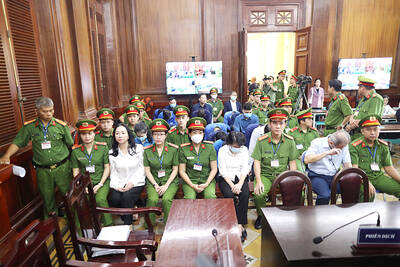
A top Vietnamese property tycoon was on Thursday sentenced to death in one of the biggest corruption cases in history, with an estimated US$27 billion in damages. A panel of three hand-picked jurors and two judges rejected all defense arguments by Truong My Lan, chair of major developer Van Thinh Phat, who was found guilty of swindling cash from Saigon Commercial Bank (SCB) over a decade. “The defendant’s actions ... eroded people’s trust in the leadership of the [Communist] Party and state,” read the verdict at the trial in Ho Chi Minh City. After the five-week trial, 85 others were also sentenced on

‘DELUSIONAL’: Targeting the families of Hamas’ leaders would not push the group to change its position or to give up its demands for Palestinians, Ismail Haniyeh said Israeli aircraft on Wednesday killed three sons of Hamas’ top political leader in the Gaza Strip, striking high-stakes targets at a time when Israel is holding delicate ceasefire negotiations with the militant group. Hamas said four of the leader’s grandchildren were also killed. Ismail Haniyeh’s sons are among the highest-profile figures to be killed in the war so far. Israel said they were Hamas operatives, and Haniyeh accused Israel of acting in “the spirit of revenge and murder.” The deaths threatened to strain the internationally mediated ceasefire talks, which appeared to gain steam in recent days even as the sides remain far


 RSS
RSS