


Maricor Akol first grew suspicious about the competition to provide the Philippines with a modern vote-counting system when one of the potential bidders nearly cried.
A woman representing a Japanese firm was almost reduced to tears after the chairman of the Commission on Elections (Comelec) mocked her questions before hustling others interested in the US$23 million contract out in less than an hour, Akol recalled.
"We knew there was something fishy," said Akol, who attended the pre-bid conference last February as part of an advisory team.
More surprises followed, including the failure of the winning company's machine to meet accuracy standards and the discovery that the firm had only been formed at the last minute.
Last week, the Supreme Court ruled that Comelec's actions were "illegal, imprudent and hasty," and nullifying the contract.
The complainants, a cross-section of the local IT community, were jubilant.
"We were able to prove that you don't need to stage a military coup if you want to stop corruption," said Augusto Lagman, one of the complainants.
"The legal process still works."
But the decision also dashed hopes the Philippines could drag its polls from a history of cheating into the modern era. Filipinos -- their faith in institutions battered by countless scandals and pervasive corruption -- could be forgiven for seeing the Comelec contract saga as a metaphor for the coming polls.
"This is yet another textbook case on why we always fail in this country," wrote political analyst and columnist Alex Magno.
"Computerizing the process is a simple enough task. But our institutions do not seem competent enough to execute it."
Comelec is scrambling to revert to a manual count in time for May 10, raising the prospect of a delayed election and stirring the usual speculation in newspapers that disgruntled generals could step in to fill the void.
Cynicism was already high after a series of political somersaults exposed parties as little more than vehicles for personalities to change careers.
Analysts see a two-way race developing between President Gloria Macapagal Arroyo and opposition candidate Fernando Poe Jr, a popular film star and friend of ousted leader Joseph Estrada.
But an absence of debate on how to solve problems suggests that money and dirty tricks will be at least as important as policy.
The culture of foul play became ingrained during the rule of the late dictator Ferdinand Marcos, who fled to Hawaii in 1986 after snap elections marred by rampant cheating triggered a military rebellion supported by massive public protests.
The Marcos legacy remains strong. In his old stomping ground in the north, his preserved body is still on public display and two of his children -- son Ferdinand Jr and daughter Imee -- are expected to win new terms in office.
Election cheating has also proved resilient.
Manual counting usually takes several weeks to yield a final result in the Philippines, holding open the door to abuses in an archipelago of 7,100 islands, where local bosses often have more clout than the government in Manila.
"It is the most complicated, vulnerable process known to man," wrote Magno.
The confusion starts with ballot papers on which voters, some of them barely literate, must write their choices for president and senators right down to town councilors. The list runs to 30 names or longer in some provinces.
With no boxes to tick or holes to punch, the need to imprint the names of candidates on the minds of voters makes personality and recognition the name of the game.
One common tactic is for a candidate's supporter to grab and complete a batch of empty ballots before passing them -- along with a few small bills -- to voters waiting outside.
The hurried return to manual counting adds to the complexity.
"Because Comelec is going to be forced to use the paper ballot, it's almost guaranteed there's going to be major cheating," said Scott Harrison, a former executive with the US Central Intelligence Agency and now the head of the Pacific Strategies and Assessments consultancy in Manila.
"In general, there will be far less cheating in Metro Manila and far more cheating in the provinces."
Analysts say Arroyo has a distinct advantage as the first sitting president to contest an election since the Marcos era.
Because she rose to power from vice president in 2001, when popular protests chased Estrada from office, Arroyo could ignore a one-term limit written into the post-Marcos Constitution and run for a fresh six years with the benefit of state machinery.
There are rules meant to limit campaign spending, but enforcing rules is not always this country's strong point.

Republican US lawmakers on Friday criticized US President Joe Biden’s administration after sanctioned Chinese telecoms equipment giant Huawei unveiled a laptop this week powered by an Intel artificial intelligence (AI) chip. The US placed Huawei on a trade restriction list in 2019 for contravening Iran sanctions, part of a broader effort to hobble Beijing’s technological advances. Placement on the list means the company’s suppliers have to seek a special, difficult-to-obtain license before shipping to it. One such license, issued by then-US president Donald Trump’s administration, has allowed Intel to ship central processors to Huawei for use in laptops since 2020. China hardliners

Conjoined twins Lori and George Schappell, who pursued separate careers, interests and relationships during lives that defied medical expectations, died this month in Pennsylvania, funeral home officials said. They were 62. The twins, listed by Guinness World Records as the oldest living conjoined twins, died on April 7 at the Hospital of the University of Pennsylvania, obituaries posted by Leibensperger Funeral Homes of Hamburg said. The cause of death was not detailed. “When we were born, the doctors didn’t think we’d make 30, but we proved them wrong,” Lori said in an interview when they turned 50, the Philadelphia Inquirer reported. The
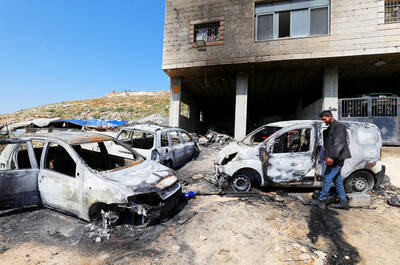
RAMPAGE: A Palestinian man was left dead after dozens of Israeli settlers searching for a missing 14-year-old boy stormed a village in the Israeli-occupied West Bank US President Joe Biden on Friday said he expected Iran to attack Israel “sooner, rather than later” and warned Tehran not to proceed. Asked by reporters about his message to Iran, Biden simply said: “Don’t,” underscoring Washington’s commitment to defend Israel. “We are devoted to the defense of Israel. We will support Israel. We will help defend Israel and Iran will not succeed,” he said. Biden said he would not divulge secure information, but said his expectation was that an attack could come “sooner, rather than later.” Israel braced on Friday for an attack by Iran or its proxies as warnings grew of

IN PURSUIT: Israel’s defense minister said the revenge attacks by Israeli settlers would make it difficult for security forces to find those responsible for the 14-year-old’s death Israeli Prime Minister Benjamin Netanyahu on Saturday condemned the “heinous murder” of an Israeli teenager in the occupied West Bank as attacks on Palestinian villages intensified following news of his death. After Benjamin Achimeir, 14, was reported missing near Ramallah on Friday, hundreds of Jewish settlers backed by Israeli forces raided nearby Palestinian villages, torching vehicles and homes, leaving at least one villager dead and dozens wounded. The attacks escalated in several villages on Saturday after Achimeir’s body was found near the Malachi Hashalom outpost. Agence France-Presse correspondents saw smoke rising from burned houses and fields. Mayor Amin Abu Alyah, of the


 RSS
RSS