


A political snapshot of America taken from the White House window couldn't look more different for President George W. Bush than what his father saw from the same vantage on a cold January day 12 years ago.
In hard statistics and a harder-to-define sense of how the country is doing, today's view is one Bush's father could only have envied as he entered the re-election year of 1992. And, likewise, the public's impression of this President Bush is much kinder than was the assessment of his father at the same point in his presidency.
In January 1992, unemployment was at a five-year high of 7.1 percent, only a quarter of Americans were satisfied with the way things were going in the US and a little less than half approved of the way the president was doing his job.
"I've known the economy is in free fall," a defensive Bush conceded that January on his first campaign trip to New Hampshire, where times were particularly difficult. The next day his spokesman lamely insisted that the economy technically was not in free fall, it was merely "flat and sluggish."
This January, by contrast, unemployment is at 5.7 percent and falling, 55 percent of Americans are satisfied with how things are going in the country, and 60 percent approve of the way the president is doing his job.
"If you were a poker player, you would want his hand," Democratic strategist Jim Duffy says of the current president.
David Wyss, chief economist at Standard and Poor's in New York, said this Bush's biggest advantage, compared with his father's situation, may be that "he had his recession earlier in his term and got it over with."
The most recent recession lasted eight months and officially ended more than two years ago, in November 2001.
The first Bush's recession also lasted eight months and officially ended in March 1991, well before the election year. But unemployment didn't peak until 15 months later, and the recession's end wasn't announced until December 1992.
That was one month after Bush had lost his bid for re-election.
As this election season gets under way, job growth still is extremely weak, but at least the economic trends are moving in the right direction. And it's the trend lines that are key in politics, said Charlie Black, a veteran Republican strategist and former chairman of the party's national committee.
Still, Black said, there are reasons for Republicans not to be overconfident this January.
"I'd rather be in our shoes than theirs, but it's also true that the country's very closely divided on a party basis, and if both sides consolidate their bases, it's going to be a close race," he said. "The president has an advantage, but it's not a huge advantage."
And there are always unexpected challenges that can pop up, Black added. For example, he pointed to the April 1992 Los Angeles riots that stole attention from the elder Bush just when he was starting to gain momentum.
The current President Bush has been the beneficiary of some good luck so far, said Allan Lichtman, a presidential historian at American University, but he also has improved his odds by working to "avoid the sins of the father," referring to the first Bush's political missteps.
Among other things, Bush has pushed through giant tax cuts to pump up the economy, finished off the reign of Saddam Hussein and tried to provide the "vision thing" that his father acknowledged he lacked, Lichtman said.
Democrats, for their part, argue that the economic gains aren't reaching ordinary Americans and they have tried to dull the luster of the tax cuts by focusing on their high cost. The projected budget deficit for fiscal 2004 is US$500 billion, which would far surpass the record deficit of US$374 billion registered in fiscal 2003.
"This is not a recovery for the working American," Senator John Kerry, who finished first among the Democrats in the Iowa caucuses, said after Bush's rosy State of the Union speech this week. "This is a Wall Street, Bush-league recovery."
In fact, the economy has lost about 2.3 million jobs under Bush, the worst job creation record of any president since Herbert Hoover.
The Democrats also have leveled unrelenting criticism at Bush for the failed search for weapons of mass destruction in Iraq and for his handling of the postwar situation there. More than 500 US service members have died since the US-led coalition launched the war on March 20, with most of those deaths occurring since major combat operations ended.
The first Bush, for his part, had sky-high approval ratings after successful prosecution of the Persian Gulf War in January 1991. But by the time of his 1992 re-election campaign, "people had forgotten about it," Black said.
Foreign policy is one area where this Bush doesn't measure up to his father in public opinion polls, although his ratings still are positive. The Gallup Poll puts the current Bush's approval rating for foreign policy matters at 58 percent, compared to 64 percent for his father in January 1992.
Duffy, the Democratic strategist, said his advice for Democratic candidates on how to counter Bush is to stay focused on winning their party's nomination for now "and then worry about how to climb the mountain later." After all, he said, even with all that the first President Bush had going against him in 1992, back in January few thought Bill Clinton had much of a chance of beating him.
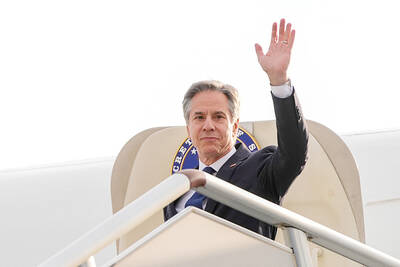
‘IN A DIFFERENT PLACE’: The envoy first visited Shanghai, where he attended a Chinese basketball playoff match, and is to meet top officials in Beijing tomorrow US Secretary of State Antony Blinken yesterday arrived in China on his second visit in a year as the US ramps up pressure on its rival over its support for Russia while also seeking to manage tensions with Beijing. The US diplomat tomorrow is to meet China’s top brass in Beijing, where he is also expected to plead for restraint as Taiwan inaugurates president-elect William Lai (賴清德), and to raise US concerns on Chinese trade practices. However, Blinken is also seeking to stabilize ties, with tensions between the world’s two largest economies easing since his previous visit in June last year. At the
Nearly half of China’s major cities are suffering “moderate to severe” levels of subsidence, putting millions of people at risk of flooding, especially as sea levels rise, according to a study of nationwide satellite data released yesterday. The authors of the paper, published by the journal Science, found that 45 percent of China’s urban land was sinking faster than 3mm per year, with 16 percent at more than 10mm per year, driven not only by declining water tables, but also the sheer weight of the built environment. With China’s urban population already in excess of 900 million people, “even a small portion

UNSETTLING IMAGES: The scene took place in front of TV crews covering the Trump trial, with a CNN anchor calling it an ‘emotional and unbelievably disturbing moment’ A man who doused himself in an accelerant and set himself on fire outside the courthouse where former US president Donald Trump is on trial has died, police said yesterday. The New York City Police Department (NYPD) said the man was declared dead by staff at an area hospital. The man was in Collect Pond Park at about 1:30pm on Friday when he took out pamphlets espousing conspiracy theories, tossed them around, then doused himself in an accelerant and set himself on fire, officials and witnesses said. A large number of police officers were nearby when it happened. Some officers and bystanders rushed

Beijing is continuing to commit genocide and crimes against humanity against Uyghurs and other Muslim minorities in its western Xinjiang province, U.S. Secretary of State Antony Blinken said in a report published on Monday, ahead of his planned visit to China this week. The State Department’s annual human rights report, which documents abuses recorded all over the world during the previous calendar year, repeated language from previous years on the treatment of Muslims in Xinjiang, but the publication raises the issue ahead of delicate talks, including on the war in Ukraine and global trade, between the top U.S. diplomat and Chinese


 RSS
RSS