


No more steaming platters of civet cat? Only a few southern Chinese hanker for them anyway. But look closer: Suddenly, China has no American beef and no South Korean wild boar. No cloven-hoofed animals from Tajikistan. No poultry from Vietnam and Japan.
In a country where people say "Have you eaten today?" when they mean hello and are renowned for stomaching just about anything, the world's health problems are shortening the menus these days.
Over the past month, on fears of SARS, bird flu, mad cow, foot-and-mouth disease and even hog cholera, China has banned those animals and their meats. And with bird flu confirmed Friday in Thailand and Cambodia, more quarantine actions could be in store.
While the bans have so far had no major impact on the food supply of China's 1.3 billion people, and restaurant owners who use mostly domestic meat supplies insist they aren't worried, the actions are striking nonetheless in their very number.
"It is better to ban these products pre-emptively than to wait for major problems," said Chen Wei, an official with the China Meat Association, the industry's government-backed trade group.
"These prohibitions are beyond argument," he said. "We still lack a clear understanding of where these diseases are actually coming from. We're simply trying to protect Chinese consumers and Chinese industries."
The quarantines illustrate a growing official willingness to take swift action to reassure the populace that it is safe -- whether from unemployment, the Falun Gong spiritual movement, criminals or foods considered risky.
Food safety has been a major issue in recent months in the tightly controlled state press. It has given wide coverage of initiatives to safeguard everything from the national grain supply to the fried-egg crepes sold as breakfast foods on the streets of Beijing.
That has only increased with the latest jitters -- and particularly with more international coverage this month of the chance that exotica eaten by southern Chinese, particularly the civet, might be linked to SARS. Civets have been slaughtered by the thousands in the south.
Last Sunday, the Beijing Daily Messenger newspaper ran a graphic front-page photograph of 800 piglets smuggled from Vietnam as pork being burned alive in tightly packed cages in the southern region of Guangxi. Masked health authorities looked on.
American beef has been sealed in its meat lockers in Beijing, border posts at China's frontier with Vietnam have been reinforced to prevent errant infected poultry from slipping in, and all border markets in Yunnan Province have been barred from selling chickens.
There has been talk of seizing eggs as well, and Chinese agricultural inspectors around the country are scouring the domestic chicken supply beak by beak, looking for problems.
"Any other country would do the same things," said Zhang Kunsheng, a professor of food science at the Tianjin University of Commerce.
In recent years, China has at turns banned everything from Pennsylvania poultry to British beef over what it calls health concerns. But the sword has two edges: China's shrimp was barred from EU countries sporadically after trace amounts of antibiotics were found.
China's growing market for meat, import and export both, is giving it great incentive to tighten its regulations as it modernizes.
According to the International Meat Secretariat, China accounts for more than half the world's pork production and consumption and is the fourth-largest beef producer. The group links 65 percent of the recent growth in global pork consumption to China.
Last year, Philip Seng, the secretariat's president, told Chinese meat producers that food safety was a major part of ensuring "greater integration of China in the world meat trade."
"Regulations are only as assuring and effective as the level of enforcement," Seng, also head of the US Meat Export Federation, told the China Meat Association. "China seems to be moving in the right direction in this regard."
As bird flu fears spread throughout Asia, and China moves to institute more bans, experts caution against tarring the country as a place where unsafe practices are rampant. They point to the bans as proof that a culture so focused on eating would ensure it's a safe activity.
"The Chinese people's traditional ways of cooking meat are safe -- especially in comparison to others. We boil and stir-fry and seldom eat raw," said Zhang, the food sciences professor. "We certainly don't care about food safety less than other countries do."

Republican US lawmakers on Friday criticized US President Joe Biden’s administration after sanctioned Chinese telecoms equipment giant Huawei unveiled a laptop this week powered by an Intel artificial intelligence (AI) chip. The US placed Huawei on a trade restriction list in 2019 for contravening Iran sanctions, part of a broader effort to hobble Beijing’s technological advances. Placement on the list means the company’s suppliers have to seek a special, difficult-to-obtain license before shipping to it. One such license, issued by then-US president Donald Trump’s administration, has allowed Intel to ship central processors to Huawei for use in laptops since 2020. China hardliners
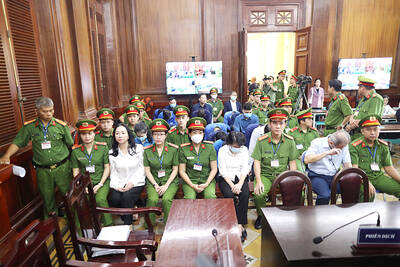
A top Vietnamese property tycoon was on Thursday sentenced to death in one of the biggest corruption cases in history, with an estimated US$27 billion in damages. A panel of three hand-picked jurors and two judges rejected all defense arguments by Truong My Lan, chair of major developer Van Thinh Phat, who was found guilty of swindling cash from Saigon Commercial Bank (SCB) over a decade. “The defendant’s actions ... eroded people’s trust in the leadership of the [Communist] Party and state,” read the verdict at the trial in Ho Chi Minh City. After the five-week trial, 85 others were also sentenced on

‘DELUSIONAL’: Targeting the families of Hamas’ leaders would not push the group to change its position or to give up its demands for Palestinians, Ismail Haniyeh said Israeli aircraft on Wednesday killed three sons of Hamas’ top political leader in the Gaza Strip, striking high-stakes targets at a time when Israel is holding delicate ceasefire negotiations with the militant group. Hamas said four of the leader’s grandchildren were also killed. Ismail Haniyeh’s sons are among the highest-profile figures to be killed in the war so far. Israel said they were Hamas operatives, and Haniyeh accused Israel of acting in “the spirit of revenge and murder.” The deaths threatened to strain the internationally mediated ceasefire talks, which appeared to gain steam in recent days even as the sides remain far
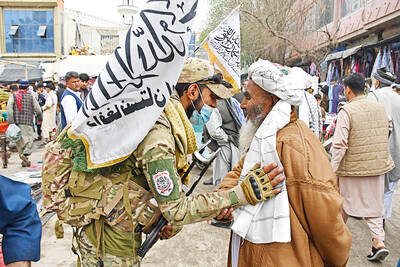
The Taliban’s reclusive supreme leader made a rare public appearance yesterday, an Afghan government spokesman said, leading thousands of worshipers in prayers marking Eid al-Fitr. Hibatullah Akhundzada has made only a handful of public appearances since inheriting the leadership of the Taliban in 2016 and leading the movement back to power with the withdrawal of US forces in 2021. Taliban government spokesman Zabihullah Mujahid said prayer in the largest mosque in Kandahar was “performed under the leadership of the supreme leader.” In a statement on X, he said the early-morning service “was attended by thousands of compatriots” in the southern province considered the


 RSS
RSS