


Two attempts on the life of Pakistani President General Pervez Musharraf, allegedly by Islamic militant groups, may have galvanized the military leader's resolve to fight extremism.
Analysts say the bomb attacks last month have forced Musharraf to rethink the long-standing -- but long-denied -- ties between Pakistan's military and religious militants.
"The attempts on Musharraf's life have brought a total rupture in the relationship" between Pakistan's military and the militants, said Talat Masood, a retired general and political and military analyst.
"As far as policy is concerned, there's a realization that militancy is harmful to the country's interests."
Musharraf's support for the US-led war on terror and his peace efforts with rival India have put him in the militants' sights.
Pakistani authorities suspect that a leading militant group fighting in Indian-held Kashmir, Jaish-e-Mohammed, was behind the second and most destructive of the two attacks against Musharraf on Dec. 25, killing 16 people. The first on Dec. 14 was also blamed on homegrown militants -- possibly acting with help from al-Qaeda.
The bombings heightening fears of a nexus between Pakistan-based extremists and the al-Qaeda network. A recorded message in September purportedly from Osama bin Laden's chief lieutenant Ayman al-Zawahri urged Pakistani Muslims to "uproot" Musharraf.
Some question Musharraf's willingness to take on religious radicals, who represent a powerful political and social force in Pakistan.
But Abdullah Muntazar, a Pakistani expert on militancy and former spokesman for the hardline Lashkar-e-Tayaba, said the attacks on Musharraf could be a sign that his policy to end Pakistan's support of the Taliban and peace moves with India have angered militants and "backfired" against him.
"We are fighting the al-Qaeda and Taliban on the western borders [with Afghanistan], and we want to negotiate a peaceful settlement of the Kashmir dispute with the Indians on the eastern one," Musharraf said Thursday. "At the same time we are fighting sectarian and religious extremism within our country.
"So I'm treading on a lot of toes, and that has led to these extremist attacks on me," he told the World Economic Forum in Davos, Switzerland.
Last week, in his first-ever address to Parliament since he took power in a bloodless coup four years ago, Musharraf called for a "jihad" or holy war on extremism -- a sign of the remarkable transformation in his career.
In 1999, months before he seized power, army chief Musharraf led the first Pakistani offensive into Indian-held Kashmir in nearly three decades -- reportedly supported by hundreds of militants. The clash almost sparked all-out war between the nuclear-armed neighbors.
The ties between Pakistan's military and various Islamic militant forces -- established when Islamic warriors fought against Soviet occupation in Afghanistan in the 1980s -- have gradually changed since the Sept. 11, 2001, attacks in America, analysts said.
Musharraf was quick to ditch the Taliban regime that Pakistan had helped into power in Afghanistan in the mid-1990s. In recent months, he has stepped up efforts to track terrorist fugitives along the rugged frontier with Afghanistan -- amid criticism that Taliban rebels are launching cross-border attacks from Pakistan's tribal regions.
In Kashmir, Musharraf was slower to act but has bowed to international pressure to prevent militants infiltrating from Pakistan into Indian-held territory across the mountainous Line of Control that divides the bloodied Himalayan region.
Pakistan has always denied giving military aid to the rebels, but has said it supports their struggle against Indian rule with diplomatic and political support.
India charges a much deeper involvement, but even its politicians acknowledge infiltration is down, helping improve ties. The two nations agreed earlier this month to start comprehensive peace talks, including discussions on the future of Kashmir.

Republican US lawmakers on Friday criticized US President Joe Biden’s administration after sanctioned Chinese telecoms equipment giant Huawei unveiled a laptop this week powered by an Intel artificial intelligence (AI) chip. The US placed Huawei on a trade restriction list in 2019 for contravening Iran sanctions, part of a broader effort to hobble Beijing’s technological advances. Placement on the list means the company’s suppliers have to seek a special, difficult-to-obtain license before shipping to it. One such license, issued by then-US president Donald Trump’s administration, has allowed Intel to ship central processors to Huawei for use in laptops since 2020. China hardliners

Conjoined twins Lori and George Schappell, who pursued separate careers, interests and relationships during lives that defied medical expectations, died this month in Pennsylvania, funeral home officials said. They were 62. The twins, listed by Guinness World Records as the oldest living conjoined twins, died on April 7 at the Hospital of the University of Pennsylvania, obituaries posted by Leibensperger Funeral Homes of Hamburg said. The cause of death was not detailed. “When we were born, the doctors didn’t think we’d make 30, but we proved them wrong,” Lori said in an interview when they turned 50, the Philadelphia Inquirer reported. The
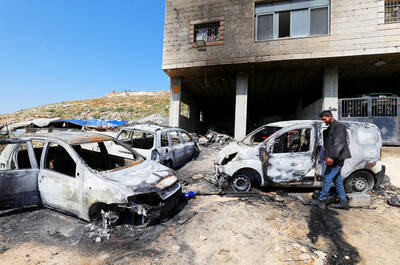
RAMPAGE: A Palestinian man was left dead after dozens of Israeli settlers searching for a missing 14-year-old boy stormed a village in the Israeli-occupied West Bank US President Joe Biden on Friday said he expected Iran to attack Israel “sooner, rather than later” and warned Tehran not to proceed. Asked by reporters about his message to Iran, Biden simply said: “Don’t,” underscoring Washington’s commitment to defend Israel. “We are devoted to the defense of Israel. We will support Israel. We will help defend Israel and Iran will not succeed,” he said. Biden said he would not divulge secure information, but said his expectation was that an attack could come “sooner, rather than later.” Israel braced on Friday for an attack by Iran or its proxies as warnings grew of

A prominent Christian leader has allegedly been stabbed at the altar during a Mass yesterday in southwest Sydney. Bishop Mar Mari Emmanuel was saying Mass at Christ The Good Shepherd Church in Wakeley just after 7pm when a man approached him at the altar and allegedly stabbed toward his head multiple times. A live stream of the Mass shows the congregation swarm forward toward Emmanuel before it was cut off. The church leader gained prominence during the COVID-19 pandemic, amassing a large online following, Officers attached to Fairfield City police area command attended a location on Welcome Street, Wakeley following reports a number


 RSS
RSS