


The US comes to the UN today, asking the organization that the Bush administration has kept at a deliberate distance from its Iraq stabilization plan to step in now and help rescue it.
In off-the-record comments, many here complain about being asked to validate a process from which they were excluded, and wonder if the world organization is not being manipulated by the White House for election-year political purposes.
The November agreement between the US and the Iraqi Governing Council to transfer sovereignty to the Iraqis on June 30 made no mention of any UN role, and the omission was one that UN Secretary-General Kofi Annan said he took as a snub.
But today, Paul Bremer, the American administrator in Iraq, and a delegation of the US-appointed Governing Council will be asking Annan to commit the UN to saving the arrangement, after it has come under fire in Iraq.
Asked what the UN's mood was after being disparaged often by the Bush administration, Fred Eckhard, Annan's spokesman, said: "The gut instinct here is not, `I told you so.' It's more relief that we are getting back to normalcy where governments work with each other, where international understanding is a national priority."
Annan has made it clear that while he favors a speedy timetable for giving authority to Iraqis, he is unwilling to commit the UN to an ill-defined mission. Today's meeting is consequently not expected to produce any definitive announcements.
It could serve, however, to ease the deep worry at the UN over the threat the strained relations with the Bush administration are seen to pose.
"It has been a truism since the time of the League of Nations that without the United States committed to and participating in international organizations, they are not going to work," said one official.
David Malone, a former Canadian ambassador to the UN who heads the International Peace Academy, a research institute across the street from the UN, said of today's meeting, "The positive feature is that the US belatedly, but importantly, is realizing what its friends have told it all along -- which is that the UN can be useful in these situations and can build confidence among multiple populations."
But he added, "The risk for the UN is that the US could simply be seeking to establish a scapegoat for the failure of its grand design."
The Security Council will hear a report on Iraq in a closed session this afternoon from the current Governing Council chairman, Adnan Pachachi. The president of the Security Council, Heraldo Munoz of Chile, said members were no longer focusing on the differences they had with the US over the war.
"My feeling is that the moment of divisions has been overcome and that there is a strong consensus on the Council around the idea that, even given the circumstances, we must do everything possible to assist the political process," Munoz said in an interview.
He noted that up until now the US appeared to want the UN kept out of the political transition and included only in the second stage after the June 30 transfer of power, where it could employ its experience in writing constitutions and setting up elections.
"It is now welcome that the US would like the UN to play a role in the first stage," Munoz said. "But what has to be elucidated is what that role is and whether the responsibility will be commensurate with the risk."
Annan withdrew international staff members from Iraq in October after attacks on relief workers and the bombing of UN headquarters, which killed 22 people, including the mission chief, Sergio Vieira de Mello.
In recent weeks, the US and some Iraqi politicians have been pressing Annan to send his staff back into Iraq, but he has insisted on assurances of protection for them and "clarity" in the description of what they would be asked to do.
In that connection, the UN announced this week that it was sending a four-person military and police team to study security provisions for the possible return of its workers.
As much as UN officials would like to end their marginalization from Iraq, they worry about the timing of going back in now.
"It's a totally novel, unprecedented and uncomfortable position for the UN to be in a country under occupation," said an official who served with Vieira de Mello in Iraq.

Republican US lawmakers on Friday criticized US President Joe Biden’s administration after sanctioned Chinese telecoms equipment giant Huawei unveiled a laptop this week powered by an Intel artificial intelligence (AI) chip. The US placed Huawei on a trade restriction list in 2019 for contravening Iran sanctions, part of a broader effort to hobble Beijing’s technological advances. Placement on the list means the company’s suppliers have to seek a special, difficult-to-obtain license before shipping to it. One such license, issued by then-US president Donald Trump’s administration, has allowed Intel to ship central processors to Huawei for use in laptops since 2020. China hardliners
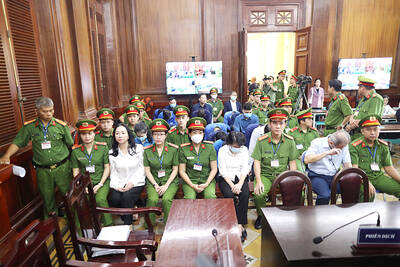
A top Vietnamese property tycoon was on Thursday sentenced to death in one of the biggest corruption cases in history, with an estimated US$27 billion in damages. A panel of three hand-picked jurors and two judges rejected all defense arguments by Truong My Lan, chair of major developer Van Thinh Phat, who was found guilty of swindling cash from Saigon Commercial Bank (SCB) over a decade. “The defendant’s actions ... eroded people’s trust in the leadership of the [Communist] Party and state,” read the verdict at the trial in Ho Chi Minh City. After the five-week trial, 85 others were also sentenced on

Conjoined twins Lori and George Schappell, who pursued separate careers, interests and relationships during lives that defied medical expectations, died this month in Pennsylvania, funeral home officials said. They were 62. The twins, listed by Guinness World Records as the oldest living conjoined twins, died on April 7 at the Hospital of the University of Pennsylvania, obituaries posted by Leibensperger Funeral Homes of Hamburg said. The cause of death was not detailed. “When we were born, the doctors didn’t think we’d make 30, but we proved them wrong,” Lori said in an interview when they turned 50, the Philadelphia Inquirer reported. The
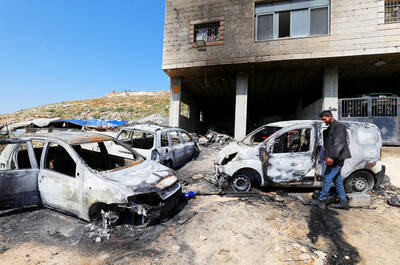
RAMPAGE: A Palestinian man was left dead after dozens of Israeli settlers searching for a missing 14-year-old boy stormed a village in the Israeli-occupied West Bank US President Joe Biden on Friday said he expected Iran to attack Israel “sooner, rather than later” and warned Tehran not to proceed. Asked by reporters about his message to Iran, Biden simply said: “Don’t,” underscoring Washington’s commitment to defend Israel. “We are devoted to the defense of Israel. We will support Israel. We will help defend Israel and Iran will not succeed,” he said. Biden said he would not divulge secure information, but said his expectation was that an attack could come “sooner, rather than later.” Israel braced on Friday for an attack by Iran or its proxies as warnings grew of


 RSS
RSS