


American officials are calling General Richard Myers' visit to China a sign that military relations between the two countries are recovering. But joint maneuvers by their combat forces are not expected anytime soon because Washington and Beijing remain far too wary of each other.
Military ties, severely curtailed three years ago after a Chinese fighter collided with an American spy plane off the Chinese coast, are regarded as a vital part of US diplomacy with the world's most populous nation.
Myers, chairman of the Joint Chiefs of Staff, met on Wednesday and Thursday with Chinese officials in Beijing. He was the highest-ranking US military official to visit China since 1997.
"We're making some good progress in our military-to-military relationship," Myers said at the end of his visit.
Myers and his entourage became the first foreign delegation allowed access to the mission control facility for China's manned space program. Myers congratulated China for last October's achievement of becoming only the third nation to put a man into orbit.
Still, the visit was one with few immediately tangible results: no new agreements, no sweeping new statements of US or Chinese policy.
Instead of joint exercises by combat forces, a usual training procedure of allied military forces, Myers suggested joint search-and-rescue exercises, educational exchanges and additional visits by warships to ports in each country.
A possible new crisis could be brewing over Taiwan, always a sticking point between the two nations.
President Chen Shui-bian (陳水扁), has declared an immediate security threat from China and has announced that the nation will hold a referendum March 20 -- the day Chen seeks re-election -- on whether China should stop pointing hundreds of missiles at Taiwan. Washington criticized the referendum as unnecessary and Chen softened its wording last week.
Still, Myers told Chinese reporters that the missiles constitute one reason the US continues to sell high-tech military equipment to Taiwan.

Republican US lawmakers on Friday criticized US President Joe Biden’s administration after sanctioned Chinese telecoms equipment giant Huawei unveiled a laptop this week powered by an Intel artificial intelligence (AI) chip. The US placed Huawei on a trade restriction list in 2019 for contravening Iran sanctions, part of a broader effort to hobble Beijing’s technological advances. Placement on the list means the company’s suppliers have to seek a special, difficult-to-obtain license before shipping to it. One such license, issued by then-US president Donald Trump’s administration, has allowed Intel to ship central processors to Huawei for use in laptops since 2020. China hardliners
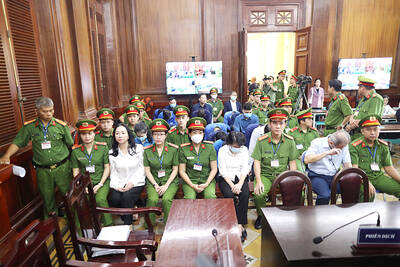
A top Vietnamese property tycoon was on Thursday sentenced to death in one of the biggest corruption cases in history, with an estimated US$27 billion in damages. A panel of three hand-picked jurors and two judges rejected all defense arguments by Truong My Lan, chair of major developer Van Thinh Phat, who was found guilty of swindling cash from Saigon Commercial Bank (SCB) over a decade. “The defendant’s actions ... eroded people’s trust in the leadership of the [Communist] Party and state,” read the verdict at the trial in Ho Chi Minh City. After the five-week trial, 85 others were also sentenced on

‘DELUSIONAL’: Targeting the families of Hamas’ leaders would not push the group to change its position or to give up its demands for Palestinians, Ismail Haniyeh said Israeli aircraft on Wednesday killed three sons of Hamas’ top political leader in the Gaza Strip, striking high-stakes targets at a time when Israel is holding delicate ceasefire negotiations with the militant group. Hamas said four of the leader’s grandchildren were also killed. Ismail Haniyeh’s sons are among the highest-profile figures to be killed in the war so far. Israel said they were Hamas operatives, and Haniyeh accused Israel of acting in “the spirit of revenge and murder.” The deaths threatened to strain the internationally mediated ceasefire talks, which appeared to gain steam in recent days even as the sides remain far
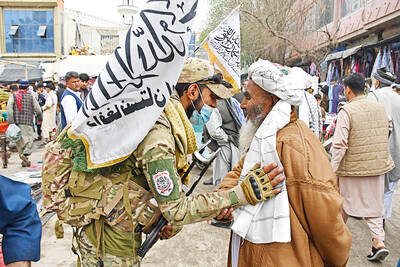
The Taliban’s reclusive supreme leader made a rare public appearance yesterday, an Afghan government spokesman said, leading thousands of worshipers in prayers marking Eid al-Fitr. Hibatullah Akhundzada has made only a handful of public appearances since inheriting the leadership of the Taliban in 2016 and leading the movement back to power with the withdrawal of US forces in 2021. Taliban government spokesman Zabihullah Mujahid said prayer in the largest mosque in Kandahar was “performed under the leadership of the supreme leader.” In a statement on X, he said the early-morning service “was attended by thousands of compatriots” in the southern province considered the


 RSS
RSS