


The US will move all of its troops out of metropolitan Seoul over the next three years without reducing total forces in South Korea, officials of both countries agreed on Friday.
Under a historic plan to end a US presence in the capital dating to the end of the Korean War, about 7,000 US forces and their families will be moved to an expanded facility about 60km south of Seoul, US defense official Richard Lawless said.
He and Lieutenant General Cha Young-koo of South Korea announced the agreement at a news conference ending a sixth round of joint talks on the future of the US-South Korean alliance.
Cha, South Korea's assistant defense minister for policy, said the South Koreans had wanted to keep some US soldiers in the city -- about 1,000 -- but agreed to the relocation of all US forces from the Yongsan Garrison in downtown Seoul.
Only a group of 50 to 100 US military liaison personnel would remain, said Lawless, deputy assistant secretary of defense for Asia and Pacific affairs.
Cha said there was no discussion in the talks, or in previous talks, of any reduction of US forces on the Korean Peninsula. The number now stands at 35,000.
Some details of the plan remained to be worked out over the next few weeks, both officials said. Lawless said the move is expected to be completed by the end of 2006, and units would not begin moving out until the end of next year.
The officials said the US has agreed to spend $11 billion over the next several years to improve U.S. readiness on the peninsula.
Most South Koreans support the U.S. military presence in South Korea as a deterrent against communist North Korea. But residents of Seoul have complained that the base occupies prime real estate and worsens the city's chronic traffic congestion. Younger generations also see the foreign military presence in their capital as a slight to national pride.
Cha said the move should defuse anti-U.S. sentiments.
Lawless said it would enhance South Korean security by allowing the consolidation of U.S. forces south of Seoul in the area of Camp Humphreys, an Army installation, and Osan Air Base.
The United States and South Korea earlier agreed that U.S. forces positioned between the Demilitarized Zone and Seoul will eventually be consolidated at a central hub at Camp Humphreys, with Osan and Kunsan air bases serving as a hub for the U.S. Air Force.
``This decision is all about what is best for the Republic of Korea's alliance with the United States,'' Lawless said, adding that it would also leave U.S. troops ``better positioned'' to defend against any North Korean aggression.
``We will not move from Yongsan in an abrupt or uncoordinated manner,'' he said.
In response to a question, Lawless said he did not think the enhanced military capabilities would be viewed as a provocation by North Korea.
Cha said the talks did not address plans for South Korea to send 3,000 more troops to Iraq, in addition to the 700 already there, to help the U.S.-led postwar effort. He said the government was trying to get National Assembly approval for the deployment and was also considering sending troops to Afghanistan.
Washington has asked for up to 12,000 South Korean troops for Iraq and Afghanistan.

Republican US lawmakers on Friday criticized US President Joe Biden’s administration after sanctioned Chinese telecoms equipment giant Huawei unveiled a laptop this week powered by an Intel artificial intelligence (AI) chip. The US placed Huawei on a trade restriction list in 2019 for contravening Iran sanctions, part of a broader effort to hobble Beijing’s technological advances. Placement on the list means the company’s suppliers have to seek a special, difficult-to-obtain license before shipping to it. One such license, issued by then-US president Donald Trump’s administration, has allowed Intel to ship central processors to Huawei for use in laptops since 2020. China hardliners

Conjoined twins Lori and George Schappell, who pursued separate careers, interests and relationships during lives that defied medical expectations, died this month in Pennsylvania, funeral home officials said. They were 62. The twins, listed by Guinness World Records as the oldest living conjoined twins, died on April 7 at the Hospital of the University of Pennsylvania, obituaries posted by Leibensperger Funeral Homes of Hamburg said. The cause of death was not detailed. “When we were born, the doctors didn’t think we’d make 30, but we proved them wrong,” Lori said in an interview when they turned 50, the Philadelphia Inquirer reported. The
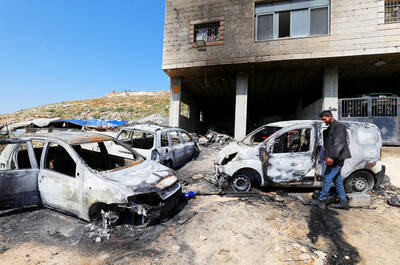
RAMPAGE: A Palestinian man was left dead after dozens of Israeli settlers searching for a missing 14-year-old boy stormed a village in the Israeli-occupied West Bank US President Joe Biden on Friday said he expected Iran to attack Israel “sooner, rather than later” and warned Tehran not to proceed. Asked by reporters about his message to Iran, Biden simply said: “Don’t,” underscoring Washington’s commitment to defend Israel. “We are devoted to the defense of Israel. We will support Israel. We will help defend Israel and Iran will not succeed,” he said. Biden said he would not divulge secure information, but said his expectation was that an attack could come “sooner, rather than later.” Israel braced on Friday for an attack by Iran or its proxies as warnings grew of

A prominent Christian leader has allegedly been stabbed at the altar during a Mass yesterday in southwest Sydney. Bishop Mar Mari Emmanuel was saying Mass at Christ The Good Shepherd Church in Wakeley just after 7pm when a man approached him at the altar and allegedly stabbed toward his head multiple times. A live stream of the Mass shows the congregation swarm forward toward Emmanuel before it was cut off. The church leader gained prominence during the COVID-19 pandemic, amassing a large online following, Officers attached to Fairfield City police area command attended a location on Welcome Street, Wakeley following reports a number


 RSS
RSS