


When Japan's US-drafted, pacifist Constitution came into effect two years after the country's defeat in World War II, a Japanese brass band marked the occasion by playing The Stars and Stripes Forever near the Imperial Palace.
That same day -- May 3, 1947 -- a former senior Japanese official committed suicide in shame over the document, which renounced war and placed sovereignty in the hands of citizens rather than an emperor worshipped as a living god.
Fifty-seven years later, as Japan's military heads for Iraq at the nudging of the US on its riskiest overseas mission since 1945, a consensus is emerging among politicians in favor of revising the constitution, not one word of which has been altered since enactment.
That itself is a sea change in a country where the security debate has long been constrained by the Constitution's famed Article 9, which renounces the right to wage war and, if taken literally, rules out the very notion of a standing army.
"For much of the postwar era, the mere mention of tinkering with the Constitution was enough to bring down a government," noted the liberal-leaning Asahi newspaper this week.
"Now, the only apparent disagreement between the ruling Liberal Democratic Party and the main opposition Democratic Party of Japan is what revisions to make and when," the newspaper said.
Conservatives who have chafed for decades at the Constitution hope that a public increasingly worried about regional military threats, notably from North Korea, will back a revision.
But thrashing out specific amendments will be contentious.
"It will take five years at a minimum," Prime Minister Junichiro Koizumi, who favors revising Article 9 to resolve the ambiguous status of the Self-Defense Forces, as Japan's military is known, said this week.
Yesterday, Koizumi's Liberal Democratic Party (LDP) adopted a party platform including a plan to draft a bill to revise the Constitution by 2005 and a pledge to enact as soon as possible a law spelling out procedures for a referendum.
Amendments must be approved by two-thirds of both houses of parliament and a majority of voters in a national referendum.
The LDP's Buddhist-backed coalition partner, the New Komeito, is wary of revising the pacifist clause and a voter survey last year showed that only 42 percent of respondents were in favor.
But in a sign of the changing times, Naoto Kan, leader of the main opposition Democratic Party, called this week for a new Constitution written by the Japanese themselves.
Kan says that altering Article 9 requires winning the trust of Asian nations with bitter memories of World War II and the Japanese colonization that preceded it.
"If we revise the Constitution to allow the overseas dispatch of Self-Defense Forces, it will invite huge problems unless we create a relationship of trust with neighboring countries [and assure them] that Japan will not take actions like those in the 1930s," he said in an interview late last year.
The government has been stretching the limits of Article 9 for the past decade, most recently with the decision to dispatch ground troops to help rebuild Iraq.
An advance army team left yesterday for Iraq to act as scouts for a mission that could total some 1,000 personnel.
The debate, however, looks certain to go well beyond Article 9 to embrace issues of culture, rights and obligations.
The Constitution "focuses on universalism, peace, democracy, basic human rights, international cooperation. In that sense, it is a fine Constitution," said Okiharu Yasuoka, head of an LDP panel on constitutional reform.
"But it also worked to exclude everything Japanese," Yasuoka said, adding a revised constitution should incorporate Japanese tradition and cultural values such as "wa," or harmony.
Proponents of such revisions argue they would help halt such social ills as rising crime and a breakdown in school discipline.
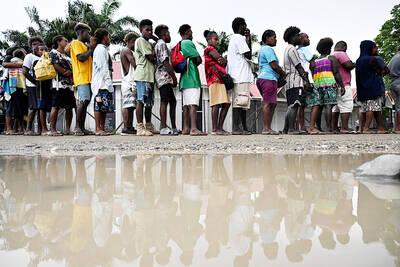
SEEKING CHANGE: A hospital worker said she did not vote in previous elections, but ‘now I can see that maybe my vote can change the system and the country’ Voting closed yesterday across the Solomon Islands in the south Pacific nation’s first general election since the government switched diplomatic allegiance from Taiwan to Beijing and struck a secret security pact that has raised fears of the Chinese navy gaining a foothold in the region. The Solomon Islands’ closer relationship with China and a troubled domestic economy weighed on voters’ minds as they cast their ballots. As many as 420,000 registered voters had their say across 50 national seats. For the first time, the national vote also coincided with elections for eight of the 10 local governments. Esther Maeluma cast her vote in the
Nearly half of China’s major cities are suffering “moderate to severe” levels of subsidence, putting millions of people at risk of flooding, especially as sea levels rise, according to a study of nationwide satellite data released yesterday. The authors of the paper, published by the journal Science, found that 45 percent of China’s urban land was sinking faster than 3mm per year, with 16 percent at more than 10mm per year, driven not only by declining water tables, but also the sheer weight of the built environment. With China’s urban population already in excess of 900 million people, “even a small portion

UNSETTLING IMAGES: The scene took place in front of TV crews covering the Trump trial, with a CNN anchor calling it an ‘emotional and unbelievably disturbing moment’ A man who doused himself in an accelerant and set himself on fire outside the courthouse where former US president Donald Trump is on trial has died, police said yesterday. The New York City Police Department (NYPD) said the man was declared dead by staff at an area hospital. The man was in Collect Pond Park at about 1:30pm on Friday when he took out pamphlets espousing conspiracy theories, tossed them around, then doused himself in an accelerant and set himself on fire, officials and witnesses said. A large number of police officers were nearby when it happened. Some officers and bystanders rushed

HYPOCRISY? The Chinese Ministry of Foreign Affairs yesterday asked whether Biden was talking about China or the US when he used the word ‘xenophobic’ US President Joe Biden on Wednesday called for a hike in steel tariffs on China, accusing Beijing of cheating as he spoke at a campaign event in Pennsylvania. Biden accused China of xenophobia, too, in a speech to union members in Pittsburgh. “They’re not competing, they’re cheating. They’re cheating and we’ve seen the damage here in America,” Biden said. Chinese steel companies “don’t need to worry about making a profit because the Chinese government is subsidizing them so heavily,” he said. Biden said he had called for the US Trade Representative to triple the tariff rates for Chinese steel and aluminum if Beijing was


 RSS
RSS