


The art galleries on Tbilisi's Irakly II Street have almost everything they need for success: well-done artwork and a prime location on one of the Georgian capital's most picturesque lanes. What they don't have is customers.
Alexander Cherkezishvili at The Old Gallery hopes the landslide election of Mikhail Saakashvili two days ago will change all that.
"He's young, he's educated; I'm sure he will bring changes," said Cherkezishvili, an unemployed architect minding the gallery for the owner, on Tuesday.
The gaggle of unemployed men hanging around outside the gallery echo Cherkezishvili's hopes, as do most Georgians, judging by Sunday's election results. With ballots counted from 57 of the 75 electoral districts, Saakashvili had 97.6 percent of the vote, said Zurab Chiaberashvili, the central election commission chairman.
Such huge victories usually result only from rigged elections, but international observers called Sunday's balloting substantially free and fair. By comparison, November parliamentary elections were marred by widespread fraud, prompting Saakashvili and other opposition figures to lead massive protests that drove President Eduard Shevardnadze to resign.
"Changes for sure -- though I don't know how," said Goga Tsakareishvili, part of the idle group in the street.
When asked what Saakashvili should choose as his top priority, Tsakareishvili said he should promote respect for law.
"Fight corruption!" shouted 76-year-old Sergei Uchava from a nearby bench, too frail to join the others standing.
Corruption -- ranging from small bribes to massive siphoning off of foreign aid and misappropriation of state assets -- dogs Georgians' thoughts constantly. In its smallest manifestations, it's a demoralizing irritant -- or worse -- a bothersome complication in daily life.
David Rurua says he lost his internal passport once and had to pay US$20 on top of the regular fee to get a new one.
"I'm a Georgian, I need a passport. What could I do?" he said.
Tsakareishvili, an unemployed construction worker, said building inspectors ask bribes for simple home renovations.
"If you build a new kitchen, the inspectors come and ask for US$50 or $US100," Tsakareishvili said.
"They can ask for a million if they want," he said.
At its highest manifestations, corruption has drained state coffers to the point that Uchava can't even expect regular payment of his 14-lari (US$7) monthly pension.
When it doesn't come, "my life goes on, but I don't know how," he said.
Georgia is perceived as one of the world's most corrupt countries, according to the Transparency International watchdog group, and the endemic corruption has discouraged foreign investors and stifled local entrepreneurship.
As they stood and sat in the street, the men were on a symbolic fault line between Georgia's failure and hopes.
On one side of the street, the buildings were in near-collapse, including a 17th century caravanserai -- an inn built around a central court -- where wet underwear dripped from the rough timbers holding up the walls.
On the other side, buildings with filigreed iron and wooden balconies gleamed with new coats of pink and blue paint, spurred by a local and World Bank project to repair the buildings' foundations, pump out the cellars and pave the street.
The buildings showcase the combination of Eastern and Western architecture that charmed visitors to Tbilisi back when tourists weren't an anomaly.
"They came from all over -- Germany, Ukraine, France," said Halil Mamed-Zade, owner of a carpet shop on a nearby street.
"Maybe they'll start coming again," he said.
"And from America, too, because America supports Saakashvili," said his assistant, Vladimir Grigorian.
Nearly half of China’s major cities are suffering “moderate to severe” levels of subsidence, putting millions of people at risk of flooding, especially as sea levels rise, according to a study of nationwide satellite data released yesterday. The authors of the paper, published by the journal Science, found that 45 percent of China’s urban land was sinking faster than 3mm per year, with 16 percent at more than 10mm per year, driven not only by declining water tables, but also the sheer weight of the built environment. With China’s urban population already in excess of 900 million people, “even a small portion

UNSETTLING IMAGES: The scene took place in front of TV crews covering the Trump trial, with a CNN anchor calling it an ‘emotional and unbelievably disturbing moment’ A man who doused himself in an accelerant and set himself on fire outside the courthouse where former US president Donald Trump is on trial has died, police said yesterday. The New York City Police Department (NYPD) said the man was declared dead by staff at an area hospital. The man was in Collect Pond Park at about 1:30pm on Friday when he took out pamphlets espousing conspiracy theories, tossed them around, then doused himself in an accelerant and set himself on fire, officials and witnesses said. A large number of police officers were nearby when it happened. Some officers and bystanders rushed

HYPOCRISY? The Chinese Ministry of Foreign Affairs yesterday asked whether Biden was talking about China or the US when he used the word ‘xenophobic’ US President Joe Biden on Wednesday called for a hike in steel tariffs on China, accusing Beijing of cheating as he spoke at a campaign event in Pennsylvania. Biden accused China of xenophobia, too, in a speech to union members in Pittsburgh. “They’re not competing, they’re cheating. They’re cheating and we’ve seen the damage here in America,” Biden said. Chinese steel companies “don’t need to worry about making a profit because the Chinese government is subsidizing them so heavily,” he said. Biden said he had called for the US Trade Representative to triple the tariff rates for Chinese steel and aluminum if Beijing was
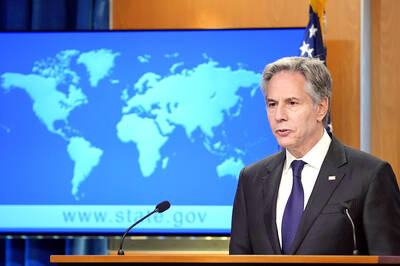
Beijing is continuing to commit genocide and crimes against humanity against Uyghurs and other Muslim minorities in its western Xinjiang province, U.S. Secretary of State Antony Blinken said in a report published on Monday, ahead of his planned visit to China this week. The State Department’s annual human rights report, which documents abuses recorded all over the world during the previous calendar year, repeated language from previous years on the treatment of Muslims in Xinjiang, but the publication raises the issue ahead of delicate talks, including on the war in Ukraine and global trade, between the top U.S. diplomat and Chinese


 RSS
RSS