


The ranks of the unemployed have swelled by nearly 1 million, consumer purchasing power has declined by 20 percent and the economy itself has failed to grow.
Yet as Luiz Inacio Lula da Silva completes his first year in office as Brazil's first working-class president, his popularity among Brazilians remains at a record high.
Da Silva, a 58-year-old former factory worker and labor leader, was elected in October 2002 with 52.5 million votes, more than the total of the winner of any presidential election in a democratic country anywhere except Ronald Reagan. Though da Silva occupies the other side of the political spectrum from Reagan, he now finds himself also being accused of being a Teflon leader.
Recent polls show that barely 40 percent of those surveyed believe that the Workers' Party government da Silva heads is doing a good job. But the president's favorable rating is holding steady at 70 percent, nearly 10 points higher than his share of the vote in October 2002.
"People don't just admire his biography or respect his political trajectory, they genuinely like and trust Lula in a way that has no precedent for a Brazilian president," said Marcos Coimbra, director of Vox Populi, a leading public opinion polling company here. "In spite of everything, he ends the year with more credibility and political capital than he started with, because he has shown that someone with his origins is capable of running the government."
For the most part, da Silva has followed the same economic policies that he criticized when they were being executed by the previous government, and he has failed, at least temporarily, to carry out the promises he made during the campaign. Inflation and interest rates have dropped and the budget surplus has risen, thrilling Wall Street, but the cost has been more joblessness and recession, which disappoints da Silva's supporters.
"I had to wait nine months to be born, 11 months to walk and 12 months to talk," he told restive factory workers in the industrial suburbs of Sao Paulo, where he began his political career 25 years ago, in a typically folksy plea for the patience he said was needed while he did the spadework the country required for a burst of growth. "So why am I going to do things in a hurry?"
At times, though, his Workers' Party has acted as if it is still in opposition and not governing a nation of 175 million people. The education minister has urged students to march on Brasilia, the capital, to protest tight financing for universities. One of the president's closest advisers described a jailed peasant leader as a "political prisoner," a term not used here since military rule ended nearly 20 years ago.
The social agenda, supposedly the greatest strength of the Workers' Party, has proved to be its principal weakness. Though sweeping agrarian reform was pledged, only a quarter of the promised number of families were resettled. Spending on social programs is down 8 percent from the level in the last year of the previous government, according to a recent opposition study, but even at that, da Silva's Zero Hunger program was able to spend only a third of its allotment last year.
"A government of beginners" was the phrase the daily O Estado de Sao Paulo used to describe the Workers' Party administration in an assessment published this week.
The daily Jornal do Brasil, in a similar article, stated, "Blunders, localized incompetence, festivals of insensitivity or simple slips and gaffes have lowered the ratings of some sectors of the government."
Da Silva has recently been promising that this year will be the year in which Brazil once again experiences "the spectacle of growth." Municipal elections are scheduled for October, and opposition leaders, seeking to turn the vote into a referendum on the national government, have warned that da Silva's embrace of their political program will not be enough to gain their support.
"This government is going to have to be weaned now," the minority leader in the Senate, Artur Virgilio, said just before Christmas. "This year we gave them a lot of sustenance, but now they are going to have to learn to walk on their own instead of being carried around in our lap."
In one area, at least, da Silva has been as good as his word: foreign relations. Though he criticized his predecessor, Fernando Henrique Cardoso, for spending too much time away from Brazil, da Silva has traveled abroad even more. He has been lobbying for a permanent seat on the UN Security Council for Brazil and pursuing a nationalist foreign policy.
With little to show on the domestic front, da Silva has been able to placate the left wing of his party by organizing a group of major developing nations to stand up to the US and the EU in global trade talks. But some of his other initiatives have been faulted as unnecessarily provocative, like a recent Middle East trip on which he visited Libya, where he described its dictator, Colonel Muammar Qaddafi as a good friend, and Syria, where he called on the US to withdraw from Iraq, but skipped Israel and Saudi Arabia.

Republican US lawmakers on Friday criticized US President Joe Biden’s administration after sanctioned Chinese telecoms equipment giant Huawei unveiled a laptop this week powered by an Intel artificial intelligence (AI) chip. The US placed Huawei on a trade restriction list in 2019 for contravening Iran sanctions, part of a broader effort to hobble Beijing’s technological advances. Placement on the list means the company’s suppliers have to seek a special, difficult-to-obtain license before shipping to it. One such license, issued by then-US president Donald Trump’s administration, has allowed Intel to ship central processors to Huawei for use in laptops since 2020. China hardliners
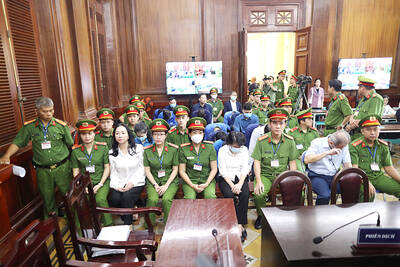
A top Vietnamese property tycoon was on Thursday sentenced to death in one of the biggest corruption cases in history, with an estimated US$27 billion in damages. A panel of three hand-picked jurors and two judges rejected all defense arguments by Truong My Lan, chair of major developer Van Thinh Phat, who was found guilty of swindling cash from Saigon Commercial Bank (SCB) over a decade. “The defendant’s actions ... eroded people’s trust in the leadership of the [Communist] Party and state,” read the verdict at the trial in Ho Chi Minh City. After the five-week trial, 85 others were also sentenced on
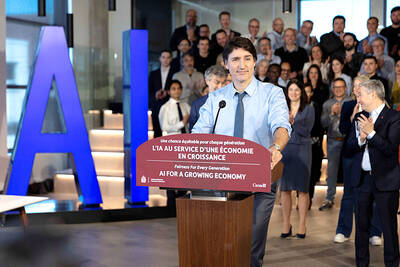
DISADVANTAGE: Erin O’Toole, who led the Conservatives during the election campaign in 2021, estimated that the interference cost his party as many as nine legislative seats Canada’s domestic spy agency on Monday concluded that China interfered in the past two elections, an official probe heard, the firmest evidence so far of suspected Chinese meddling in Canadian politics. Canadian Prime Minister Justin Trudeau’s Liberal Party won both the elections, held in 2019 and 2021. Under pressure from opposition lawmakers unhappy about media reports on China’s possible role, Trudeau set up a commission into foreign interference. The commission was shown a slide on Monday containing an extract of a briefing in February last year from the Canadian Security Intelligence Service (CSIS). “We know that the PRC [People’s Republic of China] clandestinely

‘DELUSIONAL’: Targeting the families of Hamas’ leaders would not push the group to change its position or to give up its demands for Palestinians, Ismail Haniyeh said Israeli aircraft on Wednesday killed three sons of Hamas’ top political leader in the Gaza Strip, striking high-stakes targets at a time when Israel is holding delicate ceasefire negotiations with the militant group. Hamas said four of the leader’s grandchildren were also killed. Ismail Haniyeh’s sons are among the highest-profile figures to be killed in the war so far. Israel said they were Hamas operatives, and Haniyeh accused Israel of acting in “the spirit of revenge and murder.” The deaths threatened to strain the internationally mediated ceasefire talks, which appeared to gain steam in recent days even as the sides remain far


 RSS
RSS