


Under pressure from consumer groups and Democratic presidential contenders, the Bush administration said on Monday it might require that more cattle be tested for mad cow disease, and it reported strong evidence the first US cow found with the sickness came from Canada.
White House officials were worried about both the political fallout and the economic impact of the disease just as the US.economy is showing signs of strength.
Privately, some Bush administration officials said that if the US case is linked to a Canadian herd in Alberta, where another case of mad cow was discovered in May, there may be little or no need to make any regulatory changes, according to an administration source.
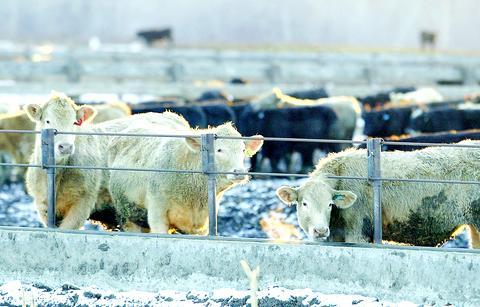
PHOTO: AFP
Mad cow, or bovine spongiform encephalopathy (BSE), is a fatal disease that destroys the brains of infected cattle. Humans can contract a form of the disease known as variant Creutzfeldt-Jakob Disease by eating tissue from the brains, spinal cords or central nervous systems of infected animals.
"One of the things we are looking at is additional testing," Ron DeHaven, the US Agriculture Department's chief veterinary officer, told reporters. "All of those options are on the table and they are being actively considered."
But he was cool to demands that USDA test all cattle, as Japan does. "This is a disease of older animals" with an incubation period of up to six years, DeHaven said.
The USDA now tests cattle that show signs of neurological disease, but it does not test all of the estimated 195,000 "downer" cattle that arrive for slaughter too sick or injured to walk.
The USDA has tested some 20,000 cattle this year and will nearly double that number next year, but that would still be a small fraction of the total US cattle slaughter which numbered some 35 million head last year.
USDA officials said they were convinced that the infected US cow was 6-1/2 years old at slaughter, old enough to have eaten tainted feed before the Canadian and US governments in 1997 banned cattle remains as an ingredient in cattle rations.
The animal's age "is a likely explanation" of how it was infected, DeHaven said. The probe is focusing on the source of livestock feed consumed by the infected US animal and its herdmates during their first few months of life, he said.
USDA officials reported more evidence that the infected Holstein cow in Washington state was born in Canada in April 1997, a link the USDA hopes will reassure US trade partners.
More than two dozen nations have stopped buying US beef, bringing the US$3.2 billion US beef export business to a halt.
Canada reported its first mad cow case in late May when a Black Angus cow was found to be infected. Ottawa was never able to pinpoint the cause, and it has insisted there is no definitive evidence yet to link the US cow to Canada.
In Calgary, Alberta, Premier Ralph Klein said the problem of mad cow disease requires cooperation, not finger-pointing.
"The frustrating part is, whether it's an American cow or a Canadian cow, the damage is damage that is caused by perception rather than reality," Klein told reporters.
The growing evidence of a Canadian link failed to persuade Japan to reconsider its ban on importing US beef. Japan bought more than US$1 billion worth of US beef, veal and variety meats last year.
US trade officials met with their Japanese counterparts in Tokyo on Monday to assure them that US safeguards were adequate, so beef sales could resume.
"I replied that safety issues come first," Japanese Agriculture Ministry official Hiroshi Nakagawa told reporters.
The USDA also expanded its investigation to trace the whereabouts of eight more animals that were shipped to the US along with the sick cow. That brings to 81 the total number of cattle being traced for possible infection.
Nearly half of China’s major cities are suffering “moderate to severe” levels of subsidence, putting millions of people at risk of flooding, especially as sea levels rise, according to a study of nationwide satellite data released yesterday. The authors of the paper, published by the journal Science, found that 45 percent of China’s urban land was sinking faster than 3mm per year, with 16 percent at more than 10mm per year, driven not only by declining water tables, but also the sheer weight of the built environment. With China’s urban population already in excess of 900 million people, “even a small portion

UNSETTLING IMAGES: The scene took place in front of TV crews covering the Trump trial, with a CNN anchor calling it an ‘emotional and unbelievably disturbing moment’ A man who doused himself in an accelerant and set himself on fire outside the courthouse where former US president Donald Trump is on trial has died, police said yesterday. The New York City Police Department (NYPD) said the man was declared dead by staff at an area hospital. The man was in Collect Pond Park at about 1:30pm on Friday when he took out pamphlets espousing conspiracy theories, tossed them around, then doused himself in an accelerant and set himself on fire, officials and witnesses said. A large number of police officers were nearby when it happened. Some officers and bystanders rushed

HYPOCRISY? The Chinese Ministry of Foreign Affairs yesterday asked whether Biden was talking about China or the US when he used the word ‘xenophobic’ US President Joe Biden on Wednesday called for a hike in steel tariffs on China, accusing Beijing of cheating as he spoke at a campaign event in Pennsylvania. Biden accused China of xenophobia, too, in a speech to union members in Pittsburgh. “They’re not competing, they’re cheating. They’re cheating and we’ve seen the damage here in America,” Biden said. Chinese steel companies “don’t need to worry about making a profit because the Chinese government is subsidizing them so heavily,” he said. Biden said he had called for the US Trade Representative to triple the tariff rates for Chinese steel and aluminum if Beijing was
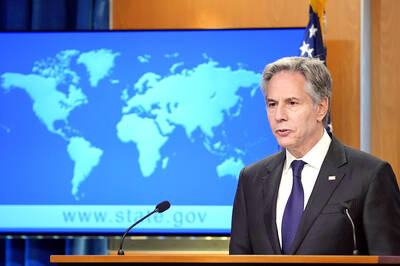
Beijing is continuing to commit genocide and crimes against humanity against Uyghurs and other Muslim minorities in its western Xinjiang province, U.S. Secretary of State Antony Blinken said in a report published on Monday, ahead of his planned visit to China this week. The State Department’s annual human rights report, which documents abuses recorded all over the world during the previous calendar year, repeated language from previous years on the treatment of Muslims in Xinjiang, but the publication raises the issue ahead of delicate talks, including on the war in Ukraine and global trade, between the top U.S. diplomat and Chinese


 RSS
RSS