


China marked the 110th anniversary of revolutionary leader Mao Zedong's birth yesterday with a rap song, new books and praise by state media -- but little public notice from the country's increasingly market-oriented communist leaders.
Dozens of plays, exhibitions and television documentaries were scheduled to glorify the life of Mao, the communist founder who led China from 1949 until his death in 1976.
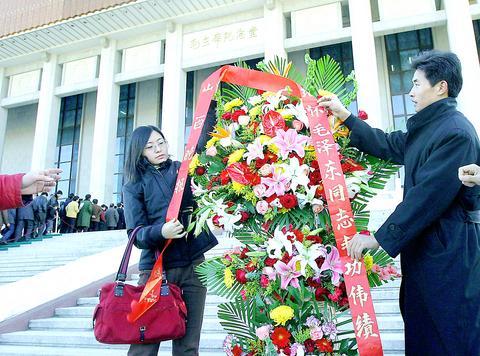
PHOTO: AFP
"The greatness of comrade Mao Zedong (
However, in a sign of Mao's declining political importance, the editorial appeared on page four of the newspaper. The front page was dominated by a picture of current President Hu Jintao (
In a pop culture twist, a rap titled "The Two Musts," after one of the former Great Leader's sayings on politics, appears on a new album titled "Mao Zedong and Us."
Its lyrics say:
"You must preserve modesty and prudence.
"You must preserve the style of plain living and hard struggle."
The low-key official commemoration underscored the desire to hold Mao up as a model of leadership and service, while playing down his destructive political campaigns and vendettas.
Soon after Mao's death, the party began undoing many of his restrictions on private business, as well as some of its intrusions into the arts and private life.
And in a move that would have horrified Mao, the party earlier this week proposed amending the Chinese Constitution to guarantee the right to private property. It will raise the official status of the entrepreneurs who once were considered the enemy but now drive China's economy.
Still, Mao's political theories remain a required course in universities. A steady stream of books, films and even Web sites cater to an abiding interest in his life.
The Mao memorial hall in Shaoshan -- the southern town where he was born on Dec. 26, 1893 -- recently installed multimedia presentations, along with the thousands of pieces of clothing, books, crockware and other articles used by Mao in his daily life, the official Xinhua News Agency reported.
Some 40 million people have visited the hall, including top leaders from more than 100 nations, it said.
Commemorations have also delved into the lives of Mao's descendants, none of whom has been prominent in Chinese politics since his death.

Republican US lawmakers on Friday criticized US President Joe Biden’s administration after sanctioned Chinese telecoms equipment giant Huawei unveiled a laptop this week powered by an Intel artificial intelligence (AI) chip. The US placed Huawei on a trade restriction list in 2019 for contravening Iran sanctions, part of a broader effort to hobble Beijing’s technological advances. Placement on the list means the company’s suppliers have to seek a special, difficult-to-obtain license before shipping to it. One such license, issued by then-US president Donald Trump’s administration, has allowed Intel to ship central processors to Huawei for use in laptops since 2020. China hardliners

Conjoined twins Lori and George Schappell, who pursued separate careers, interests and relationships during lives that defied medical expectations, died this month in Pennsylvania, funeral home officials said. They were 62. The twins, listed by Guinness World Records as the oldest living conjoined twins, died on April 7 at the Hospital of the University of Pennsylvania, obituaries posted by Leibensperger Funeral Homes of Hamburg said. The cause of death was not detailed. “When we were born, the doctors didn’t think we’d make 30, but we proved them wrong,” Lori said in an interview when they turned 50, the Philadelphia Inquirer reported. The

RAMPAGE: A Palestinian man was left dead after dozens of Israeli settlers searching for a missing 14-year-old boy stormed a village in the Israeli-occupied West Bank US President Joe Biden on Friday said he expected Iran to attack Israel “sooner, rather than later” and warned Tehran not to proceed. Asked by reporters about his message to Iran, Biden simply said: “Don’t,” underscoring Washington’s commitment to defend Israel. “We are devoted to the defense of Israel. We will support Israel. We will help defend Israel and Iran will not succeed,” he said. Biden said he would not divulge secure information, but said his expectation was that an attack could come “sooner, rather than later.” Israel braced on Friday for an attack by Iran or its proxies as warnings grew of

IN PURSUIT: Israel’s defense minister said the revenge attacks by Israeli settlers would make it difficult for security forces to find those responsible for the 14-year-old’s death Israeli Prime Minister Benjamin Netanyahu on Saturday condemned the “heinous murder” of an Israeli teenager in the occupied West Bank as attacks on Palestinian villages intensified following news of his death. After Benjamin Achimeir, 14, was reported missing near Ramallah on Friday, hundreds of Jewish settlers backed by Israeli forces raided nearby Palestinian villages, torching vehicles and homes, leaving at least one villager dead and dozens wounded. The attacks escalated in several villages on Saturday after Achimeir’s body was found near the Malachi Hashalom outpost. Agence France-Presse correspondents saw smoke rising from burned houses and fields. Mayor Amin Abu Alyah, of the


 RSS
RSS