


A massive suicide bomb ripped through a crowded road near the capital yesterday in a failed attempt to assassinate President General Pervez Musharraf, a senior government official said. The president was unhurt, but at least seven passers-by were killed.
It was the second attack this month targeting the military president, and came just a day after he agreed to step down as army chief by the end of next year.
The blast occurred when a suicide bomber rammed a pickup truck into a police vehicle in Rawalpindi, a city near the capital, Islamabad, at about 1:45pm. Eyewitnesses reported seeing body parts, shattered cars and broken glass along the route.
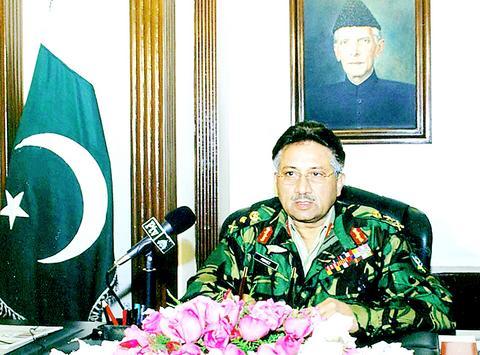
PHOTO: AFP
Information Minister Sheikh Rashid Ahmed said the suicide attack appeared to be aimed at Musharraf, and that the Pakistani leader was safe.
"The president's motorcade had just passed and about half a minute later the explosion went off," one eyewitness, Nasir Sadiqi, told Pakistan's Geo television.
Abdur Rauf Chaudry, a spokesman for the Interior Ministry, said the dead appeared to all be passers-by. Fourteen other people were injured, including two policemen, Chaudry said.
General Shaukat Sultan, the army spokesman, said officials are investigating.
Police and soldiers quickly cordoned off the area and ambulances rushed to the site. About 15 cars were destroyed in the attack and windows from nearby buildings were shattered.
The blast occurred just 300m from the spot where would-be assassins detonated a huge bomb on Dec. 14 in a failed attempt to assassinate Musharraf. High-tech jamming devices in the president's motorcade apparently delayed the detonation long enough for him to pass by safely.
Islamic militant groups were believed behind that attack, though no major arrests have been made. Government officials have speculated that al-Qaeda might have had a hand in the first attempt, which employed a sophisticated bomb hidden in five places on a bridge.
Security is always tight when Musharraf travels, with roads closed to allow his long motorcade to pass and heavily-armed soldiers surrounding his vehicle. Musharraf lives at the heavily-guarded army headquarters in Rawalpindi.
Security measures were even more stringent yesterday as Pakistan's tiny Christian community celebrated Christmas.
The attack came a day after Musharraf agreed to step-down as army chief by the end of next year, ending a political stalemate that had paralyzed parliament and stalled this nation's return to democracy.
Musharraf called his decision "difficult."
"I realize that it's time. I have decided that I will give up my uniform by December 2004 and will step down as Chief of Army Staff," he said on state television.
Speaking in Urdu and wearing military dress, Musharraf added: "These are all historic decisions. Nobody has won or lost because of these decisions. Democracy has won and the victory is Pakistan's."
Musharraf made the decision as part of a deal with the opposition Muttahida Majlis-e-Amal (MMA) -- an alliance of six Islamic opposition parties -- which have promised to abstain in a vote of confidence in the government expected early next year.
The agreement is likely to see the general's term in office extended until 2007, although any weakening of his links to the military could undermine his position.
Although he does not come away from the deal empty-handed, Musharraf's concessions could raise eyebrows in the West.
A key ally in the US "war on terror," Musharraf has been hailed as instrumental to Pakistan's economic recovery and its crackdown on Islamic militancy.

Republican US lawmakers on Friday criticized US President Joe Biden’s administration after sanctioned Chinese telecoms equipment giant Huawei unveiled a laptop this week powered by an Intel artificial intelligence (AI) chip. The US placed Huawei on a trade restriction list in 2019 for contravening Iran sanctions, part of a broader effort to hobble Beijing’s technological advances. Placement on the list means the company’s suppliers have to seek a special, difficult-to-obtain license before shipping to it. One such license, issued by then-US president Donald Trump’s administration, has allowed Intel to ship central processors to Huawei for use in laptops since 2020. China hardliners
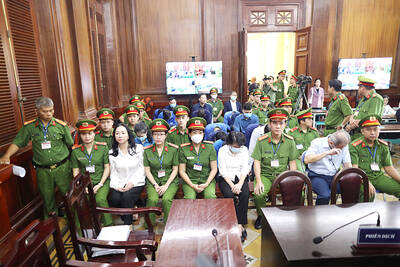
A top Vietnamese property tycoon was on Thursday sentenced to death in one of the biggest corruption cases in history, with an estimated US$27 billion in damages. A panel of three hand-picked jurors and two judges rejected all defense arguments by Truong My Lan, chair of major developer Van Thinh Phat, who was found guilty of swindling cash from Saigon Commercial Bank (SCB) over a decade. “The defendant’s actions ... eroded people’s trust in the leadership of the [Communist] Party and state,” read the verdict at the trial in Ho Chi Minh City. After the five-week trial, 85 others were also sentenced on

‘DELUSIONAL’: Targeting the families of Hamas’ leaders would not push the group to change its position or to give up its demands for Palestinians, Ismail Haniyeh said Israeli aircraft on Wednesday killed three sons of Hamas’ top political leader in the Gaza Strip, striking high-stakes targets at a time when Israel is holding delicate ceasefire negotiations with the militant group. Hamas said four of the leader’s grandchildren were also killed. Ismail Haniyeh’s sons are among the highest-profile figures to be killed in the war so far. Israel said they were Hamas operatives, and Haniyeh accused Israel of acting in “the spirit of revenge and murder.” The deaths threatened to strain the internationally mediated ceasefire talks, which appeared to gain steam in recent days even as the sides remain far
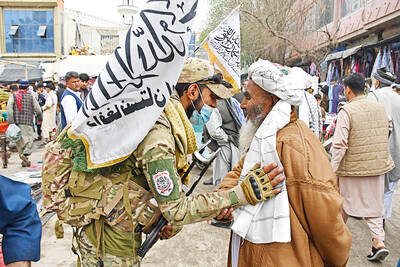
The Taliban’s reclusive supreme leader made a rare public appearance yesterday, an Afghan government spokesman said, leading thousands of worshipers in prayers marking Eid al-Fitr. Hibatullah Akhundzada has made only a handful of public appearances since inheriting the leadership of the Taliban in 2016 and leading the movement back to power with the withdrawal of US forces in 2021. Taliban government spokesman Zabihullah Mujahid said prayer in the largest mosque in Kandahar was “performed under the leadership of the supreme leader.” In a statement on X, he said the early-morning service “was attended by thousands of compatriots” in the southern province considered the


 RSS
RSS