


Just before Japan announced its decision to buy an unproven US missile shield to defend itself against any future North Korean attack, the Australian government chose a much cheaper option.
It announced its decision to seek a research role in the multi-layered systems being developed by the US' Missile Defense Agency.
Although overshadowed by the later Japanese commitment to spend tens of billions of dollars to acquire a missile defense capability as soon as 2007, the Australian move adds to regional concerns that the program may spur a dangerous Asian arms race.
The Indonesian government said Australia's decision could destabilize the region and spark a regional contest to acquire increasingly sophisticated offensive and defensive systems.
"Australia should deal with its neighbors and not try to isolate itself from the region," the Indonesian foreign affairs spokesman, Marty Natelgawa, told Australian reporters.
"Our view has always been that research into such a system opens the potential for a new arms race. It could be potentially destabilizing," he said.
"As far as Indonesia is concerned, destabilization is not something that's inevitable, but from where we stand at the moment we see these things offering more uncertainties or complications than solutions."
The Chinese embassy in Canberra refused to comment on the Australian support for the missile defense system.
Its silence was a clear diplomatic signal of its displeasure and put the Australian foreign minister, Alexander Downer, on the defensive.
"The arms race argument is absurd," Downer said. "While China has never supported our position they increasingly understand that it isn't directed either at them, or the China-Taiwan issue.
"Australia is not being a US lackey as some of our critics claim. Our concern is the possibility of long range missiles being fired at Australia.
"We have to have some capacity to defend ourselves."
However, the analytical briefings being given in Canberra include some additional elements.
A comparison is being drawn between the economic stresses that US president Ronald Reagan's Star Wars program put on an already failing Soviet economy in its final years and the impact the "little" or baby Star Wars technology of the missile defense program might impose on the cash-starved regime of North Korean leader Kim Jong-il in Pyongyang.
Even though the Star Wars missile defense umbrella for the US was later declared a technological impossibility it is often argued to have been the most lethal mind game ever waged by one superpower against another.
The US ambassador in Australia, Thomas Schieffer, keeps comparing the two programs in his public comments.
"Star Wars was a strategic system designed to deter great powers like Russia and China. This system is directed only at rogue states.
"We hope that China and Russia will participate. We do not think it is a threat," he said.
Whether designed to bring down the North Korean economy, or any missiles it might fire at Japanese, the missile defense program seems likely to get conditional support from Mark Latham, the new leader of the Australian Labor Party.
In the few weeks that he has been opposition leader, Latham has put Labor into serious contention to beat the current conservative coalition government of Prime Minister John Howard in the general election, which must be held sometime next year.
While Latham has refused to give immediate endorsement to an Australian role in the US program pending future discussions, party sources say he favours participation because it would give the country a seat at the table when crucial decisions were being made.
Apart from that, Latham has pledged to maintain defense ties with the US despite calling US President George W Bush "the most dangerous US president in history."
Canberra defense analyst Geoffrey Barker said the missile defense system was technically speculative and strategically momentous.
"It is especially likely to have repercussions in our region, where China, our most important emerging trading partner, is deeply skeptical.
"It overturns three decades of thinking on nuclear containment based on the deterrent of mutually assured destruction and the Anti-Ballistic Missile Treaty. It also promises to be prohibitively costly, with a down payment of $50 billion over the next five years, though Australia's contribution will be small."
And the doubts keep mounting up, like the costs. In September the US General Accounting Office noted that only two of ten technologies vital to the success of the missile shield are proven.
The American Physical Society, representing eminent physicists and engineers linked to the defense establishment, had declared that a crucial part of the missile shield -- stopping a missile during the rocket boost phase -- might never work.
However, defense sources in Canberra say the initial system looks promising, being based on Aegis class destroyers firing SM-3 interceptor rockets toward rising hostile missiles, and ground-based Patriot Advanced Capability-3 missiles mopping up those that made it closer to their targets.
Unfortunately, promising doesn't mean foolproof or terrorist-proof.
None of the analysts briefing the Australian media could explain how the missile defense system would stop the personal delivery of a nuclear or biological weapon via a briefcase.

Republican US lawmakers on Friday criticized US President Joe Biden’s administration after sanctioned Chinese telecoms equipment giant Huawei unveiled a laptop this week powered by an Intel artificial intelligence (AI) chip. The US placed Huawei on a trade restriction list in 2019 for contravening Iran sanctions, part of a broader effort to hobble Beijing’s technological advances. Placement on the list means the company’s suppliers have to seek a special, difficult-to-obtain license before shipping to it. One such license, issued by then-US president Donald Trump’s administration, has allowed Intel to ship central processors to Huawei for use in laptops since 2020. China hardliners

Conjoined twins Lori and George Schappell, who pursued separate careers, interests and relationships during lives that defied medical expectations, died this month in Pennsylvania, funeral home officials said. They were 62. The twins, listed by Guinness World Records as the oldest living conjoined twins, died on April 7 at the Hospital of the University of Pennsylvania, obituaries posted by Leibensperger Funeral Homes of Hamburg said. The cause of death was not detailed. “When we were born, the doctors didn’t think we’d make 30, but we proved them wrong,” Lori said in an interview when they turned 50, the Philadelphia Inquirer reported. The
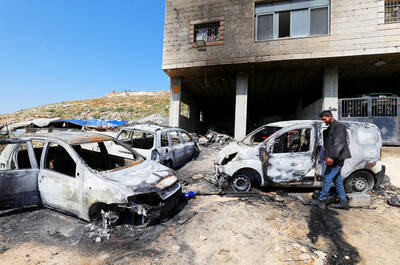
RAMPAGE: A Palestinian man was left dead after dozens of Israeli settlers searching for a missing 14-year-old boy stormed a village in the Israeli-occupied West Bank US President Joe Biden on Friday said he expected Iran to attack Israel “sooner, rather than later” and warned Tehran not to proceed. Asked by reporters about his message to Iran, Biden simply said: “Don’t,” underscoring Washington’s commitment to defend Israel. “We are devoted to the defense of Israel. We will support Israel. We will help defend Israel and Iran will not succeed,” he said. Biden said he would not divulge secure information, but said his expectation was that an attack could come “sooner, rather than later.” Israel braced on Friday for an attack by Iran or its proxies as warnings grew of
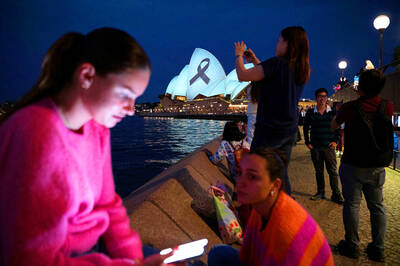
A prominent Christian leader has allegedly been stabbed at the altar during a Mass yesterday in southwest Sydney. Bishop Mar Mari Emmanuel was saying Mass at Christ The Good Shepherd Church in Wakeley just after 7pm when a man approached him at the altar and allegedly stabbed toward his head multiple times. A live stream of the Mass shows the congregation swarm forward toward Emmanuel before it was cut off. The church leader gained prominence during the COVID-19 pandemic, amassing a large online following, Officers attached to Fairfield City police area command attended a location on Welcome Street, Wakeley following reports a number


 RSS
RSS