


The Christmas carol Deck the Halls blares over the speakers of the warehouse store as the toddler lunges for a plastic Santa. His mother grabs him by the seat of his pants and hauls him back.
It's a classic Christmas shopping moment in the unlikely setting of central China -- though one that is becoming more common as Chinese, few of whom are Christians, adopt the holiday as a festive shopping season.
But for members of China's unofficial Christian congregations, this is a season of fear as communist authorities crack down on unauthorized worship, detaining activists and bulldozing churches.
"Everyone is scared now. This Christmas will be tougher than usual," said the organizer of an underground church in the eastern city of Hangzhou whose building was destroyed in October. The man asked not to be identified by name.
The sharp contrast between the crackdown and the Christmas festivities highlights Chinese authorities' desire to isolate religious dissenters while exploiting the holiday's commercial potential.
"The central policy of the Communist Party has never shied from good commercial opportunities," said Bob Fu, a US-based monitor of the underground Chinese church.
"They can call it `Christmas with Chinese characteristics,'" Fu said, borrowing the ruling party's language for China's interpretation of such Western concepts as socialism.
China's government allows worship only in government-monitored churches, temples and mosques. But tens of millions of believers belong to unauthorized churches, whose clergy and members are frequently harassed and detained.
Official controls on religion stem from government unease that churches could act as a rallying point for opposition that could threaten communist rule.
Communist leaders barred most religious activity following the 1949 revolution, ordering Chinese to cut ties with fellow believers abroad.
Christianity took root in China about 150 years ago, spread by missionaries accompanying European and American traders who were setting up colonial enclaves along its east coast.
Today, about 15 million Protestants and 10 million Catholics worship in the official churches. Millions more are believed to belong to the unofficial or "house" churches.
The rise of Christmas as a secular bright spot during the bleak Chinese winter has paralleled the rise of capitalist-style economic reforms.
In Shanghai, the country's commercial capital, a 21m-high Christmas tree stands on a stretch of Nanjing West Road that is dotted with boutiques for Gucci, Versace and other expensive foreign designer brands.
In an echo of American tradition, several shopping centers are advertising visits by Santa Claus. Another promises a "red-nosed clown special holiday."
Such marketing has spread inland to Changsha, an industrial center along the Yangtze river, where Christmas carols are piped through the Trust Mart discount store and ribbons, wreathes and fake snow adorn doorways.
"It's a lively atmosphere. It makes people happy and helps with business," said shop assistant Wendy Huang, wearing a red-and-white Santa Claus hat and vest.
It's not clear how much the promotions are boosting sales.
Secret too is how authorities wish to keep information about the crackdown on unregistered churches outside Hangzhou, about 150km southwest of Shanghai.
About a dozen churches have been destroyed here since the summer, along with scores of Buddhist temples and Taoist shrines, according to activists and human rights monitors.
Three church activists have been arrested on charges of revealing state secrets for talking about the crackdown, according to the Hong Kong-based Information Center for Human Rights and Democracy.
Such actions vary from place to place, with greater tolerance reported in the northeast and some other parts of China.
Yet selective enforcement of rules can intimidate unofficial congregations everywhere, the US State Department said in its annual report on religious freedom in China.
China's "respect for freedom of religion and freedom of conscience remained poor, especially for many unregistered religious groups and spiritual movements," the report said.
China's Foreign Ministry res-ponded Sunday, rejecting the criticism and accusing Washington of "interfering in China's internal affairs under the guise of religious issues."
At Shanghai's imposing Cath-edral of St. Ignatius -- part of the officially authorized Roman Catholic Church -- such feuds and commercialism seem far away.
Parishioners follow the Chinese-language Mass on big screen televisions while the only ornaments are a nativity scene in one of the vaults. Christmas Day services are so popular that the church distributes tickets in order to limit the numbers who attend.
"We don't pay any attention to the rest of those things," said Li Ting, a middle-aged parishioner. "We just want to carry out our religion and celebrate this special time of year."
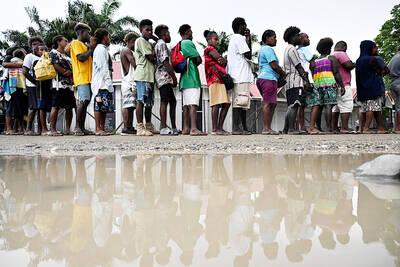
SEEKING CHANGE: A hospital worker said she did not vote in previous elections, but ‘now I can see that maybe my vote can change the system and the country’ Voting closed yesterday across the Solomon Islands in the south Pacific nation’s first general election since the government switched diplomatic allegiance from Taiwan to Beijing and struck a secret security pact that has raised fears of the Chinese navy gaining a foothold in the region. The Solomon Islands’ closer relationship with China and a troubled domestic economy weighed on voters’ minds as they cast their ballots. As many as 420,000 registered voters had their say across 50 national seats. For the first time, the national vote also coincided with elections for eight of the 10 local governments. Esther Maeluma cast her vote in the
Nearly half of China’s major cities are suffering “moderate to severe” levels of subsidence, putting millions of people at risk of flooding, especially as sea levels rise, according to a study of nationwide satellite data released yesterday. The authors of the paper, published by the journal Science, found that 45 percent of China’s urban land was sinking faster than 3mm per year, with 16 percent at more than 10mm per year, driven not only by declining water tables, but also the sheer weight of the built environment. With China’s urban population already in excess of 900 million people, “even a small portion

UNSETTLING IMAGES: The scene took place in front of TV crews covering the Trump trial, with a CNN anchor calling it an ‘emotional and unbelievably disturbing moment’ A man who doused himself in an accelerant and set himself on fire outside the courthouse where former US president Donald Trump is on trial has died, police said yesterday. The New York City Police Department (NYPD) said the man was declared dead by staff at an area hospital. The man was in Collect Pond Park at about 1:30pm on Friday when he took out pamphlets espousing conspiracy theories, tossed them around, then doused himself in an accelerant and set himself on fire, officials and witnesses said. A large number of police officers were nearby when it happened. Some officers and bystanders rushed

HYPOCRISY? The Chinese Ministry of Foreign Affairs yesterday asked whether Biden was talking about China or the US when he used the word ‘xenophobic’ US President Joe Biden on Wednesday called for a hike in steel tariffs on China, accusing Beijing of cheating as he spoke at a campaign event in Pennsylvania. Biden accused China of xenophobia, too, in a speech to union members in Pittsburgh. “They’re not competing, they’re cheating. They’re cheating and we’ve seen the damage here in America,” Biden said. Chinese steel companies “don’t need to worry about making a profit because the Chinese government is subsidizing them so heavily,” he said. Biden said he had called for the US Trade Representative to triple the tariff rates for Chinese steel and aluminum if Beijing was


 RSS
RSS