


Global efforts to battle HIV/AIDS and other diseases and reduce the number of women who die in childbirth will founder unless the international community boosts basic medical care in poor countries, the UN health agency said yesterday.
Campaigns against individual diseases are essential, but policy-makers also must focus on overall health services because neglecting them increases the risk that epidemics will spread across national borders, the World Health Organization (WHO) said in its annual report.
AIDS kills 5,000 adults and 1,000 children every day in Africa. Life expectancy there has plunged as much as 20 years because of the disease.
The disease has put medical services under such pressure that they have trouble coping with a host of other diseases, widening the health divide between rich and poor nations, said WHO.
"These global health gaps are unacceptable," said WHO chief Dr. Lee Jong-wook in his introduction to the 193-page World Health Report. Global efforts -- like a WHO-spearheaded program to increase access to anti-HIV drugs -- face "obstacles that have slowed and in some cases reversed progress toward meeting the health needs of all people."
"Effective action to improve population health is possible in every country but it takes local knowledge and strength and sustained international support to turn that possibility into reality," Lee said. "This means working with countries -- especially those most in need -- not only to confront health crises, but to construct sustainable and equitable health systems," Lee said.
The report said donors can counter some of the weaknesses by funding more training for health workers, while governments should boost partnerships between health officials and affected communities.
The urgency of the challenge is illustrated by the contrasting prospects of baby girls born at the same moment in Japan and Sierra Leone, the report said. While the Japanese baby can expect to live for about 85 years, life expectancy for the child in one of Africa's poorest countries is just 36 years.
The Japanese girl will likely receive some of the world's best health care whenever she needs it, but the girl in Sierra Leone may never see a doctor, nurse or health worker.
Around 30 million people in African nations are infected with HIV/AIDS, about 70 per cent of all cases in the world. But even without the impact of the disease, the WHO said, millions of children born in Africa and other poor regions are at greater risk of dying before their fifth birthday than they were a decade ago.
In developing countries, infectious diseases represent seven out of the 10 major causes of child deaths. Some of the leading child killers last year were respiratory infections, which caused 1.9 million deaths. Diarrhea killed 1.6 million and malaria 1.1 million.
"Those who do make it past childhood are confronted with adult death rates that exceed those of 30 years ago," the report said.
The gap between industrialized and developing countries is also stark in the statistics on maternal mortality, the WHO said. The risk for women of dying in childbirth is 250 times higher in poor countries than in rich ones. More than 500,000 women die each year as a result of complications during pregnancy.
The report also highlights the spread in developing countries of epidemics of heart disease, stroke and other chronic diseases, which in addition to communicable diseases create a "double burden" of premature death and ill-health.
The WHO said policy-makers should find a "double response," by integrating prevention and control of communicable and non-communicable diseases.
Of the 45 million deaths among adults worldwide last year, almost three-quarters were caused by non-communicable diseases. These are the main cause of death in all regions, except Africa, where HIV/AIDS has become the leading cause of mortality among adults aged 15-59 years.
The leading killers last year were: HIV/AIDS, with 2.3 million deaths; heart disease, 1.3 million; tuberculosis, 1 million; stroke, 800,000. Road accidents killed 800,000 people, mostly in developing countries.

Republican US lawmakers on Friday criticized US President Joe Biden’s administration after sanctioned Chinese telecoms equipment giant Huawei unveiled a laptop this week powered by an Intel artificial intelligence (AI) chip. The US placed Huawei on a trade restriction list in 2019 for contravening Iran sanctions, part of a broader effort to hobble Beijing’s technological advances. Placement on the list means the company’s suppliers have to seek a special, difficult-to-obtain license before shipping to it. One such license, issued by then-US president Donald Trump’s administration, has allowed Intel to ship central processors to Huawei for use in laptops since 2020. China hardliners
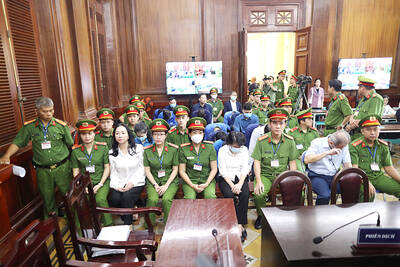
A top Vietnamese property tycoon was on Thursday sentenced to death in one of the biggest corruption cases in history, with an estimated US$27 billion in damages. A panel of three hand-picked jurors and two judges rejected all defense arguments by Truong My Lan, chair of major developer Van Thinh Phat, who was found guilty of swindling cash from Saigon Commercial Bank (SCB) over a decade. “The defendant’s actions ... eroded people’s trust in the leadership of the [Communist] Party and state,” read the verdict at the trial in Ho Chi Minh City. After the five-week trial, 85 others were also sentenced on

Conjoined twins Lori and George Schappell, who pursued separate careers, interests and relationships during lives that defied medical expectations, died this month in Pennsylvania, funeral home officials said. They were 62. The twins, listed by Guinness World Records as the oldest living conjoined twins, died on April 7 at the Hospital of the University of Pennsylvania, obituaries posted by Leibensperger Funeral Homes of Hamburg said. The cause of death was not detailed. “When we were born, the doctors didn’t think we’d make 30, but we proved them wrong,” Lori said in an interview when they turned 50, the Philadelphia Inquirer reported. The
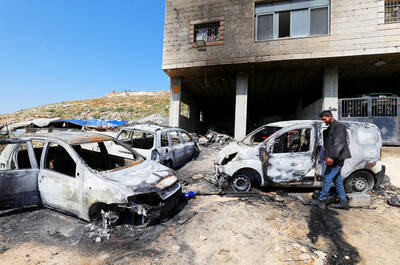
RAMPAGE: A Palestinian man was left dead after dozens of Israeli settlers searching for a missing 14-year-old boy stormed a village in the Israeli-occupied West Bank US President Joe Biden on Friday said he expected Iran to attack Israel “sooner, rather than later” and warned Tehran not to proceed. Asked by reporters about his message to Iran, Biden simply said: “Don’t,” underscoring Washington’s commitment to defend Israel. “We are devoted to the defense of Israel. We will support Israel. We will help defend Israel and Iran will not succeed,” he said. Biden said he would not divulge secure information, but said his expectation was that an attack could come “sooner, rather than later.” Israel braced on Friday for an attack by Iran or its proxies as warnings grew of


 RSS
RSS