


Afghanistan's grand council was yesterday finally due to debate the new constitution after days of wrangling over procedure and uproar after a woman delegate accused former mujahidin of causing the four-year civil war.
The 502 delegates to the Loya Jirga ("grand assembly") have been divided into 10 groups to discuss the controversial document and debate the country's future form of government.
Malalai Joya, a delegate from western Farah province, inflamed the gathering on Wednesday by criticizing the mujahidin and calling for them to be put on trial.
Afghan soldiers had to mount the stage to keep order as dozens of angry mujahidin delegates rushed it, demanding she be expelled.
The unruly scenes were sparked after Joya opposed a plan by several mujahidin delegates for an open discussion on the proposed system of government before splitting up into 10 groups to debate the document which is intended to pave the way for Afghanistan's first democratic elections next year.
Joya's intervention exacerbated the sharp differences that have emerged over key issues such as the power of the president since Sunday's opening by former king Mohammad Zahir Shah.
She told the assembly the mujahidin were "the main factors who led this country towards crisis and civil war."
"They should be tried in national and international courts," she said before dozens of mujahidin rushed to the stage and demanded the expulsion of Joya, one of around 100 female delegates. She was eventually allowed to stay.
The struggle between former anti-Soviet mujahidin factions plunged Afghanistan into four years of civil war until the Taliban seized power in 1996.
Most of Kabul was destroyed by mujahidin fighting, rather than during the Soviet or Taliban eras.
Delegates are divided between those who support the strong presidential system laid down in the draft and those, including some mujahidin factions, who would prefer some form of prime minister or at least a parliament with real teeth to counter-balance sweeping presidential powers.
President Hamid Karzai has repeatedly said he will only stand in next year's presidential polls if the Loya Jirga approves the system laid down in the draft document.
Despite his repeated calls for a presidential system, Karzai on Wednesday said it was up to Loya Jirga delegates to decide now the draft constitution was in their hands.
"It's none of our business," he told reporters.
Some delegates however have alleged government interference behind the scenes and threatened to boycott the convention.
With Afghanistan slowly emerging from decades of conflict, several delegates have previously backed Karzai's view that a strong presidential system was needed as the country lacked the mature political parties for a successful parliamentary democracy.
Others pointed out that many groups claiming to be political parties are little more than armed militia factions.
However, several delegates have called for a parliamentary system and one said Karzai should compromise with his opponents.
Critics have warned that the current draft risks widening the country's deep ethnic and factional divides.
Streets around the Loya Jirga site have been sealed off while foreign peacekeepers, newly-trained Afghan soldiers, police and secret service agents provided heavy layers of security.
The ousted Taliban have threatened to disrupt the assembly. They claimed responsibility for a rocket attack on Kabul early on Tuesday which damaged a house but injured no-one.

Republican US lawmakers on Friday criticized US President Joe Biden’s administration after sanctioned Chinese telecoms equipment giant Huawei unveiled a laptop this week powered by an Intel artificial intelligence (AI) chip. The US placed Huawei on a trade restriction list in 2019 for contravening Iran sanctions, part of a broader effort to hobble Beijing’s technological advances. Placement on the list means the company’s suppliers have to seek a special, difficult-to-obtain license before shipping to it. One such license, issued by then-US president Donald Trump’s administration, has allowed Intel to ship central processors to Huawei for use in laptops since 2020. China hardliners
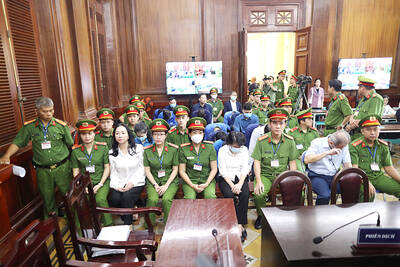
A top Vietnamese property tycoon was on Thursday sentenced to death in one of the biggest corruption cases in history, with an estimated US$27 billion in damages. A panel of three hand-picked jurors and two judges rejected all defense arguments by Truong My Lan, chair of major developer Van Thinh Phat, who was found guilty of swindling cash from Saigon Commercial Bank (SCB) over a decade. “The defendant’s actions ... eroded people’s trust in the leadership of the [Communist] Party and state,” read the verdict at the trial in Ho Chi Minh City. After the five-week trial, 85 others were also sentenced on

‘DELUSIONAL’: Targeting the families of Hamas’ leaders would not push the group to change its position or to give up its demands for Palestinians, Ismail Haniyeh said Israeli aircraft on Wednesday killed three sons of Hamas’ top political leader in the Gaza Strip, striking high-stakes targets at a time when Israel is holding delicate ceasefire negotiations with the militant group. Hamas said four of the leader’s grandchildren were also killed. Ismail Haniyeh’s sons are among the highest-profile figures to be killed in the war so far. Israel said they were Hamas operatives, and Haniyeh accused Israel of acting in “the spirit of revenge and murder.” The deaths threatened to strain the internationally mediated ceasefire talks, which appeared to gain steam in recent days even as the sides remain far

Conjoined twins Lori and George Schappell, who pursued separate careers, interests and relationships during lives that defied medical expectations, died this month in Pennsylvania, funeral home officials said. They were 62. The twins, listed by Guinness World Records as the oldest living conjoined twins, died on April 7 at the Hospital of the University of Pennsylvania, obituaries posted by Leibensperger Funeral Homes of Hamburg said. The cause of death was not detailed. “When we were born, the doctors didn’t think we’d make 30, but we proved them wrong,” Lori said in an interview when they turned 50, the Philadelphia Inquirer reported. The


 RSS
RSS