


When a prominent Jordanian academic heard on Sunday that former Iraqi president Saddam Hussein had been captured alive, he dialed a friend who had long been a booster of the Iraqi as the last significant Arab leader to defy the US.
He found his friend getting drunk, despairing that Saddam, after more than two decades of painting himself as the knight of the Arabs, had been captured without so much as firing a shot.
"It is a shock to many," said the academic, Mustapha Hamarneh, who is the director of the Center for Strategic Studies at the University of Jordan.
"They wanted him to at least die fighting, not be caught lying down in some hole like a rat. The image they built of him over the past 35 years was that he was a knight who would not die lying down. The real image or the real character turned out to be radically different," he said.
Across the Arab world, the ambiguity that has shadowed the entire American effort to replace Iraq's totalitarian government was reinforced by the indignity of Saddam's capture.
While Arabs harbor no particular love for the deposed dictator or similarly oppressive governments, they despair when they see that an outside power can humiliate the Arab world by capturing such a significant figure with relative impunity, underscoring their own impotence.
"On the one hand, we are very happy, relieved that this man is out of the picture," said Khaled Batarfi, managing editor of Al Madina, a newspaper in Jeddah, Saudi Arabia.
"On the other hand, to see him so humiliated -- he is an Arab president after all," he said. "Whether you love him or hate him, he is still a member of the family. He did not fight like his sons; he went like a dog or a cave man, so they feel sorry more for Arab pride than for the man himself."
The reactions were not monolithic, of course, ranging from giddy horn-honking in Kuwait, which Saddam invaded in 1990, to doubts that the capture had actually taken place. Official reaction was muted, too, with only a few senior government officials stepping forward, mostly to express hope for a better future for the Iraqi people and a fair trial for Saddam.
"We hope that what happened will be a step to accelerate the Iraqi people toward handling their own affairs," Ahmed Maher, the Egyptian foreign minister, said at a news conference.
"We hope that this step will make the Iraqi people more dedicated to building their country and developing greater independence," he said.
Egypt supports a fair trial, with Saddam given the right to defend himself like any other defendant, Maher said.
Some experts wondered if the ease of Saddam's capture might finally undermine his image as the last Arab action hero, but an attitude of denial seemed more prevalent. Many found it beyond belief that a man who had shot dead at least one Cabinet minister, not to mention starting wars against Iran and Kuwait, had not so much as wounded a single American soldier.
In Cairo and elsewhere, there was no shortage of those who found it easier to dismiss the capture as an American hoax.
"The whole scenario makes me doubt that this is Saddam Hussein," said Abdel Moneim Abdel Maq-sood, a lawyer for the Muslim Brotherhood in Egypt.
In Kuwait, the mood was more jubilant than anywhere else in the Arab world except perhaps Iraq, with Kuwaitis zapping instant messages on their mobile telephones saying, "Congratulations!"
Several jokes circulated by the same method, reputedly quoting Muhammad Said al-Sahhaf, Iraq's notorious information minister, as denying the capture, saying the man nabbed was actually a Taliban leader.
Elsewhere, though, many Arabs said that at a minimum, they would have preferred that Iraqis, not American soldiers, had captured Saddam.
"It is a shameful day in the history of the Arab nation when a prominent Arab president is caught by foreign occupiers and not the Iraqi people," said Abu Khaled, a Damascus taxi driver who gave only his nickname.
"In the absence of Saddam, the Americans will have no excuses; they will not be able to explain away the resistance as something related to him," said Abdel Bari Taha, a Yemeni political analyst.
"The Americans will come to realize that resistance is coming from the Iraqi people, not his followers or the Baath Party," he said.

Republican US lawmakers on Friday criticized US President Joe Biden’s administration after sanctioned Chinese telecoms equipment giant Huawei unveiled a laptop this week powered by an Intel artificial intelligence (AI) chip. The US placed Huawei on a trade restriction list in 2019 for contravening Iran sanctions, part of a broader effort to hobble Beijing’s technological advances. Placement on the list means the company’s suppliers have to seek a special, difficult-to-obtain license before shipping to it. One such license, issued by then-US president Donald Trump’s administration, has allowed Intel to ship central processors to Huawei for use in laptops since 2020. China hardliners
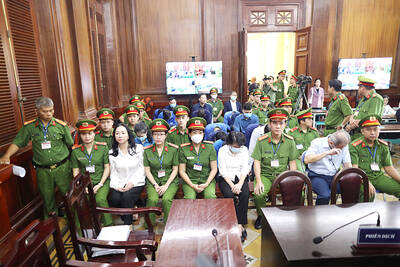
A top Vietnamese property tycoon was on Thursday sentenced to death in one of the biggest corruption cases in history, with an estimated US$27 billion in damages. A panel of three hand-picked jurors and two judges rejected all defense arguments by Truong My Lan, chair of major developer Van Thinh Phat, who was found guilty of swindling cash from Saigon Commercial Bank (SCB) over a decade. “The defendant’s actions ... eroded people’s trust in the leadership of the [Communist] Party and state,” read the verdict at the trial in Ho Chi Minh City. After the five-week trial, 85 others were also sentenced on

Conjoined twins Lori and George Schappell, who pursued separate careers, interests and relationships during lives that defied medical expectations, died this month in Pennsylvania, funeral home officials said. They were 62. The twins, listed by Guinness World Records as the oldest living conjoined twins, died on April 7 at the Hospital of the University of Pennsylvania, obituaries posted by Leibensperger Funeral Homes of Hamburg said. The cause of death was not detailed. “When we were born, the doctors didn’t think we’d make 30, but we proved them wrong,” Lori said in an interview when they turned 50, the Philadelphia Inquirer reported. The
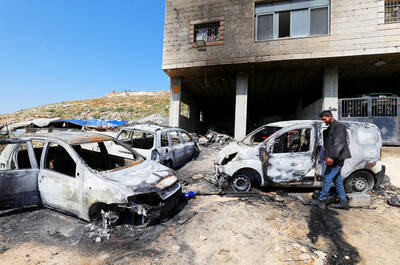
RAMPAGE: A Palestinian man was left dead after dozens of Israeli settlers searching for a missing 14-year-old boy stormed a village in the Israeli-occupied West Bank US President Joe Biden on Friday said he expected Iran to attack Israel “sooner, rather than later” and warned Tehran not to proceed. Asked by reporters about his message to Iran, Biden simply said: “Don’t,” underscoring Washington’s commitment to defend Israel. “We are devoted to the defense of Israel. We will support Israel. We will help defend Israel and Iran will not succeed,” he said. Biden said he would not divulge secure information, but said his expectation was that an attack could come “sooner, rather than later.” Israel braced on Friday for an attack by Iran or its proxies as warnings grew of


 RSS
RSS