


Japan and Southeast Asia agreed to tighten security and economic ties yesterday, a day after Tokyo, seeking to counter China's influence in the region, said it would start free-trade talks with Malaysia, Thailand and the Philippines.
Japan's concern about its role in fast-growing Southeast Asia has grown since last year, when Bei-jing signed a pact setting a framework for talks on free-trade agreements (FTAs) with the 10-member ASEAN.
On the final day of a two-day leaders' summit, Japanese Prime Minister Junichiro Koizumi and ASEAN leaders signed documents pledging increased cooperation across a wide range of areas.
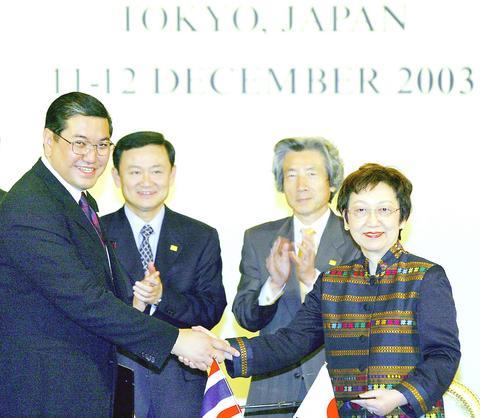
PHOTO: AFP
Japan's Foreign Minister Yoriko Kawaguchi also signed a document indicating Japan's intention to join the Treaty of Amity and Cooperation (TAC) in Southeast Asia, a 1976 non-aggression pact that China and India agreed to sign in October.
Despite the documents, analysts said the two-day summit was basically a chance to court Southeast Asia by emphasizing Japan's long history of friendship -- and generous financial aid -- in the face of China's advances in the region.
"I think all of it, including signing the TAC, is Koizumi's way of showing the ASEAN countries that Japan is treating them well, out of concern about China's influence," said Hisao Iwashima, a diplomatic commentator.
"In particular, China's efforts to help realize talks on North Korea's nuclear program have really raised its profile, and I believe the government is very aware of this."
Business groups applauded the decision to start FTA talks with Thailand, Malaysia and the Philippines, hailing it as a crucial step towards a trade pact with ASEAN as a whole. Talks are expected to start early next year, and Japanese officials said they hoped deals could be sealed by the start of 2005, when Tokyo wants to start talks on an ASEAN-wide pact.
Statements issued after the decisions were announced set no deadlines, saying only they hoped agreement could be reached "within a reasonable period of time."
China and ASEAN aim to finalize their free-trade zone by 2010.
Nearly half of China’s major cities are suffering “moderate to severe” levels of subsidence, putting millions of people at risk of flooding, especially as sea levels rise, according to a study of nationwide satellite data released yesterday. The authors of the paper, published by the journal Science, found that 45 percent of China’s urban land was sinking faster than 3mm per year, with 16 percent at more than 10mm per year, driven not only by declining water tables, but also the sheer weight of the built environment. With China’s urban population already in excess of 900 million people, “even a small portion

UNSETTLING IMAGES: The scene took place in front of TV crews covering the Trump trial, with a CNN anchor calling it an ‘emotional and unbelievably disturbing moment’ A man who doused himself in an accelerant and set himself on fire outside the courthouse where former US president Donald Trump is on trial has died, police said yesterday. The New York City Police Department (NYPD) said the man was declared dead by staff at an area hospital. The man was in Collect Pond Park at about 1:30pm on Friday when he took out pamphlets espousing conspiracy theories, tossed them around, then doused himself in an accelerant and set himself on fire, officials and witnesses said. A large number of police officers were nearby when it happened. Some officers and bystanders rushed

HYPOCRISY? The Chinese Ministry of Foreign Affairs yesterday asked whether Biden was talking about China or the US when he used the word ‘xenophobic’ US President Joe Biden on Wednesday called for a hike in steel tariffs on China, accusing Beijing of cheating as he spoke at a campaign event in Pennsylvania. Biden accused China of xenophobia, too, in a speech to union members in Pittsburgh. “They’re not competing, they’re cheating. They’re cheating and we’ve seen the damage here in America,” Biden said. Chinese steel companies “don’t need to worry about making a profit because the Chinese government is subsidizing them so heavily,” he said. Biden said he had called for the US Trade Representative to triple the tariff rates for Chinese steel and aluminum if Beijing was

Beijing is continuing to commit genocide and crimes against humanity against Uyghurs and other Muslim minorities in its western Xinjiang province, U.S. Secretary of State Antony Blinken said in a report published on Monday, ahead of his planned visit to China this week. The State Department’s annual human rights report, which documents abuses recorded all over the world during the previous calendar year, repeated language from previous years on the treatment of Muslims in Xinjiang, but the publication raises the issue ahead of delicate talks, including on the war in Ukraine and global trade, between the top U.S. diplomat and Chinese


 RSS
RSS