


An intensely private South African writer, scientists whose research has helped develop magnetic resonance imaging and researchers who uncovered secrets of human cells were being honored at the Nobel Prize awards ceremony.
Ten laureates were set to accept the prestigious awards in medicine, physics, chemistry, literature and economics yesterday from King Carl XVI Gustaf, the Swedish monarch.
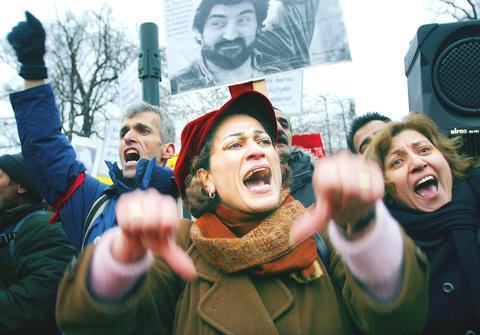
PHOTO: AP
The peace prize was being awarded in the Norwegian capital, Oslo, in line with the will of Alfred Nobel.
Each prize carries a cash award of 10 million kronor (nearly US$1.4 million).
According to tradition, the awards ceremony at Stockholm's concert hall was to be followed by a banquet a few blocks away at City Hall.
More than 1,300 guests, including the laureates' families, Sweden's royal family, government officials, ambassadors, scientists and business leaders, were invited to the exclusive dinner, which was to be broadcast live on Swedish television.
J.M. Coetzee, 63, was to receive the literature prize, the second South African to pick up the award after Nadine Gordimer, who won in 1991. Coetzee is a solitary figure, who rarely communicates with the media and prefers doing so by e-mail. He declined to show up to collect his two Booker prizes in Britain, but was in Stockholm to accept the Nobel, although he passed on the traditional news conference.
The Swedish Academy called Coetzee "a scrupulous doubter, ruthless in his criticism of the cruel rationalism and cosmetic morality of Western civilization." It also cited his "well-crafted composition, pregnant dialogue and analytical brilliance" in more than a dozen novels, including Disgrace, Life and Times of Michael K., Waiting for the Barbarians and Age of Iron.
American Paul Lauterbur and Briton Peter Mansfield were selected for the Nobel Prize in medicine or physiology for discoveries leading to magnetic resonance imaging, or MRI, the body-scanning technique that has revolutionized the detection of disease.
It was the most controversial among this year's science awards. An American researcher, Raymond Damadian, said he was unfairly left out and tried to sway the award committee with newspaper advertisements in both the US and Sweden explaining why he should have won.
However, the secretive Nobel committee did not budge and said its reasoning might become clearer when the selection proceedings are made public -- in 2053.
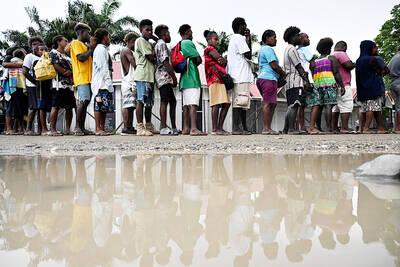
SEEKING CHANGE: A hospital worker said she did not vote in previous elections, but ‘now I can see that maybe my vote can change the system and the country’ Voting closed yesterday across the Solomon Islands in the south Pacific nation’s first general election since the government switched diplomatic allegiance from Taiwan to Beijing and struck a secret security pact that has raised fears of the Chinese navy gaining a foothold in the region. The Solomon Islands’ closer relationship with China and a troubled domestic economy weighed on voters’ minds as they cast their ballots. As many as 420,000 registered voters had their say across 50 national seats. For the first time, the national vote also coincided with elections for eight of the 10 local governments. Esther Maeluma cast her vote in the
Nearly half of China’s major cities are suffering “moderate to severe” levels of subsidence, putting millions of people at risk of flooding, especially as sea levels rise, according to a study of nationwide satellite data released yesterday. The authors of the paper, published by the journal Science, found that 45 percent of China’s urban land was sinking faster than 3mm per year, with 16 percent at more than 10mm per year, driven not only by declining water tables, but also the sheer weight of the built environment. With China’s urban population already in excess of 900 million people, “even a small portion

UNSETTLING IMAGES: The scene took place in front of TV crews covering the Trump trial, with a CNN anchor calling it an ‘emotional and unbelievably disturbing moment’ A man who doused himself in an accelerant and set himself on fire outside the courthouse where former US president Donald Trump is on trial has died, police said yesterday. The New York City Police Department (NYPD) said the man was declared dead by staff at an area hospital. The man was in Collect Pond Park at about 1:30pm on Friday when he took out pamphlets espousing conspiracy theories, tossed them around, then doused himself in an accelerant and set himself on fire, officials and witnesses said. A large number of police officers were nearby when it happened. Some officers and bystanders rushed

HYPOCRISY? The Chinese Ministry of Foreign Affairs yesterday asked whether Biden was talking about China or the US when he used the word ‘xenophobic’ US President Joe Biden on Wednesday called for a hike in steel tariffs on China, accusing Beijing of cheating as he spoke at a campaign event in Pennsylvania. Biden accused China of xenophobia, too, in a speech to union members in Pittsburgh. “They’re not competing, they’re cheating. They’re cheating and we’ve seen the damage here in America,” Biden said. Chinese steel companies “don’t need to worry about making a profit because the Chinese government is subsidizing them so heavily,” he said. Biden said he had called for the US Trade Representative to triple the tariff rates for Chinese steel and aluminum if Beijing was


 RSS
RSS