


An Israeli woman runs toward a soldier, admonishing him not to hit a Palestinian teen he had just slammed against a fence at a West Bank roadblock.
The soldier slowly relaxes his grip and eventually lets the teen go -- another small victory for Sara Alimi, 53, a volunteer in Checkpoint Watch, a group of about 300 Israeli women trying to stop abuses at dozens of checkpoints restricting Palestinian travel in the West Bank.
Every week, the women fan out, armed with menthol cream against the effects of tear gas and mobile phones to complain to senior commanders.
The women don't reflect Israeli consensus.
Many Israelis feel the barriers serve as a shield, albeit an imperfect one, against suicide bombers and gunmen who have killed hundreds of people since 2000, and that the Palestinians are largely to blame for the hardships caused by the travel bans since they are not reining in militants.
Critics consider the women a threat to security.
"In a directed and organized way, they disrupt the work of soldiers at checkpoints who are trying, not always successfully, to prevent the entry of terrorists," political commentator Yossi Olmert wrote in the Yediot Ahronot daily.
The army says troops are told to cooperate with the women, but some soldiers consider them a nuisance.
Founders of the organization, including Yehudit Elkana, 69, said they sought a practical way to express their opposition to Israel's 36-year occupation of the West Bank and Gaza Strip.
"I saw what my country was doing as an occupier," said Elkana, whose son is a lieutenant colonel in the army reserves.
"But then I realized I could prevent such things," she said.
All members are women. The group learned from experience that male activists tended to inflame situations, if only because soldiers considered them more of a threat.
Palestinians often seek out the volunteers. At one crossing, Palestinian mothers sending their children to school often ask the Israeli women to take them by the hand and walk them across.
Sometimes, the women feel powerless.
Aya Kanyuk, a 43-year-old bookstore clerk, said that in March she walked in front of a soldier's rifle to stop him from shooting at youths throwing stones at the Qalandiya checkpoint north of Jerusalem. Her intervention forced the soldier to halt, but by then, 14-year-old Omar Muater had already been shot in the neck. The Palestinian boy died three days later.
Qalandiya is one of the busiest checkpoints, controling traffic between the northern and southern West Bank. When Alimi and her friends arrived there for a vigil this week, they found that the checkpoint commander, who identified himself only as Amit, had stopped car traffic in retaliation for youths throwing stones. Amit demanded that the drivers get the boys to stop.
Alimi and fellow volunteer Tova Szeintuch called the regional commander, to no avail, and the roadblock remained closed for another two hours, with dozens of trucks and cars lining up on either side.
Palestinian truck driver Tariq Suraki watched the two women arguing with Amit.
"They help us, they are real human beings," he said.
Szeintuch, 60, later told a soldier who had shouted at a handicapped Palestinian that she was concerned about him becoming increasingly short-tempered during his two-week stint.
"I don't want to hear you," he said, kicking at a concrete block with his boot.
Nearly half of China’s major cities are suffering “moderate to severe” levels of subsidence, putting millions of people at risk of flooding, especially as sea levels rise, according to a study of nationwide satellite data released yesterday. The authors of the paper, published by the journal Science, found that 45 percent of China’s urban land was sinking faster than 3mm per year, with 16 percent at more than 10mm per year, driven not only by declining water tables, but also the sheer weight of the built environment. With China’s urban population already in excess of 900 million people, “even a small portion

‘IN A DIFFERENT PLACE’: The envoy first visited Shanghai, where he attended a Chinese basketball playoff match, and is to meet top officials in Beijing tomorrow US Secretary of State Antony Blinken yesterday arrived in China on his second visit in a year as the US ramps up pressure on its rival over its support for Russia while also seeking to manage tensions with Beijing. The US diplomat tomorrow is to meet China’s top brass in Beijing, where he is also expected to plead for restraint as Taiwan inaugurates president-elect William Lai (賴清德), and to raise US concerns on Chinese trade practices. However, Blinken is also seeking to stabilize ties, with tensions between the world’s two largest economies easing since his previous visit in June last year. At the

UNSETTLING IMAGES: The scene took place in front of TV crews covering the Trump trial, with a CNN anchor calling it an ‘emotional and unbelievably disturbing moment’ A man who doused himself in an accelerant and set himself on fire outside the courthouse where former US president Donald Trump is on trial has died, police said yesterday. The New York City Police Department (NYPD) said the man was declared dead by staff at an area hospital. The man was in Collect Pond Park at about 1:30pm on Friday when he took out pamphlets espousing conspiracy theories, tossed them around, then doused himself in an accelerant and set himself on fire, officials and witnesses said. A large number of police officers were nearby when it happened. Some officers and bystanders rushed
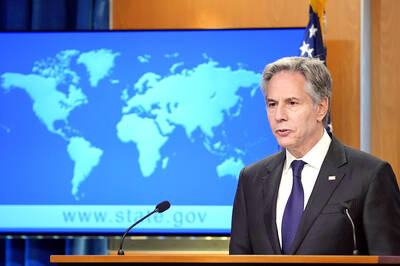
Beijing is continuing to commit genocide and crimes against humanity against Uyghurs and other Muslim minorities in its western Xinjiang province, U.S. Secretary of State Antony Blinken said in a report published on Monday, ahead of his planned visit to China this week. The State Department’s annual human rights report, which documents abuses recorded all over the world during the previous calendar year, repeated language from previous years on the treatment of Muslims in Xinjiang, but the publication raises the issue ahead of delicate talks, including on the war in Ukraine and global trade, between the top U.S. diplomat and Chinese


 RSS
RSS