


As the crowd swings kicks and punches at the young Tanzanian, he covers his head and tries to escape from the angry crowd screaming that he is a thief.
The throng swells, attracted by the shouts, but he somehow manages to slip away between the second-hand shoe stalls and disappears, fleeing for his life. He is one of the lucky ones.
Every day brings new tales of suspected robbers being lynched by crowds in Tanzania, one of the world's poorest countries, where more than half the population lives on less than US$1 a day. Suspects are often hacked with machetes before being "necklaced" with old tyres soaked in petrol and set alight to the cheers of bystanders.
"Everyone knows who the thieves are, so when we catch them they get exactly what they deserve," said Abdul, who sells clothes on a busy street corner in the centre of Dar es Salaam.
Sometimes the mobs claim innocent victims in their passion and haste to make an example of criminals.
"Dar es Salaam is getting more dangerous, and it is getting more dangerous very quickly," said one European professional who is moving back to France. "Just the other night a woman was carjacked outside her house near us. They fired through the side window, but luckily the bullet missed her."
Others stress that the city and the vast country as a whole have a long way to go before they experience the level of violent crime seen elsewhere in Africa.
"I still feel much safer walking around here at night than in Dublin," said Dennis, an Irish student at a university in Dar es Salaam.
But armed crime is on the increase in Tanzania, much of it blamed on illegal immigrants and refugees from the wars in neighboring Burundi, Rwanda and the Democratic Republic of Congo.
Vigilante groups have sprung up in response to what communities say is a lack of protection from under-funded, demoralized and corrupt police forces.
In Tanzania, they are popularly known as sungusungu, and in some areas they have been praised by the police and even given rewards for making the streets safer.
Sungusungu was born among the Sukuma tribe of the northwestern Mwanza and Shinyanga regions in the early 1980s as a grass-roots response to cattle rustlers armed with weapons left over from the war with Uganda.
Authorities in Dar es Salaam are now considering formalizing the groups in the city as crime fighters.
"They are doing a good job," said one senior detective. "There is no way the police have enough numbers to be everywhere at all times."
According to one report, city officials are considering giving the groups legal backing.
"We want to make sure each district, each ward and each locality has trained militia ... and these will be making patrols as scheduled," said Athuman Mdoe, a district commissioner of Ilala district.
Some residents say that will just give police the extra task of policing the militias. A night guard at a primary school in coastal Tanga was killed by vigilantes who believed robbers had taken refuge inside the building and attacked the man and his teenage son in just one recent case of apparent mistaken identity.
But some senior police officers are convinced sungusungu can make a vital contribution.
Maganzo village people's militia in Shinyanga was recently given a cow, 10 torches, 48 batteries and 50,000 Tanzanian shillings (about US$50) for helping catch robbers.
"We value their efforts in a bid to curb crime in the region," Regional Police Commander Abdalla Msika told the Daily News.
He said police officers would soon start running short courses for sungusungu groups on how to arrest suspects, keep records of exhibits and crime scenes, and to respect human rights.
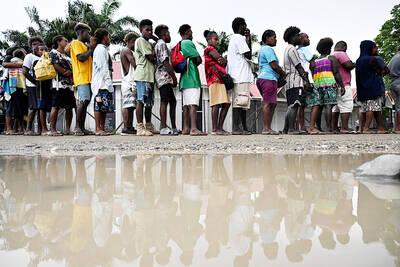
SEEKING CHANGE: A hospital worker said she did not vote in previous elections, but ‘now I can see that maybe my vote can change the system and the country’ Voting closed yesterday across the Solomon Islands in the south Pacific nation’s first general election since the government switched diplomatic allegiance from Taiwan to Beijing and struck a secret security pact that has raised fears of the Chinese navy gaining a foothold in the region. The Solomon Islands’ closer relationship with China and a troubled domestic economy weighed on voters’ minds as they cast their ballots. As many as 420,000 registered voters had their say across 50 national seats. For the first time, the national vote also coincided with elections for eight of the 10 local governments. Esther Maeluma cast her vote in the
Nearly half of China’s major cities are suffering “moderate to severe” levels of subsidence, putting millions of people at risk of flooding, especially as sea levels rise, according to a study of nationwide satellite data released yesterday. The authors of the paper, published by the journal Science, found that 45 percent of China’s urban land was sinking faster than 3mm per year, with 16 percent at more than 10mm per year, driven not only by declining water tables, but also the sheer weight of the built environment. With China’s urban population already in excess of 900 million people, “even a small portion

UNSETTLING IMAGES: The scene took place in front of TV crews covering the Trump trial, with a CNN anchor calling it an ‘emotional and unbelievably disturbing moment’ A man who doused himself in an accelerant and set himself on fire outside the courthouse where former US president Donald Trump is on trial has died, police said yesterday. The New York City Police Department (NYPD) said the man was declared dead by staff at an area hospital. The man was in Collect Pond Park at about 1:30pm on Friday when he took out pamphlets espousing conspiracy theories, tossed them around, then doused himself in an accelerant and set himself on fire, officials and witnesses said. A large number of police officers were nearby when it happened. Some officers and bystanders rushed

HYPOCRISY? The Chinese Ministry of Foreign Affairs yesterday asked whether Biden was talking about China or the US when he used the word ‘xenophobic’ US President Joe Biden on Wednesday called for a hike in steel tariffs on China, accusing Beijing of cheating as he spoke at a campaign event in Pennsylvania. Biden accused China of xenophobia, too, in a speech to union members in Pittsburgh. “They’re not competing, they’re cheating. They’re cheating and we’ve seen the damage here in America,” Biden said. Chinese steel companies “don’t need to worry about making a profit because the Chinese government is subsidizing them so heavily,” he said. Biden said he had called for the US Trade Representative to triple the tariff rates for Chinese steel and aluminum if Beijing was


 RSS
RSS