


Just six months after Israel committed to a peace plan requiring it to dismantle scores of illegal Jewish settlement outposts, an inspection of 18 of the encampments found the settlers have expanded significantly.
New roads, additional trailer homes and construction on stone villas were among the striking signs of permanence.
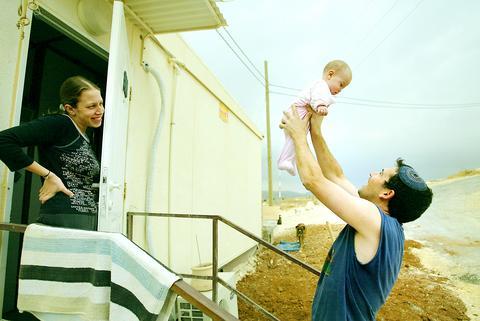
PHOTO: AP
The creation of the outposts -- many of which began with only an antenna, a water tower or a few trailers on a hill -- mirrors the birth of some older West Bank settlements, which began decades ago as unauthorized homesteads of a few trailers before the government legitimized them, gave them financial aid and installed public utilities.
The outposts -- none of which house more than a few dozen families -- are so far unauthorized, and are widely viewed as a separate issue from the 150 established West Bank and Gaza Strip settlements where some 220,000 Israelis live.
At Mitzpeh Danny, 10km from the Palestinian town of Ramallah, residents easily smuggled four large trailer homes into their burgeoning community over the last four months, well after the US-backed "road map" peace plan was accepted.
The trailers were brought into the outpost under the cover of darkness -- not out of fear the government would stop them, but as part of an effort to avoid protests and unwanted attention, resident Reuven Gafni said.
With the arrival of a new family last week, 20 families now call this hilltop community home, up from six a year ago.
With paved roads, running water and a hookup to the electric grid from a settlement across the road, the people of Mitzpeh Danny don't act like they're waiting to be evicted.
On a recent afternoon, Gafni stacked large stones to create a border for a garden. Elichai Dinner spread soil in front of his home in preparation for planting a lawn. Rami Dayan installed a canopy over a playground bench.
"We build. What they argue about, I have no idea," Dayan said.
Mitzpeh Danny and the other outposts run up and down the spine of the West Bank, separating the major population centers of Nablus, Ramallah and Jericho. Were they to become permanent settlements, the creation of a contiguous Palestinian state would be impossible.
Many Palestinians and peace activists who yearn for a two-state solution fear that is exactly what is happening.
Such outposts were supposed to end with the acceptance of the road map at a summit in June attended by Prime Minister Ariel Sharon, President Bush and then-Palestinian Prime Minister Mahmoud Abbas.
The plan required Israel to immediately remove the estimated 60 outposts established since March 2001, when Sharon took office, and freeze construction at the rest -- as well as at older settlements.
Soon after the summit, soldiers, under the glare of television cameras, defied protesting settlers to tear down a few outposts.
The government says it has taken down or prevented the establishment of 43 outposts since the summit. It has refused to release a list of these, despite repeated requests.
Peace Now, an Israeli group opposed to the settlements, says Israel has only taken down eight of the old outposts, but settlers have established five new ones that remain standing.
The group says over 100 outposts remain, some established before March 2001. The numbers can change daily with the comings and goings of trailer homes.
Sharon told reporters last week his government did not plan to tear down all the outposts, saying some had "supreme security value."
"Whatever is illegal will be removed ... What is necessary will remain," he said. Officials said some outposts would be legalized.

Republican US lawmakers on Friday criticized US President Joe Biden’s administration after sanctioned Chinese telecoms equipment giant Huawei unveiled a laptop this week powered by an Intel artificial intelligence (AI) chip. The US placed Huawei on a trade restriction list in 2019 for contravening Iran sanctions, part of a broader effort to hobble Beijing’s technological advances. Placement on the list means the company’s suppliers have to seek a special, difficult-to-obtain license before shipping to it. One such license, issued by then-US president Donald Trump’s administration, has allowed Intel to ship central processors to Huawei for use in laptops since 2020. China hardliners

A top Vietnamese property tycoon was on Thursday sentenced to death in one of the biggest corruption cases in history, with an estimated US$27 billion in damages. A panel of three hand-picked jurors and two judges rejected all defense arguments by Truong My Lan, chair of major developer Van Thinh Phat, who was found guilty of swindling cash from Saigon Commercial Bank (SCB) over a decade. “The defendant’s actions ... eroded people’s trust in the leadership of the [Communist] Party and state,” read the verdict at the trial in Ho Chi Minh City. After the five-week trial, 85 others were also sentenced on

Conjoined twins Lori and George Schappell, who pursued separate careers, interests and relationships during lives that defied medical expectations, died this month in Pennsylvania, funeral home officials said. They were 62. The twins, listed by Guinness World Records as the oldest living conjoined twins, died on April 7 at the Hospital of the University of Pennsylvania, obituaries posted by Leibensperger Funeral Homes of Hamburg said. The cause of death was not detailed. “When we were born, the doctors didn’t think we’d make 30, but we proved them wrong,” Lori said in an interview when they turned 50, the Philadelphia Inquirer reported. The
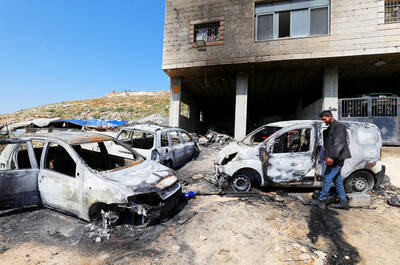
RAMPAGE: A Palestinian man was left dead after dozens of Israeli settlers searching for a missing 14-year-old boy stormed a village in the Israeli-occupied West Bank US President Joe Biden on Friday said he expected Iran to attack Israel “sooner, rather than later” and warned Tehran not to proceed. Asked by reporters about his message to Iran, Biden simply said: “Don’t,” underscoring Washington’s commitment to defend Israel. “We are devoted to the defense of Israel. We will support Israel. We will help defend Israel and Iran will not succeed,” he said. Biden said he would not divulge secure information, but said his expectation was that an attack could come “sooner, rather than later.” Israel braced on Friday for an attack by Iran or its proxies as warnings grew of


 RSS
RSS